Can FedEx Ship Luggage?
Quick Answer
Yes, FedEx ships luggage domestically and internationally. You'll need to box it up, and costs start around $50-60 for ground shipping depending on weight and distance. It's a solid option when you want to skip baggage claim or avoid airline baggage fees.
The Short Answer
Yes, FedEx can absolutely ship your luggage. You can send suitcases, duffel bags, golf clubs, ski equipment, and pretty much any travel gear through FedEx domestically or internationally. People do it all the time, whether they're relocating, sending bags ahead to a vacation rental, or just avoiding the hassle of checked bags at the airport.
There are some rules to follow, though. You can't just slap a label on your suitcase and drop it off. FedEx has specific packaging requirements, weight limits, and prohibited items you need to know about before shipping.
FedEx Packaging Requirements for Luggage
Here's the part most people miss: FedEx strongly recommends packing your suitcase inside a cardboard box. Why? Because luggage shipped without outer packaging isn't protected by FedEx's damage claims process. If your suitcase gets scuffed, dented, or a wheel breaks off during transit, FedEx won't cover it unless it was boxed.
If boxing your luggage isn't practical, you can still ship it as-is. You'll need to:
- Attach shipping labels with a tie-on tag rather than sticking them directly to the luggage fabric
- Remove or cover old airline tags and barcodes so they don't confuse FedEx's sorting system
- Secure all zippers and buckles with zip ties or tape so nothing pops open in transit
- Wrap the entire bag in stretch wrap for extra protection (FedEx locations can do this for you)
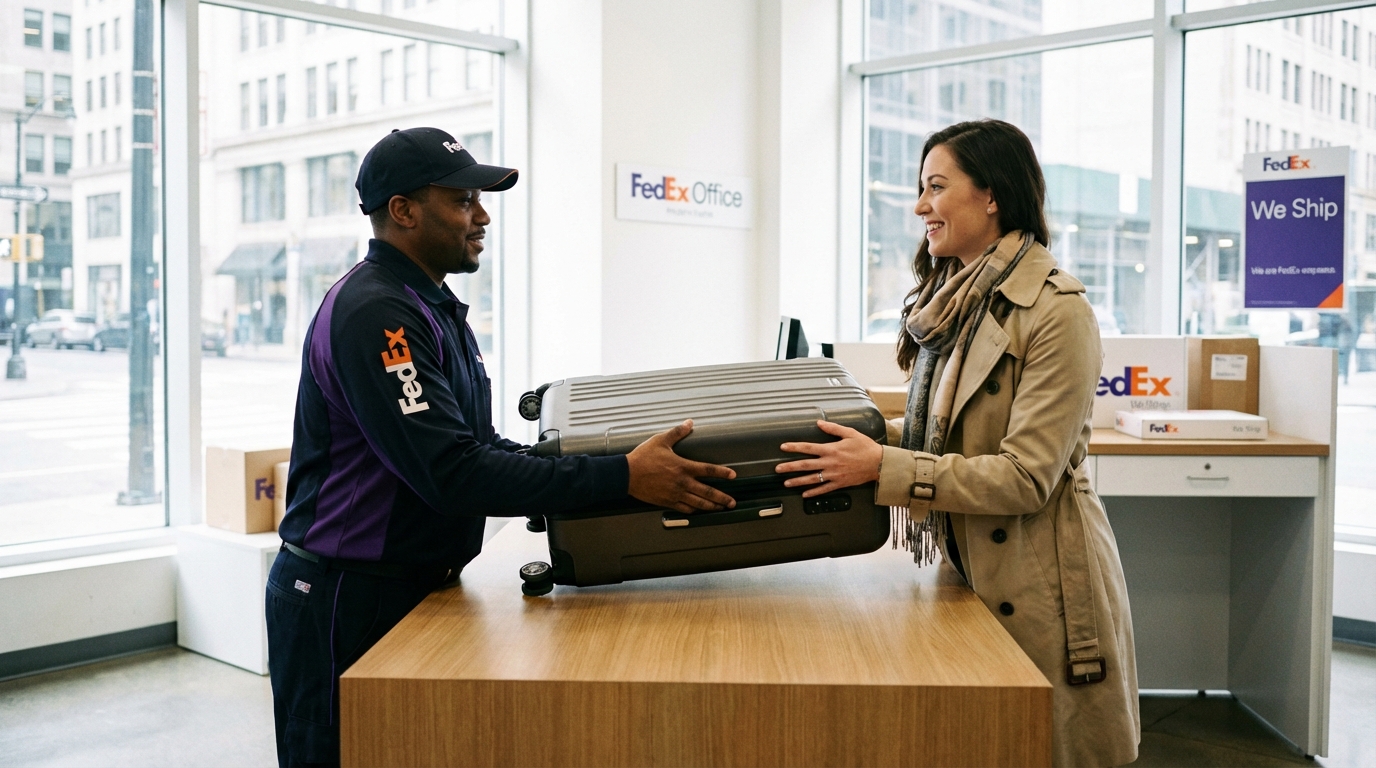
You can bring your luggage to any FedEx Office or FedEx Ship Center, and they'll help you package it. They sell boxes large enough for most suitcases, though expect to pay $10-25 for the box alone.
Weight and Size Limits
FedEx has clear limits on what they'll accept:
- Domestic shipments: Up to 150 lbs per package
- International shipments: Up to 150 lbs (68 kg), but packages over 75 lbs (34 kg) require a heavyweight label and may incur extra charges
- Maximum dimensions: 108 inches in length, or 165 inches in length plus girth combined
Most standard suitcases fall well within these limits. A typical checked bag weighs 30-50 lbs and measures around 62 linear inches, so you'll be fine.
How Much Does It Cost?
FedEx luggage shipping costs depend on three things: weight (or dimensional weight, whichever is greater), distance, and speed. Here's a rough breakdown for shipping a standard 50-lb suitcase domestically:
- FedEx Ground (3-7 business days): $55-120 depending on distance
- FedEx Express Saver (3 business days): $120-200
- FedEx 2Day: $150-250
- FedEx Priority Overnight: $230-400+
International rates are significantly higher. Shipping a suitcase from the U.S. to Europe via FedEx International Economy can run $200-500+.
One thing to watch out for: FedEx charges based on either actual weight or dimensional (DIM) weight, whichever is greater. Suitcases are bulky, so you'll often get hit with DIM weight pricing even if your bag isn't that heavy. DIM weight is calculated by multiplying length x width x height (in inches) and dividing by 139.
FedEx also applied a 5.9% general rate increase in January, so current prices are slightly higher than what you might find in older guides.
What You Can't Ship in Your Luggage
FedEx has a prohibited items list that overlaps a lot with airline restrictions, but there are some differences:
- No lithium batteries (laptops, power banks, tablets) via FedEx Ground. FedEx Express allows them with restrictions.
- No aerosols including hairspray, sunscreen spray, or deodorant spray
- No lighters or matches
- No nail polish or nail polish remover
- No perfume or cologne in large quantities
- No firearms or ammunition without special authorization
Basically, remove anything flammable, pressurized, or battery-powered before shipping your bag. These items will need to travel with you on the plane.
FedEx vs. UPS vs. USPS for Luggage
FedEx isn't your only option. Here's how the major carriers compare:
UPS
UPS is very similar to FedEx in terms of pricing and service. For a 50-lb suitcase, UPS Ground rates are typically within $5-10 of FedEx Ground. UPS also requires boxing for damage protection and has the same DIM weight pricing structure. Some travelers find UPS has more convenient drop-off locations thanks to The UPS Store network.
USPS
USPS can ship luggage via Retail Ground, Priority Mail, or Priority Mail Express. For a 50-lb package, USPS Retail Ground costs roughly $105-435 depending on distance and speed. USPS maxes out at 70 lbs per package, which is lower than FedEx's 150-lb limit. The upside? USPS doesn't charge DIM weight on most services, so bulky-but-light bags can be cheaper.
Specialty Luggage Shipping Services
Companies like LugLess, Luggage Free, Luggage Forward, and ShipSticks actually use FedEx and UPS behind the scenes but negotiate volume discounts. They often beat the price you'd get shipping directly, plus they handle the packaging logistics. LugLess sends a shipping label to your phone, and you just drop the bag at a FedEx or UPS location. Prices can be 20-40% lower than going direct.
When Shipping Luggage Makes Sense
Shipping your luggage through FedEx isn't always cheaper than checking a bag. Airlines charge $30-45 for a first checked bag on most domestic flights. FedEx Ground will cost more than that for anything beyond a short-distance shipment.
But shipping makes sense in certain situations:
- You're flying a budget airline that charges $45-65 per checked bag each way
- You have oversized or overweight bags that trigger $100-200 airline surcharges
- You're shipping ahead to a resort, cruise port, or Airbnb and want bags waiting when you arrive
- You're relocating or doing a one-way move and have more bags than you can check
- You want to travel light and skip baggage claim entirely
- You're shipping sports equipment like golf clubs, skis, or surfboards that airlines charge premium fees for
How to Ship Luggage Through FedEx: Step by Step
Here's the process:
- Pack your suitcase and remove any prohibited items. Take out electronics with lithium batteries.
- Box it up if you want damage protection. FedEx Office can help with this.
- Weigh and measure your package to get an accurate quote.
- Create a shipment on fedex.com or at a FedEx location. You'll need the destination address and your contact info.
- Choose your service level based on when you need it to arrive. Build in a buffer, as ground shipping times are estimates, not guarantees.
- Drop it off at a FedEx location, or schedule a pickup for an extra fee (usually $5-10).
- Track your shipment online. FedEx provides tracking updates throughout transit.
Tips for Shipping Luggage Successfully
- Ship 5-7 days before you travel if using FedEx Ground. This gives you a cushion in case of delays.
- Take photos of your packed bag before sealing the box, in case you need to file a damage claim.
- Insure valuable contents. FedEx includes $100 of declared value for free, but you can purchase additional coverage.
- Use a FedEx business account or third-party service for discounted rates. Retail counter prices are the highest.
- Ship to a staffed address when possible. FedEx will leave packages at residential doors, but a hotel front desk or office is safer for expensive luggage.
- Keep essentials in your carry-on. Medications, chargers, a change of clothes, and important documents should always fly with you.
Shipping Luggage Internationally Through FedEx
International luggage shipping adds a few wrinkles. Beyond the higher cost, you need to deal with customs declarations. FedEx will ask you to fill out a commercial invoice listing what's inside, even for personal belongings. Describe items generically ("clothing," "shoes," "toiletries") and mark the shipment as "personal effects" with a low declared value.
Some countries charge import duties on shipped goods, even personal luggage. The U.S., Canada, and most EU countries have exemptions for personal effects being temporarily imported, but the rules vary. If you're shipping to a destination where customs is strict, research duty-free thresholds before you ship.
Delivery times are also less predictable internationally. FedEx International Economy quotes 5-7 business days, but customs clearance can add 1-3 days. FedEx International Priority is faster at 1-3 business days but costs significantly more. Always build extra time into your international shipment schedule.
Frequently Asked Questions
How much does it cost to ship luggage through FedEx?
Shipping a standard 50-lb suitcase domestically via FedEx Ground costs roughly $55-120 depending on distance. Faster options like FedEx 2Day run $150-250, and Priority Overnight can exceed $230. International shipments start around $200 and go up from there. FedEx charges based on actual weight or dimensional weight, whichever is greater.
Do I have to put my suitcase in a box to ship it through FedEx?
FedEx strongly recommends boxing your luggage because unboxed suitcases aren't covered by damage claims. You can ship a suitcase without a box, but you'll need to attach labels with a tie-on tag and secure all zippers and buckles. FedEx Office locations sell boxes large enough for most suitcases.
Is it cheaper to ship luggage or check it with the airline?
For most domestic flights, checking a bag is cheaper. Airlines charge $30-45 for a first checked bag, while FedEx Ground starts around $55. However, shipping can save money if you have oversized or overweight bags that trigger airline surcharges, or if you're flying a budget carrier with high baggage fees.
How far in advance should I ship my luggage before a trip?
Ship at least 5-7 days before you travel if using FedEx Ground. Ground delivery times are estimates, not guarantees, and delays happen. If you need it faster, FedEx Express options deliver in 1-3 business days but cost significantly more.
Can I ship electronics in my luggage through FedEx?
Laptops, tablets, and devices with lithium batteries can't be shipped via FedEx Ground. FedEx Express allows them with restrictions. It's safest to remove all lithium battery devices from your luggage and carry them with you on the plane.
Written by Aviation Experts
Aviation Professionals
With decades of combined experience in the aviation industry, our team shares insider knowledge to make your travel experience smoother and less stressful.
Was this article helpful?