Morning Flights vs Afternoon Flights: Which Gets Delayed Less?
Quick Answer
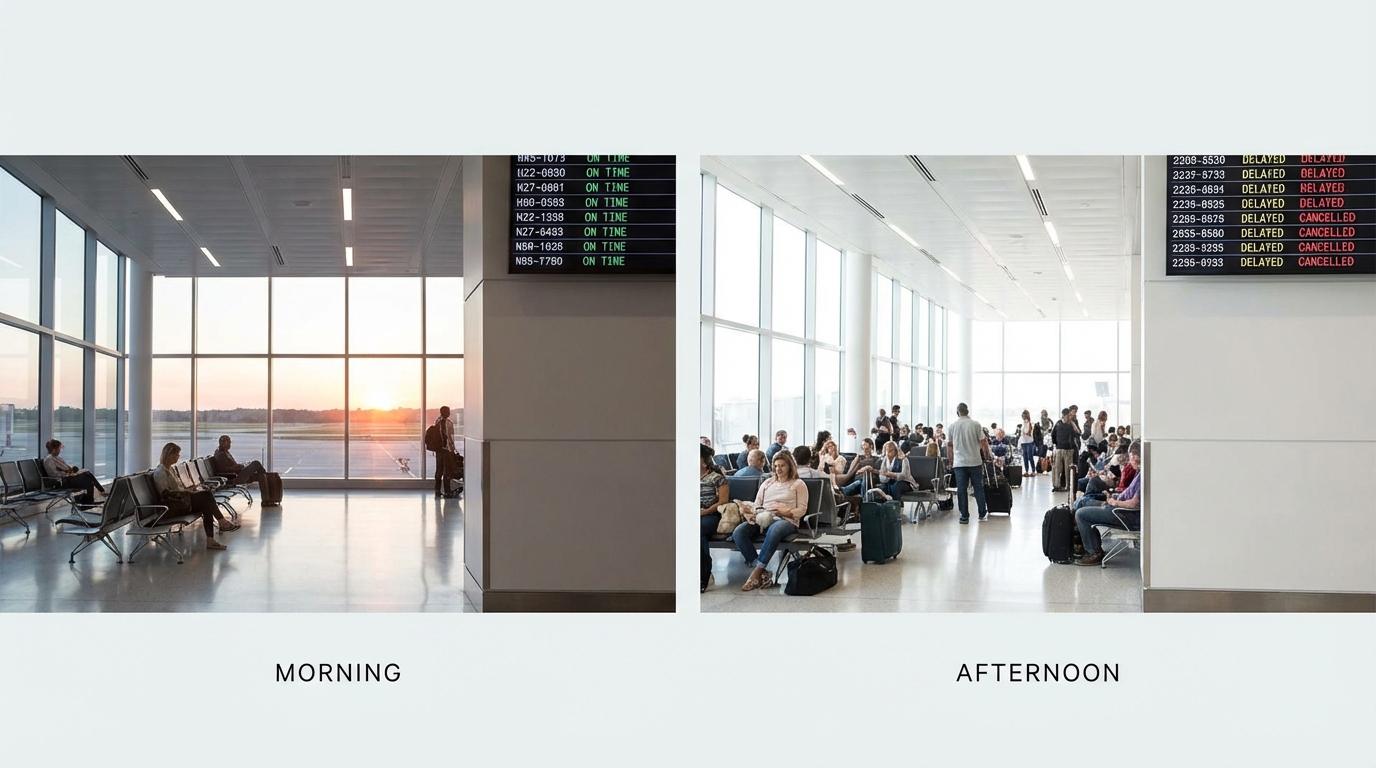
Morning flights win, and it's not even close. Flights before 8 AM have an 85% on-time rate. By 3 PM, your odds of a delay jump to 1 in 3.
The Data Is Clear
Book a morning flight. Flights departing between 6 AM and 9 AM are roughly 30% more likely to leave on time compared to afternoon and evening flights. This isn't a travel myth — it's backed by U.S. Department of Transportation data year after year.
Here's how the numbers break down during peak travel season:
- 6-9 AM: About 83% of flights depart on time
- 10 AM-12 PM: On-time rate drops to around 80%
- 12-3 PM: Falls to roughly 72%
- 3-6 PM: Drops further to about 67%
- 6-9 PM: Under 50% on-time departure rate
Put differently: an early morning flight has about a 1-in-9 chance of being delayed or canceled. By midafternoon, those odds worsen to 1-in-3. By evening, you're essentially flipping a coin.
Why Morning Flights Are More Reliable
It's not that airlines schedule morning flights better. Several factors compound throughout the day to make afternoon flights progressively less reliable.
The Domino Effect
This is the biggest reason. Airlines don't park planes overnight at every airport — they circulate aircraft across multiple routes throughout the day. Your 3 PM flight from Dallas uses the same plane that flew from New York at 11 AM, which flew from Boston at 8 AM. If any earlier flight runs late, that delay cascades forward to every subsequent flight on that aircraft.
Morning flights don't have this problem. The plane sat at the gate overnight, the crew is fresh, and there's no upstream delay to inherit. Your 6 AM flight is essentially starting from a clean slate.
Weather Builds During the Day
Thunderstorms are far more common in the afternoon and evening, especially during spring and summer. Convective weather (the kind that causes ground stops and major delays) typically develops between 2 PM and 8 PM. Morning flights usually depart before the weather gets bad.
This is particularly true in thunderstorm-prone areas like Atlanta, Dallas, Denver, and Chicago during summer months. A morning departure from these airports significantly reduces your weather-delay risk.
Air Traffic Congestion
Airports and airspace get progressively more crowded as the day goes on. By mid-afternoon, the system is operating at or near capacity. Ground delays, holding patterns, and departure sequencing all add minutes (or hours) to afternoon flights. At 6 AM, there's simply less traffic competing for runway time.
Crew and Gate Availability
Crew duty-time limits can cause afternoon delays when morning disruptions eat into a crew's available hours. If a flight attendant crew started late in the morning, they might "time out" before their afternoon flight, requiring a replacement crew. Gates also fill up during peak afternoon hours, causing arriving aircraft to wait on the taxiway.
Maintenance Issues Accumulate
Aircraft that have been flying all day are more likely to develop minor mechanical issues that require inspection. An early morning plane just came out of overnight maintenance checks and is in its best condition of the day.
How Much Earlier Are We Talking?
Let's be specific about what "morning" means, because there's a big difference between 6 AM and 10 AM.
The sweet spot is the first departure of the day — typically between 6 and 7 AM. This is the flight least likely to be delayed on any given day, at any airport, on any airline. The data consistently shows the first wave of departures (6-8 AM) performing best.
By 9-10 AM, you're still in good shape but the advantage starts to shrink. By noon, you've lost most of the morning benefit. And anything after 2 PM carries meaningful delay risk, especially during summer or around holidays.
When the Time of Day Matters Most
The morning vs. afternoon gap isn't constant — it widens during certain conditions:
Summer Travel (June-August)
This is when the gap is widest. Afternoon thunderstorms are a daily occurrence across much of the U.S., and the cascading delays from weather events make evening flights particularly unreliable. Morning flights during summer are dramatically more likely to run on time.
Holiday Periods
Thanksgiving, Christmas, spring break — airports are packed, flights are full, and any disruption has a bigger ripple effect because there are fewer empty seats to rebook into. Morning flights still have the advantage, and it's amplified by the system-wide congestion.
Connecting Flights
If you have a connection, the morning advantage doubles. A delayed first leg means a missed connection, and afternoon connections carry more risk. Book a morning first leg with a generous layover and your odds of making it through smoothly go way up.
Busy Hub Airports
The difference is most pronounced at major hubs like Atlanta (ATL), Chicago O'Hare (ORD), Dallas (DFW), Denver (DEN), and New York area airports. These airports handle the most traffic and are the most vulnerable to cascading delays. At a small regional airport, the morning advantage exists but is less dramatic.
The Trade-Offs of Morning Flights
Morning flights aren't perfect. Here's what you're signing up for:
- Early wake-ups: A 6 AM departure means a 4 AM alarm if you're driving to the airport, or even earlier for international flights. That's rough.
- Airport parking: Some airport parking lots have limited overnight options, and ride-shares at 4 AM can be harder to get and more expensive.
- Less sleep: If you didn't sleep well, you're starting your trip exhausted. A slightly later morning flight (8-9 AM) might be the better trade-off for some travelers.
- TSA timing: Early morning security lines can actually be longer at some airports because everyone's trying to catch those 6-7 AM departures. Check your airport's historical TSA wait times.
Practical Tips for Avoiding Delays
Beyond booking morning flights, here's how to stack the odds in your favor:
- Book the first flight of the day. Not just "a morning flight" — the actual first departure. This has the highest on-time rate of any flight on the schedule.
- Choose nonstop when possible. Every connection is another chance for a delay. Nonstop flights have better on-time performance than connecting itineraries.
- Avoid the last flight of the day. If it gets cancelled, there's no later flight to rebook you on. You're stuck overnight.
- Check historical on-time data. Tools like FlightStats and the DOT's own database show on-time performance for specific flight numbers. If a route consistently runs late, pick a different one.
- Build in buffer time. If you have an important meeting or event, don't book the flight that arrives 2 hours before. Give yourself a full-day cushion for critical travel.
- Monitor your flight the day before. If the inbound aircraft is already running late the night before, your morning flight could start behind. Apps like FlightAware let you track the specific plane assigned to your flight.
The Verdict
Morning flights, especially before 8 AM, are measurably more reliable than afternoon or evening flights. The data is consistent across airlines, airports, and seasons. If being on time matters to you — and it probably does — book early. The lost sleep is worth the peace of mind.
Frequently Asked Questions
What time of day has the fewest flight delays?
Flights departing between 6 AM and 8 AM have the fewest delays, with roughly 83-85% departing on time. The very first flight of the day has the highest on-time rate because the aircraft sat overnight with no prior delays to inherit, the crew is fresh, and weather issues haven't developed yet.
How much more likely is an afternoon flight to be delayed?
Based on DOT data, afternoon flights (3-6 PM) have about a 1-in-3 chance of being delayed or cancelled, compared to roughly 1-in-9 for early morning flights (6-9 AM). Evening flights after 6 PM are even worse, with on-time rates dropping below 50% during peak travel season.
Why are evening flights delayed so often?
Evening delays are caused by a compounding domino effect. The same aircraft flies multiple routes during the day, so any delay in the morning cascades to every later flight. Add afternoon thunderstorms, peak air traffic congestion, and crew duty-time limits, and evening flights inherit all the problems that accumulated throughout the day.
Are morning flights less likely to be cancelled?
Yes. Cancellations follow a similar pattern to delays — they're less common in the morning and increase throughout the day. However, the last flight of the day carries extra risk because if it's cancelled, there's no later option to rebook you. You'll end up stuck overnight.
Does the morning flight advantage apply at all airports?
Yes, but the advantage is most pronounced at busy hub airports like Atlanta, Chicago O'Hare, Dallas, and Denver. These airports handle heavy traffic and are more susceptible to cascading delays. At smaller regional airports, morning flights still perform better, but the gap between morning and afternoon is narrower.
Written by Aviation Experts
Aviation Professionals
With decades of combined experience in the aviation industry, our team shares insider knowledge to make your travel experience smoother and less stressful.
Was this article helpful?