Do Backpacks Count As Personal Items?
Quick Answer
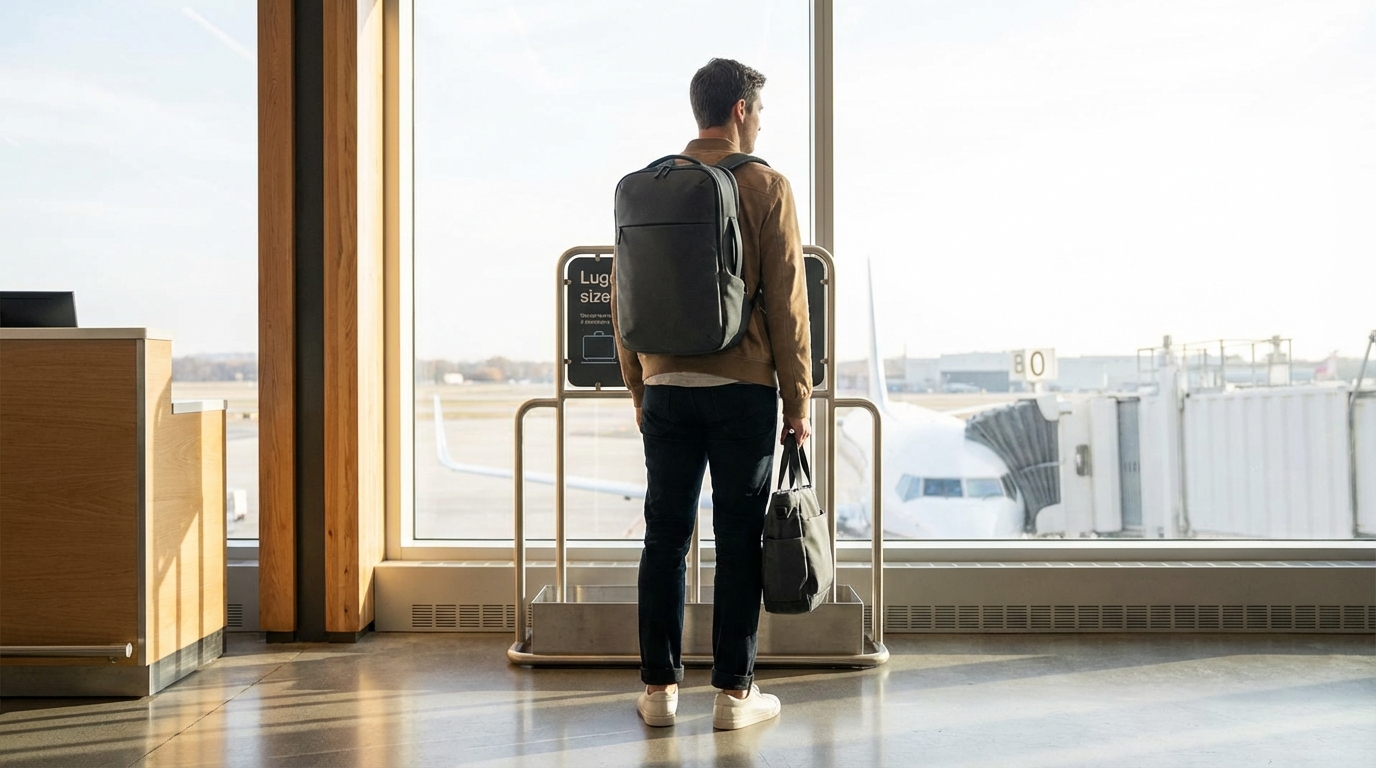
Yes, a backpack counts as your personal item as long as it fits under the seat in front of you. If it's too large, it becomes your carry-on. Here's what every airline actually allows.
The Short Answer
Yes, a backpack counts as a personal item on virtually every airline — as long as it fits under the seat in front of you. If your backpack is too big for that space, it becomes your carry-on bag instead. And if you're on a budget airline where carry-ons cost extra, that distinction could cost you $50 to $100 at the gate.
The key isn't whether it's a backpack. Airlines don't care about the type of bag. They care about the size. A small daypack that slides under the seat? Personal item. A stuffed-to-the-brim 50-liter hiking pack? That's a carry-on, and possibly a checked bag.
Personal Item Size Limits By Airline
Every airline has its own size limits for personal items, and they're not all the same. Here's what the major U.S. carriers allow:
- American Airlines: 18 x 14 x 8 inches
- Delta: No official published dimensions, but roughly 17 x 13 x 9 inches. Must fit under the seat
- United: 17 x 10 x 9 inches
- Southwest: 18.5 x 13.5 x 8.5 inches
- JetBlue: 17 x 13 x 8 inches
- Spirit: 18 x 14 x 8 inches (strictly enforced)
- Frontier: 18 x 14 x 8 inches (strictly enforced)
- Alaska: 17 x 13 x 8 inches
Notice a pattern? Most airlines cap personal items somewhere around 18 x 14 x 8 inches. If your backpack fits within those dimensions, you're good on almost any flight.
Why This Matters More On Budget Airlines
On the big three — American, Delta, and United — most tickets include both a personal item and a carry-on. So even if your backpack is a bit big, it just becomes your carry-on and you move on with your life.
Budget carriers are a different story. Spirit and Frontier include only a personal item with their cheapest fares. A carry-on costs extra — often $40 to $60 if you buy it online, and $99 or more if they catch you at the gate. They have sizer bins near the boarding area, and gate agents will absolutely ask you to test your bag.
If your backpack doesn't fit in that sizer, you're paying up. No negotiation, no exceptions.
What Size Backpack Works As A Personal Item?
For a backpack that'll reliably pass as a personal item on any airline, look for something in the 15 to 25 liter range. That covers most standard daypacks, school backpacks, and compact travel backpacks.
Here's a rough guide:
- Under 20 liters: Will fit under most seats without issue. Think small daypacks and basic book bags
- 20 to 25 liters: Usually fine, but don't overstuff it. A packed-out 25L backpack might not squeeze under a narrow seat
- 25 to 35 liters: Risky territory. This is carry-on size on most airlines. It won't fit under the seat
- Over 35 liters: Carry-on or checked bag. Don't even try to call this a personal item
The under-seat space on most planes is roughly 18 inches wide, 14 inches deep, and 8 inches tall. Some planes are more generous, but bulkhead and exit row seats often have less space — or none at all.
Backpack vs. Other Personal Items
Airlines list several types of bags that count as personal items. A backpack is just one option. Here's the full list most airlines accept:
- Backpacks (within size limits)
- Purses and handbags
- Briefcases
- Laptop bags
- Diaper bags
- Small tote bags
- Camera bags
You only get one personal item per person. If you're carrying a backpack as your personal item, your purse or laptop bag needs to go inside it — not alongside it as a second bag.
Tips For Making Your Backpack Work
Choose a soft-sided backpack
Soft bags compress and conform to tight spaces. A rigid or structured backpack might measure within the limits when empty but refuse to squeeze under the seat when packed.
Don't overpack it
A backpack stuffed to capacity expands in every direction. If your bag is bulging at the seams, it's going to look oversized to gate agents — even if the dimensions technically comply.
Use compression straps
Most travel backpacks have compression straps on the sides. Cinch them down before boarding. This flattens the profile and makes the bag easier to slide under the seat.
Wear it to the gate, not on your back at boarding
Carry your backpack by the handle when you board. A backpack on your back looks bigger than it actually is and draws more scrutiny from gate agents. Carrying it by hand makes it look smaller and more compact.
Put heavy items on the bottom
When the backpack goes under the seat, the bottom faces forward and the top faces you. Heavy items on the bottom keep the bag stable and prevent it from tipping or bulging outward into your leg room.
What Happens If Your Backpack Is Too Big?
If a gate agent decides your backpack doesn't qualify as a personal item, here's what happens:
- On full-service airlines: It gets treated as your carry-on. If you already have a carry-on, you may need to gate-check one of your bags (usually free)
- On budget airlines: You'll be charged a carry-on fee at the gate rate, which is always the most expensive option. Spirit charges up to $99. Frontier is similar
- If overhead bins are full: Your backpack might get gate-checked to the cargo hold, usually for free but sometimes with a fee
The best strategy is to avoid the conversation entirely. If your bag fits under the seat, nobody's going to bother you about it.
Specific Backpacks That Work Well
If you're shopping for a backpack specifically to use as an airline personal item, look for bags marketed as "underseat" or "personal item" backpacks. Several popular options are designed to max out the 18 x 14 x 8 inch standard without going over.
Features to look for:
- Dimensions listed on the product page that match airline limits
- Laptop sleeve (if you need to carry a computer)
- Multiple compartments for organizing in-flight essentials
- Flat bottom so the bag sits upright under the seat
- Compressible design that can flatten when not fully packed
International Airlines: Different Rules
Flying internationally? Personal item rules vary more widely. Some airlines are generous, others are strict:
- Ryanair (Europe's biggest budget carrier) allows a 40 x 20 x 25 cm personal item — that's about 15.7 x 7.9 x 9.8 inches, smaller than most U.S. airlines allow
- EasyJet allows 45 x 36 x 20 cm under the seat
- Air Canada allows a personal item of 16 x 13 x 6 inches
- British Airways allows a handbag or laptop bag in addition to your carry-on
European budget carriers are notoriously strict. If you're flying Ryanair with a standard U.S.-sized backpack, expect to get flagged. Measure your bag before you fly.
The Bottom Line
Your backpack is a personal item if it fits under the seat. That's really the only rule that matters. Keep it under 18 x 14 x 8 inches, don't overstuff it, and you'll never have an issue. On budget airlines where this distinction means real money, measure your bag before you leave for the airport — not at the gate when it's too late.
Frequently Asked Questions
Does a backpack count as a personal item or a carry-on?
A backpack counts as a personal item if it fits under the seat in front of you, typically within 18 x 14 x 8 inches. If it's larger than that, it counts as a carry-on. The type of bag doesn't matter — only the size determines which category it falls into.
What size backpack fits under an airplane seat?
A backpack of 25 liters or less will generally fit under an airplane seat. The under-seat space on most planes is roughly 18 inches wide, 14 inches deep, and 8 inches tall. Stick to backpacks within those dimensions and avoid overpacking.
Can I bring a backpack and a carry-on on a plane?
On most full-service airlines like American, Delta, and United, yes. You get one carry-on for the overhead bin and one personal item (your backpack) for under the seat. Budget airlines like Spirit and Frontier only include a personal item with basic fares — a carry-on costs extra.
Will Spirit or Frontier charge me for a backpack?
Only if your backpack is too large to qualify as a personal item. Spirit and Frontier include one free personal item (max 18 x 14 x 8 inches). If your backpack exceeds that and gets flagged at the gate sizer, you'll pay a carry-on fee of up to $99.
Do airlines actually check personal item sizes?
Budget airlines like Spirit, Frontier, and Ryanair routinely enforce size limits using sizer bins at the gate. Full-service carriers are less strict but may check if your bag looks oversized. Gate agents are increasingly using automated scanners to flag bags that don't comply.
Written by Aviation Experts
Aviation Professionals
With decades of combined experience in the aviation industry, our team shares insider knowledge to make your travel experience smoother and less stressful.
Was this article helpful?