Flight Simulator For Pilots: How They Help
Quick Answer
Flight simulators are one of the most important tools in aviation. They let pilots practice emergencies, master new aircraft, and maintain currency — all without ever leaving the ground. Here's how they work and why every pilot uses them.
Why Simulators Matter
Flight simulators save lives. That's not marketing — it's a fact. Pilots can practice engine failures, severe weather, system malfunctions, and emergency landings in a simulator without any real-world risk. Try doing that in an actual airplane.
Every airline pilot in the world trains in simulators regularly. It's required by regulations. And it's not just the airlines — student pilots, private pilots, and military aviators all use simulators to sharpen their skills. The technology has gotten so good that pilots can earn entire type ratings — permission to fly a specific aircraft — without ever sitting in the real plane.
What Flight Simulators Actually Do
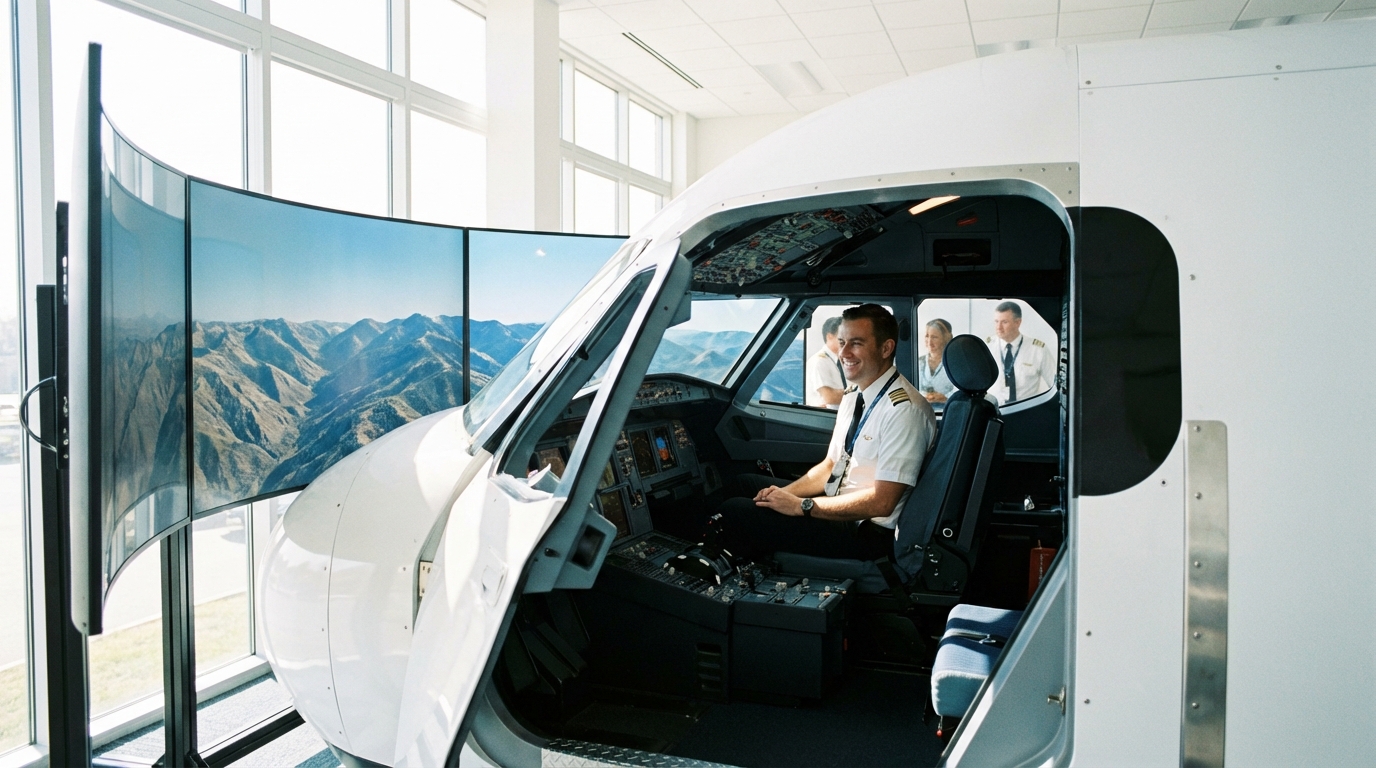
A good flight simulator replicates everything a pilot experiences in real flight:
- Realistic cockpit controls. The yoke or sidestick, throttles, rudder pedals, switches, and instruments all work exactly like the real aircraft.
- Visual systems. High-resolution screens or projectors display airports, terrain, weather, day and night conditions, and other traffic. Modern systems are sharp enough to read runway signs.
- Motion platforms. Full-flight simulators sit on hydraulic or electric platforms that tilt, pitch, roll, and vibrate to replicate the physical sensation of flying. You genuinely feel the takeoff roll, turbulence, and touchdown.
- Sound reproduction. Engine noise, wind, gear extension, and even the thump of a hard landing are all replicated.
- Environmental simulation. Rain on the windshield, ice accumulation, fog, crosswinds, wind shear — simulators recreate it all on demand.
The result is an experience so realistic that pilots often say they forget they're in a simulator during intense training scenarios.
FAA Simulator Categories
Not all simulators are created equal. The FAA classifies them into distinct categories, each with different capabilities and training credits:
Full Flight Simulator (FFS)
This is the top tier. Full flight simulators must have motion systems and visual displays that replicate a specific aircraft type. They're classified into four levels — A through D — with Level D being the most advanced.
A Level D FFS is so realistic that the FAA allows pilots to earn a type rating entirely in the simulator. An airline pilot can complete all their training for a new aircraft — say, transitioning from a 737 to a 787 — without ever flying the actual plane until their first revenue flight with passengers. That's how good these machines are.
Level D simulators cost $10-15 million each. Airlines and training centers operate them 24 hours a day to justify the investment.
Flight Training Device (FTD)
FTDs replicate a specific aircraft cockpit but may not have motion systems. They're classified into levels 4 through 7, with higher levels offering more fidelity. Level 5 and above include visual systems.
FTDs are commonly used for instrument training, procedural practice, and crew resource management. They're less expensive than full-flight simulators but still provide high-quality training. Airlines use them for supplemental training alongside FFS sessions.
Advanced Aviation Training Device (AATD)
AATDs are a step below FTDs in terms of fidelity but still offer significant training value. They must include GPS with a moving map, realistic flight deck ergonomics, a two-axis autopilot (if standard in the aircraft), and a visual system capable of rendering both VFR and IFR conditions.
For instrument rating training, the FAA allows up to 20 hours of credit in an AATD. That's 20 hours you don't need to fly in an actual airplane, saving thousands of dollars in rental and fuel costs.
Basic Aviation Training Device (BATD)
BATDs are the entry-level category. They cover core flight instruments and basic navigation but lack the advanced systems of an AATD. The FAA allows up to 10 hours of BATD time toward an instrument rating and 2.5 hours toward a private pilot certificate.
Many flight schools have BATDs available for students. They're affordable and effective for learning fundamentals like scanning instruments, tracking VOR radials, and flying basic approaches.
How Simulators Help at Every Level
Student Pilots
For someone learning to fly, simulators are a game-changer. They let you practice maneuvers repeatedly without the clock running on an expensive aircraft rental. Struggling with holding altitude during turns? Do it 20 times in the simulator until it clicks. That repetition builds muscle memory and confidence.
Student pilots can log up to 2.5 hours of simulator time toward their private pilot certificate and up to 20 hours toward an instrument rating in an AATD. At flight school rental rates of $150-250 per hour for an actual airplane, that's a significant savings.
Private and Instrument Pilots
Once you have your license, simulators keep you sharp. Instrument pilots can maintain their currency — the requirement to fly six approaches every six months — in an approved simulator instead of flying in actual instrument conditions. This is safer and more practical, especially for pilots who live in areas with consistently good weather.
Simulators also let private pilots practice emergencies they'd never want to experience for real: engine failures, electrical fires, vacuum system failures, and partial panel flying.
Commercial and Airline Pilots
This is where simulators really shine. Airline pilots undergo recurrent training every 6-12 months, and the vast majority happens in Level D full-flight simulators. A typical recurrent training session includes:
- Engine failures during takeoff — the most critical phase of flight
- Rejected takeoffs at high speed
- Wind shear encounters during approach
- System failures — hydraulics, electrical, pressurization
- Emergency descents and diversions
- Low-visibility approaches down to Category III minimums (near-zero visibility)
- Crew resource management scenarios testing communication and decision-making
None of these scenarios can be safely or practically trained in a real aircraft with passengers. Simulators make it possible to drill these procedures until they're automatic.
Military Pilots
Military aviation uses simulators extensively for tactical training, mission rehearsal, and combat scenarios. Fighter pilots practice dogfights, bombing runs, and carrier landings in simulators that replicate the cockpit of their specific aircraft. The cost savings are enormous — an F-35 costs roughly $36,000 per flight hour. A simulator session costs a fraction of that.
The Cost Savings Are Massive
Simulators aren't cheap, but they're dramatically less expensive than flying real aircraft:
- Small single-engine aircraft: $150-250/hour to rent vs. $25-75/hour for a simulator
- Multi-engine trainer: $300-500/hour vs. $50-150/hour for a simulator
- Boeing 737: Roughly $5,000-8,000/hour in direct operating costs vs. $300-500/hour for a Level D simulator session
- Wide-body jets: $10,000-15,000+/hour to operate vs. $400-700/hour for simulator time
Beyond hourly costs, simulators eliminate fuel burn, reduce aircraft wear, and don't require good weather. A simulator can run 24/7, rain or shine, day or night. Flight schools and airlines maximize their use by scheduling training around the clock.
Home Simulators vs. Professional Simulators
The rise of consumer flight simulation software like Microsoft Flight Simulator and X-Plane has made home sim setups popular among aviation enthusiasts and student pilots. But there's an important distinction.
Home simulators are great for learning procedures, practicing flows, and building general aviation knowledge. You can practice instrument approaches, navigation, and cockpit management. Some flight schools even encourage students to use home sims for chair flying — mentally rehearsing procedures.
Home simulators don't count toward FAA flight time requirements. Only FAA-approved devices — BATDs, AATDs, FTDs, and FFSs — can log training time that counts toward certificates and ratings. Your $2,000 home sim setup won't reduce the flight hours you need for your private pilot certificate.
That said, studies consistently show that students who practice at home in simulators progress faster during actual flight training. The procedures become familiar, so cockpit time is more productive.
The Future of Flight Simulation
Simulator technology keeps advancing rapidly. Recent developments include:
- Virtual reality integration. Some training programs are experimenting with VR headsets instead of traditional visual systems, dramatically reducing the cost of visual displays.
- AI-driven scenarios. Modern simulators can dynamically adjust training scenarios based on a pilot's performance, increasing difficulty where the pilot is strong and repeating areas where they need work.
- Cloud-based training records. Performance data from simulator sessions can be tracked across an airline's entire pilot workforce, identifying trends and targeting training where it's most needed.
- Electric motion systems. Newer simulators use electric actuators instead of hydraulics, reducing maintenance costs and improving responsiveness.
The FAA continues to expand the role of simulators in pilot training. As the technology improves, expect even more training hours to shift from real aircraft to simulation — saving money, reducing risk, and producing better-trained pilots.
Bottom Line
Flight simulators aren't a replacement for real flying — they're a complement that makes real flying safer. They let pilots practice the worst-case scenarios without any actual risk, build skills efficiently, and maintain proficiency year-round. Whether you're a student pilot using a BATD at your local flight school or an airline captain in a $15 million Level D simulator, the principle is the same: practice the hard stuff on the ground so you're ready for it in the air.
Frequently Asked Questions
Can you get a pilot's license using only a simulator?
No. The FAA requires actual flight time for all pilot certificates. However, simulators can replace some of those hours. For example, you can log up to 2.5 hours of simulator time toward a private pilot certificate and up to 20 hours toward an instrument rating in an approved AATD. Airline pilots can earn type ratings entirely in Level D full-flight simulators, but they already hold pilot certificates from previous real-world training.
How much does a flight simulator session cost?
It depends on the simulator type. A BATD or AATD session at a flight school typically runs $25-75 per hour. An FTD session might cost $50-150 per hour. Full-flight simulator sessions at airline training centers cost $300-700 per hour. These costs are still significantly less than flying the actual aircraft.
Does Microsoft Flight Simulator count toward pilot training hours?
No. Consumer flight simulation software like Microsoft Flight Simulator and X-Plane running on a home computer does not count toward any FAA flight time requirements. Only FAA-approved training devices (BATDs, AATDs, FTDs, and FFSs) can log time that counts toward certificates and ratings. However, home simulators are excellent for practicing procedures and building familiarity.
How realistic are modern flight simulators?
Level D full-flight simulators are so realistic that the FAA allows pilots to earn type ratings — authorization to fly a specific aircraft — without ever flying the actual plane. They replicate motion, visuals, sounds, and system behavior with extreme accuracy. Many pilots report forgetting they're in a simulator during intense training scenarios.
How often do airline pilots train in simulators?
Airline pilots undergo recurrent simulator training every 6-12 months, depending on the airline and regulatory requirements. These sessions typically last 4-8 hours and cover emergency procedures, system failures, and performance checks. It's a continuous cycle throughout a pilot's career.
Written by Aviation Experts
Aviation Professionals
With decades of combined experience in the aviation industry, our team shares insider knowledge to make your travel experience smoother and less stressful.
Was this article helpful?