Can You Fly Your Own Plane To Another Country?
Quick Answer
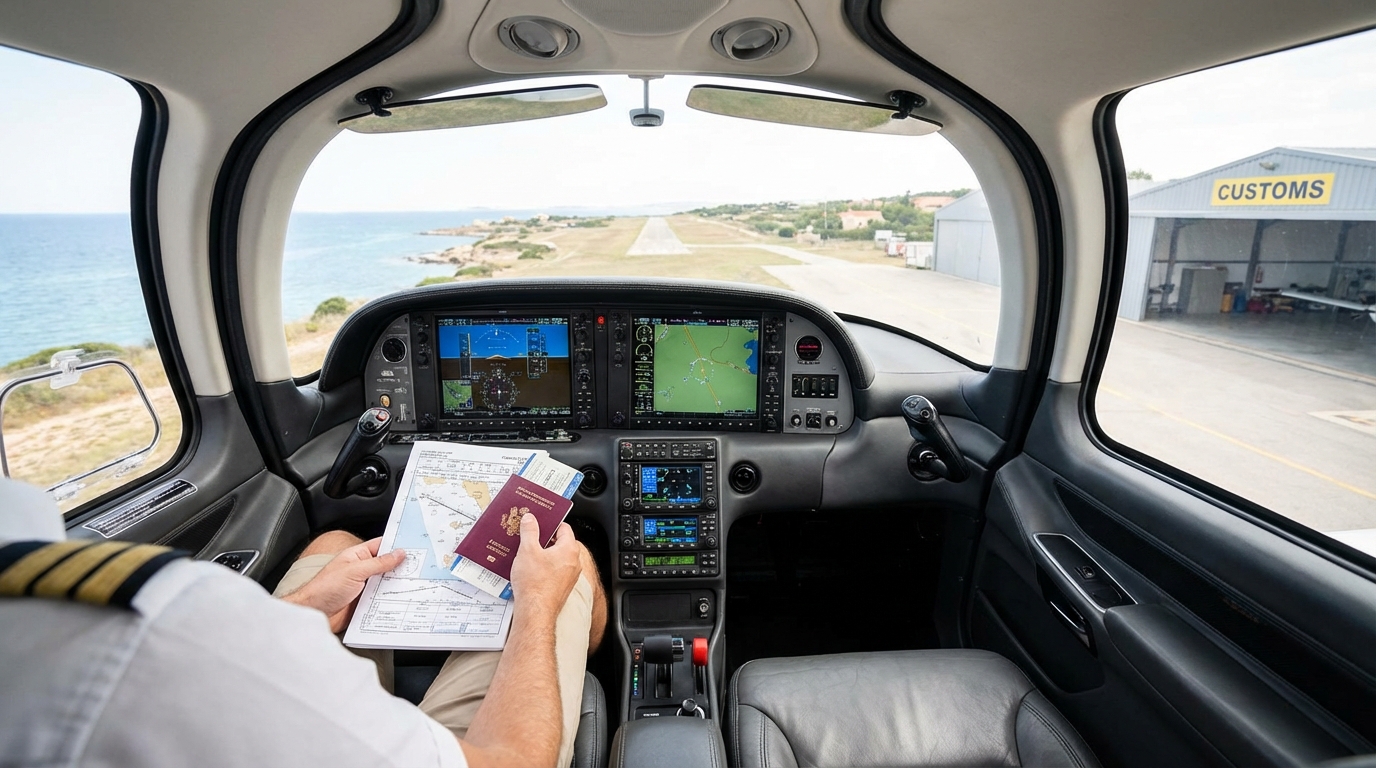
Yes, you can fly your own plane to another country — but it takes a lot more paperwork than a domestic flight. You'll need to file an international flight plan, submit customs manifests, carry proper documentation, and potentially get overflight permits for every country you cross.
The Short Answer
Yes, you can fly your own plane to another country. Private pilots do it all the time, especially between the U.S. and Canada, Mexico, the Caribbean, and the Bahamas. But unlike hopping between domestic airports, international flights in a private aircraft involve customs procedures, advance passenger manifests, flight plan requirements, and potentially permits from every country you'll fly over or into.
It's absolutely doable — but you need to plan well ahead. Here's everything you need to know.
What You Need Before You Go
Flying internationally in your own plane requires more preparation than a domestic cross-country. Here's your checklist:
Pilot Requirements
- Valid pilot certificate: Your FAA pilot certificate works in many countries, but some require validation or a local license
- Current medical certificate: Standard requirement, same as domestic
- Passport: You're leaving the country — you need a passport, just like everyone else
- Visa: Depending on your destination, you may need a visa. Check the State Department's website for your specific destination
- Radio operator's permit: For flights outside U.S. airspace, the FCC requires a Restricted Radiotelephone Operator Permit. It's free and valid for life, but you do need to apply
Aircraft Requirements
- Current airworthiness certificate and registration: Your plane needs to be properly registered and airworthy
- Insurance: Verify your aviation insurance covers international operations. Many policies don't cover flights outside the U.S. and Canada without an endorsement
- ELT (Emergency Locator Transmitter): Required and must be current
- Coded radar beacon transponder with altitude encoding: Required for ADIZ (Air Defense Identification Zone) crossings
- HF radio or satellite communication: Required for oceanic crossings (Caribbean, transatlantic, etc.)
eAPIS: The Customs Manifest You Can't Skip
This is the big one. Every private aircraft entering or leaving U.S. airspace must file an eAPIS manifest (Electronic Advance Passenger Information System) with U.S. Customs and Border Protection.
Here's how it works:
- When to file: At least 60 minutes before departure for flights leaving the U.S. and at least 60 minutes before arrival for inbound flights
- What to include: Full passenger and crew manifest with passport details, aircraft information, departure and arrival airports, and estimated times
- How to file: Through the CBP's eAPIS website. You'll need to create an account in advance — don't wait until the day of your flight
- Who files: The pilot in command or an authorized agent
Failing to file eAPIS is a federal violation. Fines can reach $5,000 per occurrence. Set up your account and familiarize yourself with the system well before your trip.
Customs and Border Protection Procedures
When you're flying your own plane internationally, you still go through customs — you just do it differently than commercial passengers.
Departing the U.S.
- File your eAPIS manifest at least 60 minutes before departure
- File an international flight plan with ATC
- Depart from any airport — you don't have to leave from a port of entry
- Follow your filed flight plan and communicate with ATC as you transition out of U.S. airspace
Returning to the U.S.
- File your eAPIS manifest at least 60 minutes before arriving in U.S. airspace
- You must land at a designated airport of entry (AOE) as your first stop in the U.S. — you can't just fly straight to your home airport
- Contact CBP at your arrival airport before departure from the foreign country to confirm your arrival time
- Stay with your aircraft after landing until a CBP officer clears you
- Complete a Customs Declaration Form (Form 6059B) for each person on board
- Present passports, aircraft documents, and your general declaration
Some airports have CBP facilities on-site. Others require you to call ahead for an officer to meet you. The CBP website lists all approved airports of entry.
Flight Planning for International Routes
International flight planning is more involved than filing a VFR flight plan to the next state over.
Flight Plans
You must file an IFR or DVFR (Defense VFR) flight plan when crossing an ADIZ, which surrounds all U.S. borders. Most international flights file IFR regardless — it's simpler and ATC expects it.
Overflight and Landing Permits
Many countries require permits before you can enter their airspace or land. Requirements vary widely:
- Canada: Relatively easy. No overflight permit needed for most GA aircraft. File a flight plan and clear customs at a designated port of entry
- Mexico: Requires advance permission. File online through Mexico's DGAC system. You'll also need a multivisit general declaration and Mexican liability insurance
- Caribbean nations: Most require overflight and landing permits. Some issue them quickly; others take days. Apply early
- European countries: Generally require prior permission for GA aircraft. Many use the EUROCONTROL system for flight planning
AOPA's international travel resources are invaluable for permit requirements by country. Don't assume your U.S. registration and pilot certificate give you automatic entry rights — they don't.
Popular Private Flying Destinations from the U.S.
Canada
The easiest international trip for U.S. private pilots. Canada and the U.S. have reciprocal agreements that make cross-border flying relatively straightforward. You'll still need eAPIS, a flight plan, and to clear customs — but the process is well-established. AOPA and COPA (Canadian Owners and Pilots Association) publish a joint cross-border guide that walks you through every step.
The Bahamas
A popular destination for GA pilots in the southeastern U.S. You'll need to file eAPIS, carry a passport, and clear Bahamian customs on arrival. The overwater leg requires careful planning — make sure you have life jackets, a life raft for longer crossings, and an ELT. Many pilots get a Bahamas cruising permit in advance to simplify the entry process.
Mexico
Doable but more paperwork. You'll need Mexican liability insurance (your U.S. policy won't cover you), a temporary aircraft import permit, and advance filing with Mexican aviation authorities. Fuel quality can vary — stick to well-known airports and FBOs.
Insurance Considerations
Don't overlook insurance. Your standard aircraft insurance policy may not cover international operations. Call your broker before the trip and ask specifically:
- Does my policy cover flights to [destination country]?
- Am I covered for overwater operations?
- Do I need additional liability coverage for the destination country?
- Is search and rescue coverage included?
Mexico specifically requires Mexican-issued liability insurance. Your U.S. policy won't satisfy their legal requirements, no matter how comprehensive it is. You can buy Mexican aviation insurance through brokers who specialize in cross-border flying.
Overwater Flying Considerations
If your route involves crossing open water — to the Bahamas, Caribbean, or beyond — there are extra safety considerations:
- Life jackets: Required for each person on board for overwater flights beyond gliding distance from shore
- Life raft: Required for extended overwater operations (more than 50 nautical miles from shore in single-engine aircraft)
- ELT: Must be current and operational
- Flight following: Stay in contact with ATC. Oceanic areas may require HF radio or satellite communication
- Fuel planning: No divert options over water. Plan conservatively with ample reserves
Common Mistakes to Avoid
Experienced international GA pilots will tell you to watch out for these:
- Forgetting eAPIS: This is the most common mistake. File it, confirm it went through, and print the confirmation
- Landing at a non-AOE airport: When returning to the U.S., you must clear customs at an airport of entry. Landing at your home airport first is a federal violation
- Inadequate fuel planning: International routes often have fewer divert options, especially over water or remote areas
- No foreign insurance: Getting caught without valid insurance in another country can mean your plane gets impounded
- Expired documents: Check passport expiration dates — many countries require six months of validity remaining
The Bottom Line
Flying your own plane to another country is one of the great privileges of being a private pilot. It takes more planning than a domestic flight — customs manifests, permits, insurance, and proper documentation all need attention. But the process is well-documented, thousands of GA pilots do it every year, and the freedom of flying yourself to a foreign destination is hard to beat. Start with an easy destination like Canada or the Bahamas, learn the procedures, and expand from there.
Frequently Asked Questions
Do I need a special pilot license to fly my own plane internationally?
Your FAA pilot certificate is valid in many countries, but some require validation or a local license. You will need a Restricted Radiotelephone Operator Permit from the FCC for flights outside U.S. airspace. Check the specific requirements for your destination country.
What is eAPIS and do I have to file it?
eAPIS (Electronic Advance Passenger Information System) is a mandatory customs manifest filed with U.S. Customs and Border Protection. Every private aircraft entering or leaving U.S. airspace must file it at least 60 minutes before departure or arrival. Failure to file can result in fines up to $5,000.
Can I land at any U.S. airport when returning from another country?
No. When returning to the U.S. in a private aircraft, your first landing must be at a designated airport of entry (AOE) where CBP can clear you. You cannot fly directly to your home airport unless it happens to be an AOE.
Does my U.S. aircraft insurance cover international flights?
Not necessarily. Many standard policies exclude international operations. Contact your insurance broker before the trip to confirm coverage. Mexico specifically requires Mexican-issued liability insurance — your U.S. policy won't satisfy their requirements.
What's the easiest country to fly to from the U.S. in a private plane?
Canada is generally considered the easiest international destination for U.S. private pilots. The two countries have reciprocal agreements, the procedures are well-documented, and you don't need special overflight permits. The Bahamas is another popular and relatively straightforward option.
Written by Aviation Experts
Aviation Professionals
With decades of combined experience in the aviation industry, our team shares insider knowledge to make your travel experience smoother and less stressful.
Was this article helpful?