Can You Bring a Bike on a Plane?
Quick Answer
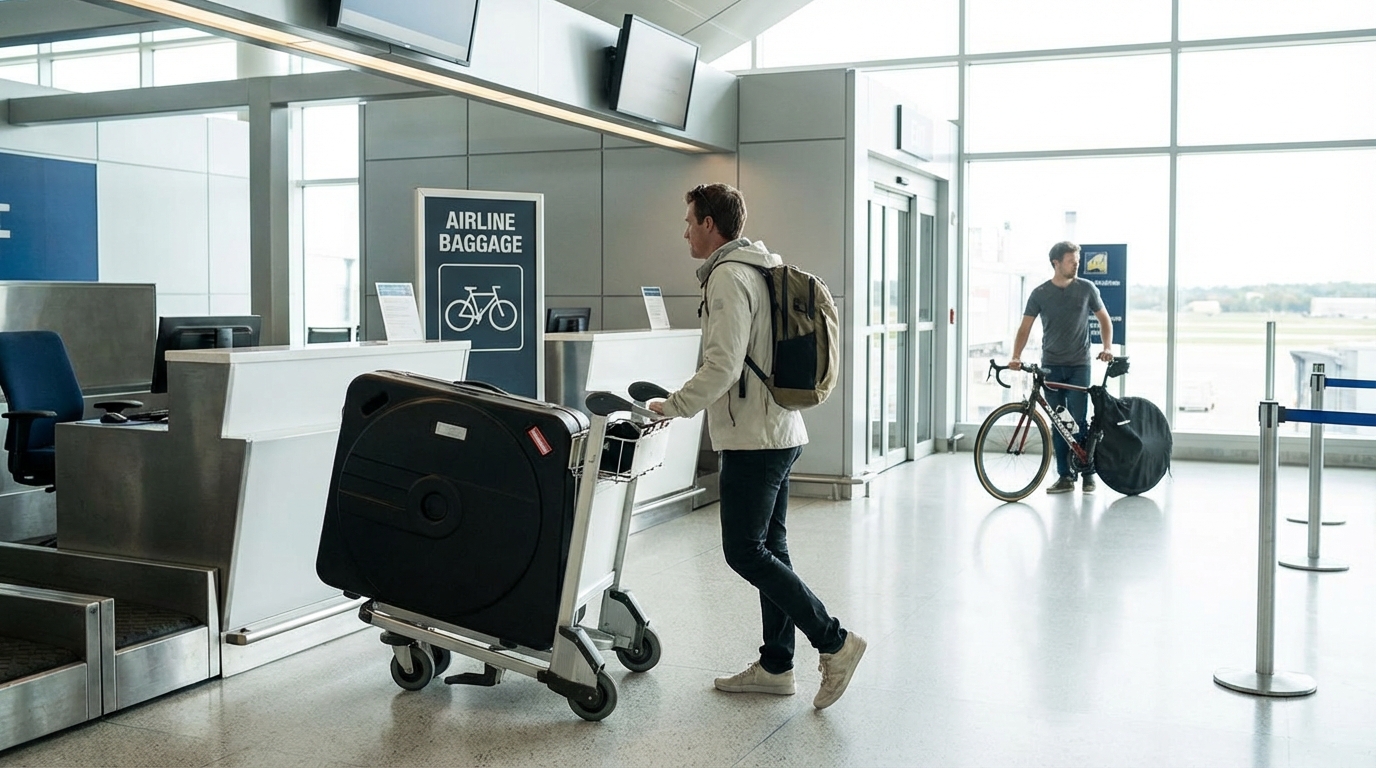
Yes, you can bring a bike on a plane as checked baggage. TSA has no restrictions on bicycles, and most major airlines now treat properly packed bikes as standard checked bags without oversize fees. You'll need a bike box or travel case, and e-bikes with batteries are not allowed.
The Quick Answer
TSA doesn't restrict bicycles at all. The agency has no rules about bikes — it's entirely up to the airlines. And the good news is that most major U.S. airlines have gotten much friendlier toward cyclists in recent years, dropping oversize surcharges and treating bike cases like standard checked bags.
You'll need to disassemble your bike, pack it in a box or travel case, and check it. Bikes don't go in the cabin. And one critical rule: e-bikes with lithium batteries are banned from all flights.
TSA Rules for Bicycles
This one's simple: TSA doesn't have any specific rules about bicycles. They're not on the prohibited items list, they don't require special screening, and there are no restrictions on bike components or accessories (other than the standard rules for tools, CO2 cartridges, etc.).
A few bike-related items to know about:
- CO2 cartridges: Allowed in checked bags only, up to 4 cartridges of 50ml or less. Not allowed in carry-on.
- Tire levers: Allowed in carry-on and checked bags
- Multi-tools: Tools with blades or sharp edges go in checked bags only
- Mini pumps: Allowed in carry-on and checked bags
- Hex wrenches: Allowed in both, but tools over 7 inches must be checked
Airline Bicycle Policies
This is where things really matter. Each airline has its own rules about bike fees, size limits, and weight restrictions. The landscape has improved dramatically — several airlines have recently eliminated oversize fees for bikes.
Delta Air Lines
- Bikes fly for standard checked bag fee ($35 first bag domestic)
- No oversize fee when packed under 115 linear inches
- 50 lb weight limit — overweight fees apply above that
- Delta recently eliminated its sports equipment surcharge entirely
- Must be in a hard case, bike bag, or sturdy box
American Airlines
- No oversize fees for bicycles regardless of dimensions
- Standard checked bag fee applies ($40 first bag domestic)
- 50 lb / 115 linear inch limits for standard rate
- Over 50 lbs incurs overweight fee (typically $100)
- Must remove pedals and turn handlebars sideways
United Airlines
- Oversize charges removed for bikes packed within limits
- Standard checked bag fee applies ($35 first bag domestic)
- Must be properly packed in a bike box or case
- 50 lb weight limit at standard rate
Southwest Airlines
- Bikes under 80 linear inches and 50 lbs: free (counts as one of two free checked bags)
- Bikes 81-100 linear inches: $75 each way
- Over 100 linear inches or over 50 lbs: not accepted
- Southwest is often the cheapest option thanks to free checked bags
JetBlue
- Bikes accepted as checked baggage
- Standard or oversize bag fees may apply depending on dimensions
- Must be properly boxed or cased
Alaska Airlines
- Bikes accepted at standard checked bag rate
- No oversize fee when properly packed
- Popular choice for Pacific Northwest and mountain biking destinations
E-Bikes: Not Allowed
This is a hard no. E-bikes with lithium-ion batteries are banned from all commercial flights — both carry-on and checked. The large battery packs in e-bikes exceed FAA lithium battery limits (100 watt-hours for carry-on, 160 watt-hours with airline approval). Most e-bike batteries are 400-700 watt-hours.
Even if you remove the battery, some airlines still won't accept the bike frame. And you can't bring the battery separately either — it's too large. If you need an e-bike at your destination, ship it ground freight or rent one there.
Bike Box vs. Travel Case
You've got three main options for getting your bike on a plane, and each has trade-offs.
Cardboard Bike Box
- Cost: Free to $20 (bike shops usually have them)
- Weight: 5-10 lbs
- Protection: Minimal — one trip use only
- Best for: Budget travelers, one-way trips, or races where you can get a new box at the destination
- Drawback: Offers the least protection and isn't reusable
Soft Bike Bag
- Cost: $100-$300
- Weight: 8-15 lbs
- Protection: Moderate — padding protects against scrapes and light impacts
- Best for: Frequent travelers who need something packable
- Popular brands: Evoc, Scicon, Dakine
Hard-Shell Bike Case
- Cost: $300-$800+
- Weight: 20-35 lbs (eats into your 50 lb limit)
- Protection: Excellent — designed for the abuse of air travel
- Best for: High-value bikes, frequent flyers, bikes with delicate components
- Popular brands: Biknd, B&W, Thule
If you're flying with a $5,000+ carbon bike, a hard case is insurance. If you've got an aluminum gravel bike worth $1,200, a cardboard box and some pipe insulation works fine.
How to Pack Your Bike for a Flight
Regardless of which container you use, the disassembly process is roughly the same:
- Remove the pedals. Left pedal is reverse threaded — turn clockwise to loosen.
- Remove the front wheel. Quick release or thru-axle, depending on your bike.
- Turn the handlebars. Loosen the stem and rotate bars parallel to the frame, or remove them entirely.
- Remove the rear derailleur. This is the most vulnerable component. Unbolt it and tape it to the inside of the chainstay.
- Lower or remove the seatpost. Mark the height with tape before removing so you can reset it at your destination.
- Protect the frame. Wrap the frame tubes with pipe insulation, bubble wrap, or towels. Pay extra attention to the head tube and dropouts.
- Secure the disc rotors. If you have disc brakes, insert rotor spacers between the pads so they don't squeeze shut during transit.
- Deflate the tires partially. Cargo holds are pressurized, but a slight deflation (to about 60-70% of normal pressure) is a good precaution.
- Fill empty space. Stuff your helmet, shoes, clothing, and soft items around the bike. This adds padding and saves luggage space.
Shipping Your Bike vs. Flying With It
Sometimes it makes more sense to ship your bike ahead of your trip.
Shipping services:
- BikeFlights: The most popular bike shipping service. Costs $60-$150+ depending on distance and speed. They'll ship your bike in a box to a bike shop or hotel.
- ShipBikes: Similar service with door-to-door options.
- FedEx/UPS: You can ship a bike box yourself. Typically $75-$200 depending on size and destination.
When to ship instead of fly with it:
- You're doing a one-way trip (ride one direction, fly home)
- The airline's baggage fees exceed shipping costs
- You don't want to deal with airport logistics
- You're flying a tight connection and can't risk the bike getting lost
What If Your Bike Gets Damaged?
- Inspect at baggage claim. Open the box or case before leaving the airport.
- Report immediately. File a damage claim at the airline's baggage service desk.
- Document everything. Photos of the damage, the packing, your claim ticket.
- Know the liability limit. Airlines are liable up to about $3,800 for domestic checked baggage damage.
- Consider bike-specific insurance. Homeowner's insurance sometimes covers bikes in transit. Dedicated cycling insurance (like Velosurance) is another option.
Tips for Flying With Your Bike
- Weigh your packed bike at home. A road bike with case is typically 30-45 lbs. Mountain bikes with hard cases can push close to 50 lbs.
- Arrive early. Checking a bike box takes longer than a standard bag. Budget an extra 15-20 minutes.
- Fly direct. Every connection is a chance for the bike to get lost or damaged.
- Bring essential tools in your carry-on. Hex wrenches, tire levers, and a mini pump let you reassemble at your destination. Just keep tools under 7 inches.
- Put an AirTag in the case. Track your bike throughout the journey.
- Take before photos. Document the bike's condition pre-packing. Helps with damage claims.
- Book with bike-friendly airlines. Southwest (free bags) and Delta (no oversize fees) are the current favorites among cyclists.
Common Mistakes to Avoid
Even experienced cycling travelers make these errors. Don't be one of them.
- Forgetting disc brake spacers. Without rotor spacers, your brake pads can squeeze shut during transit. Once that happens, you can't get the rotor back between the pads without bleeding the brakes. Carry spacers and install them every time.
- Not protecting the derailleur hanger. The rear derailleur hanger is the most fragile part of your frame. Either remove the derailleur entirely or add extra padding around it. A bent hanger means no shifting until you find a bike shop.
- Leaving the quick release skewer loose. Secure skewers to the frame with tape or rubber bands. Loose skewers bounce around inside the case and scratch paint.
- Ignoring the weight limit. A carbon road bike with a hard case is 35-40 lbs. Add shoes, a helmet, and pedals inside the case, and you're approaching 50. Weigh at home.
- Not checking the bike at the airport. Open the box at baggage claim. If there's damage, report it to the airline immediately — before you leave. Most airlines require damage claims within 24 hours.
Frequently Asked Questions
Can I bring an e-bike on a plane?
No. E-bikes with lithium-ion batteries are banned from all commercial flights. The battery packs (typically 400-700 watt-hours) exceed FAA limits for lithium batteries. You can't bring the battery separately either. Ship the e-bike via ground freight or rent one at your destination.
How much does it cost to fly with a bike?
Most airlines charge standard checked bag fees ($35-$45 for a first domestic bag). Southwest includes bikes as one of two free checked bags if packed under 80 linear inches and 50 lbs. Overweight fees ($100+) may apply if your bike and case exceed 50 lbs. Many airlines have eliminated oversize surcharges for bikes.
Do I need a special bike case for flying?
You need some form of container — airlines require bikes to be boxed or cased. Options range from a free cardboard bike box from your local bike shop, to soft bike bags ($100-$300), to hard-shell cases ($300-$800+). Match the protection level to your bike's value.
Do I need to deflate my bike tires before flying?
Cargo holds are pressurized, so full blowouts are unlikely, but partially deflating your tires to about 60-70% of normal pressure is a good precaution. This also helps reduce the overall volume of your packed bike inside the case.
Can I pack other items inside my bike box?
Yes, and you should. Pack your helmet, cycling shoes, clothing, and soft items around the bike frame. This adds padding, protects the bike, and saves space in your other luggage. Just make sure nothing can shift and scratch the frame during transit.
Written by Aviation Experts
Aviation Professionals
With decades of combined experience in the aviation industry, our team shares insider knowledge to make your travel experience smoother and less stressful.
Was this article helpful?