Can You Bring a Portable Fan on a Plane?
Quick Answer
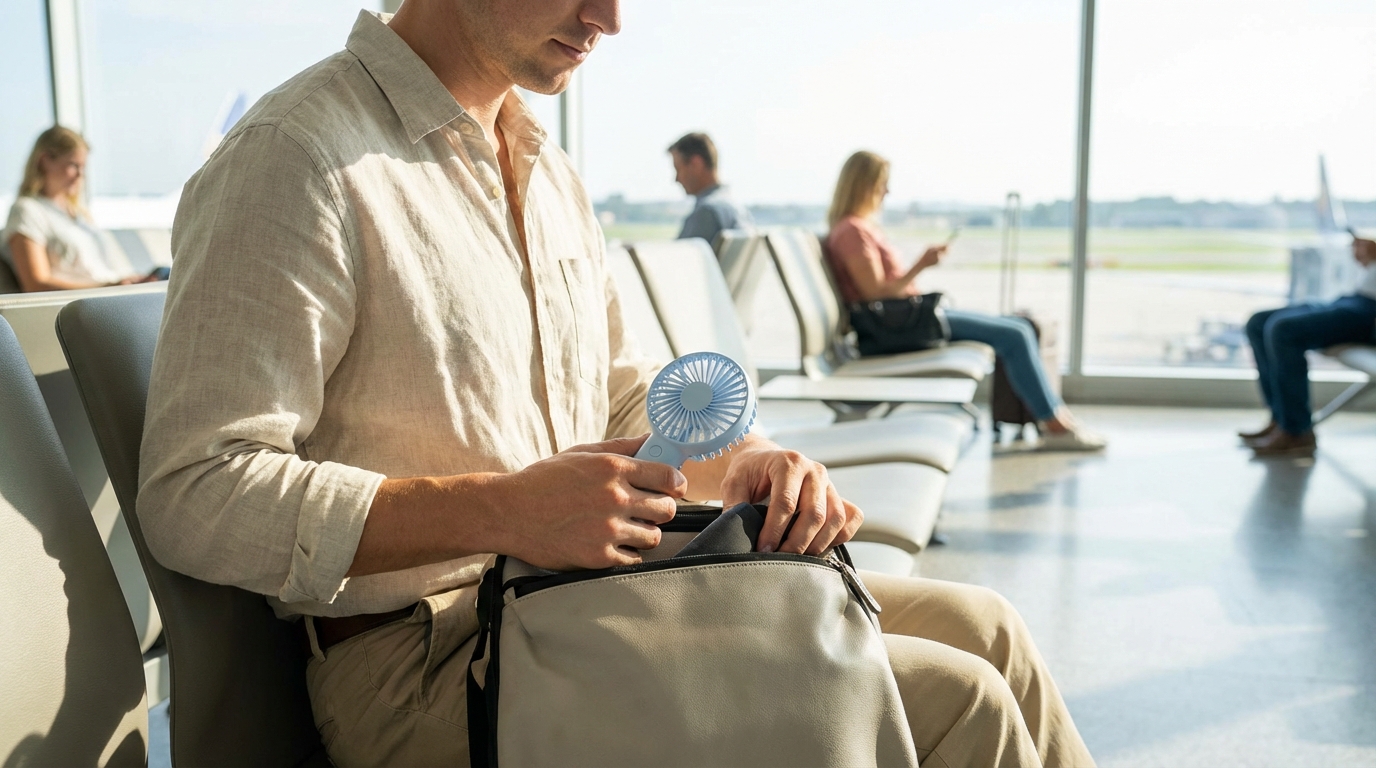
Yes, you can bring a portable fan on a plane. TSA allows electric fans in both carry-on and checked bags. Battery-powered fans should go in your carry-on due to lithium battery rules. Most small handheld and neck fans can be used during the flight.
The Short Answer
TSA allows portable fans on planes. You can pack them in carry-on or checked bags. If your fan runs on a rechargeable battery, carry-on is the way to go — lithium batteries are restricted from checked luggage. And yes, you can usually use a small portable fan during the flight.
Here's the full breakdown by fan type.
Handheld and Mini Fans: Carry-On Approved
Small battery-powered handheld fans are completely fine in your carry-on. TSA doesn't restrict them, and they sail through security without issues. These are probably the most common type travelers bring, and TSA agents see them constantly.
The key rules come down to the battery:
- Lithium-ion batteries under 100 watt-hours (Wh): Allowed in carry-on without restriction. Virtually every portable fan battery falls well under this limit — most are in the 5-20 Wh range.
- Carry-on is preferred for battery devices. The FAA recommends keeping lithium battery devices in the cabin where any battery issue can be spotted and handled immediately.
- If you check a battery-powered fan, you should remove the battery and carry it in your carry-on. This is an FAA guideline, not just a suggestion.
Neck Fans: Also Allowed
Bladeless neck fans have gotten wildly popular for travel, and for good reason. They're hands-free, quiet, and surprisingly effective. TSA treats them the same as any other small battery-powered electronic device.
You can wear a neck fan through the security checkpoint or pack it in your carry-on. Some travelers wear them right through TSA without anyone batting an eye. Just make sure it's off during the X-ray screening process.
Neck fans are probably the single best fan option for air travel because they work during every phase of your trip — the hot airport terminal, the stuffy boarding bridge, and the flight itself.
USB-Powered Clip Fans: Allowed With Caveats
Small USB clip fans — the kind you'd clip onto a desk or laptop — are allowed through TSA. But whether you can use one on the plane depends on the setup:
- Plugged into a portable battery pack: Usually fine. You're self-contained and not drawing plane power for a non-approved device.
- Plugged into the seat USB port: This should work on most airlines. USB ports on planes are designed for low-draw devices, and a small fan draws very little power.
- Clipping it to the seat or tray table: This is where you might get pushback from flight attendants. Some crews are fine with it; others might ask you to hold it or place it differently. Be flexible.
Full-Size Fans: Allowed But Impractical
Technically, TSA allows full-size electric fans in both carry-on and checked bags. The TSA website simply states: "You may transport this item in carry-on or checked bags." There's no size restriction from TSA's perspective.
But practically speaking, a full-size fan has to meet your airline's carry-on size and weight limits to go in the cabin. If it fits in the overhead bin or under the seat, you're fine. Most box fans or pedestal fans won't. Those would need to go in checked luggage, and you'll want to pack them carefully to avoid damage.
If you're bringing a fan to use at your destination — a vacation rental with no AC, a dorm room, a long-term stay — checked luggage is the practical choice for anything larger than a personal fan.
Can You Use a Portable Fan During the Flight?
Yes, in most cases. Small battery-powered fans — handheld, neck, and compact clip-on models — can generally be used during the flight. They're quiet, low-power, and don't interfere with aircraft systems.
A few common-sense guidelines:
- Keep the noise level reasonable. A quiet fan is fine. A fan that sounds like a drone might annoy your neighbors and draw a flight attendant's attention.
- Don't blow air toward other passengers. Point it at yourself. Nobody wants a stranger's fan blowing on them for four hours.
- Turn it off during safety announcements. Same as headphones — you need to be able to hear the crew.
- During takeoff and landing, stow loose items. A handheld fan should go in the seat pocket or your bag. A neck fan that's securely on your neck is generally fine.
Most airlines don't have explicit policies about personal fans because they're not considered problematic devices. But the flight crew has final say on everything in the cabin, so if an attendant asks you to turn it off, comply without argument.
Battery Rules for Portable Fans
Since most portable fans run on lithium-ion batteries, here's the full battery rundown:
- Under 100 Wh: Allowed in carry-on. No airline approval needed. This covers virtually all portable fans.
- 100-160 Wh: Allowed in carry-on with airline approval. You won't find a personal fan with a battery this large, but if yours is unusually big, check the specs.
- Over 160 Wh: Not allowed on passenger aircraft. Again, no personal fan will have a battery this large.
- Spare batteries: Must be in carry-on, never checked. Protect terminals from short-circuiting by keeping them in original packaging, a battery case, or with tape over the contacts.
To find your fan's battery capacity, check the product label, user manual, or the battery itself. If it's listed in milliamp-hours (mAh) and volts, multiply them and divide by 1,000 to get watt-hours. For example: 5,000 mAh x 3.7V = 18.5 Wh — well under the 100 Wh limit.
Packing Tips for Traveling With a Fan
- Keep your fan in your personal item. Backpack, purse, or small bag — somewhere you can easily grab it during boarding and in-flight. You don't want to dig through the overhead bin every time you need it.
- Charge it fully before your flight. You might not have access to power during long layovers, and airplane USB ports charge devices slowly.
- Bring a backup battery if it's a long trip. Portable fans drain batteries fast. A small power bank extends your runtime significantly. Just remember: power banks must also be in carry-on.
- Protect fan blades. If your fan has exposed blades, pack it where they won't get bent or broken. Some travel fans come with a protective case or cover — use it.
- Turn it off before going through security. Any fan that accidentally turns on during X-ray screening can cause a delay. Power it down completely.
Best Portable Fans for Air Travel
Based on what works well in the travel context:
- Bladeless neck fans are the top pick. Hands-free, quiet, and you can wear them through the entire airport experience.
- Folding handheld fans are a close second. They collapse for easy packing and unfold for instant cooling.
- USB clip fans work great if you have a power bank and want steady airflow at your seat.
- Traditional manual folding fans require zero battery, zero TSA concerns, and work anywhere. Old school but effective.
International Travel With Portable Fans
TSA rules cover US airport departures. For international travel:
- Most countries follow IATA guidelines for lithium batteries, which align with TSA/FAA rules. Your portable fan will be fine in most places.
- Some Asian airports are stricter about battery devices and may ask to see the watt-hour rating. Know your fan's battery specs.
- Charging abroad: If your fan charges via USB, you just need a plug adapter (not a voltage converter). USB charging is universal at 5V.
Frequently Asked Questions
Can I use a portable fan during a flight?
Yes. Small battery-powered fans — handheld, neck, and clip-on models — can generally be used during flights. Keep the noise reasonable, point it at yourself, and turn it off during safety announcements. The flight crew has final say.
Do I have to put my portable fan in carry-on or checked bags?
TSA allows fans in either bag. However, if your fan has a lithium battery (most do), it's best in your carry-on. The FAA restricts lithium batteries in checked luggage. If you do check it, remove the battery and carry it with you.
Can I bring a neck fan through airport security?
Yes. You can wear it through the security checkpoint or pack it in your carry-on. TSA treats neck fans the same as any small battery-powered electronic device. Just make sure it's turned off during X-ray screening.
Is there a battery size limit for portable fans on planes?
Lithium batteries must be under 100 watt-hours for unrestricted carry-on travel. Most portable fan batteries are 5-20 Wh, well under the limit. To calculate yours: multiply mAh by voltage, then divide by 1,000.
Can I bring a full-size fan on a plane?
TSA allows it, but it must meet your airline's carry-on size limits to go in the cabin. If it's too large, pack it in checked luggage. Wrap it well to protect the blades and motor during transit.
Written by Aviation Experts
Aviation Professionals
With decades of combined experience in the aviation industry, our team shares insider knowledge to make your travel experience smoother and less stressful.
Was this article helpful?