Can You Bring a Camera on a Plane?
Quick Answer
Yes, you can bring cameras on a plane in your carry-on or checked bag. TSA allows all types of cameras — DSLR, mirrorless, point-and-shoot, GoPro, and film cameras. Keep camera batteries in your carry-on, and always hand-carry expensive gear.
The Quick Answer
Cameras are allowed on planes. All types — DSLR, mirrorless, point-and-shoot, action cameras, film cameras, instant cameras, even large cinema rigs. TSA permits them in both carry-on and checked luggage, though carry-on is strongly recommended for anything you'd be upset about losing or breaking.
The nuances are in how batteries are handled, how to get through security smoothly, and whether your specific gear has any special considerations. Here's the full breakdown.
TSA Security Screening Rules
Cameras go through the same screening process as other electronics, but the specifics depend on the size of your camera and the type of screening lane.
Standard Screening Lanes
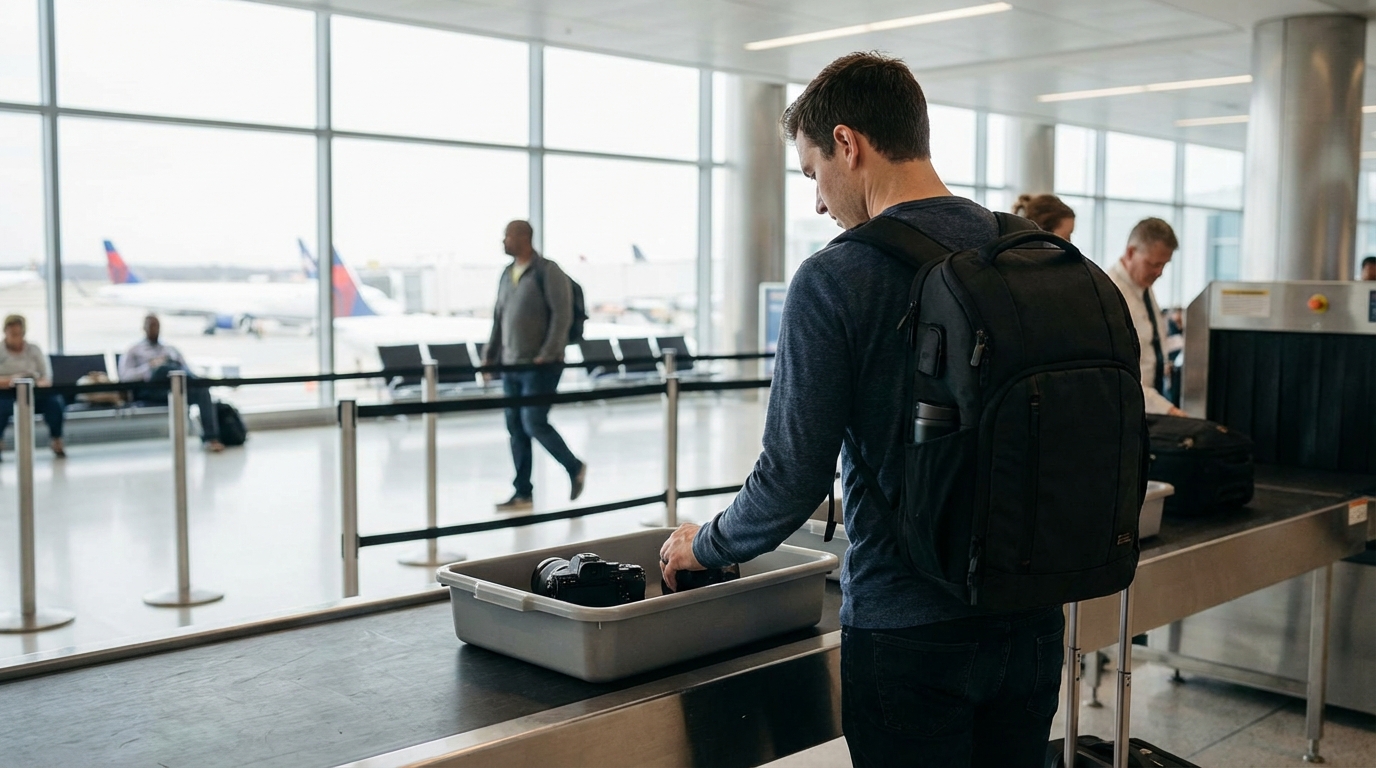
TSA requires any electronic device larger than a cell phone to be removed from your bag and placed in a separate bin. This means:
- DSLR and mirrorless cameras — remove from bag, place in bin
- Large point-and-shoot cameras — remove from bag
- GoPro and small action cameras — these are roughly phone-sized, so they can usually stay in your bag, but pulling them out doesn't hurt
- Film cameras — remove from bag, and you can request a hand inspection (more on this below)
Lenses attached to the camera body stay attached. You don't need to separate the lens from the body. Extra lenses in your bag can stay in the bag unless a TSA officer asks you to remove them.
TSA PreCheck Lanes
With PreCheck, nothing needs to come out of your bag. Your camera, lenses, and accessories all stay packed. This is a huge advantage for photographers traveling with multiple camera bodies and lenses.
CT Scanner Lanes
At airports with newer CT scanners, you don't need to remove electronics from your bag even without PreCheck. The 3D imaging technology can see through everything. These are rolling out at major airports but aren't everywhere yet.
Carry-On vs. Checked Baggage
Let's be direct: never put your camera in checked luggage if you can avoid it.
Why Carry-On Is the Only Smart Choice
- Baggage handlers aren't gentle — checked bags get thrown, stacked, and dropped. Camera gear is precision equipment that doesn't handle impact well.
- Airlines don't cover it — most airlines explicitly exclude electronics, cameras, and valuables from their liability for checked baggage. If your camera breaks or disappears, you're on your own.
- Lithium batteries belong in the cabin — the FAA requires spare lithium batteries to travel in carry-on bags. Camera batteries are lithium-ion.
- Theft risk — cameras are obvious high-value targets. Checked bags pass through many hands between check-in and the carousel.
What About Checked Camera Gear?
If you're traveling with more gear than fits in a carry-on — say, a full cinema kit with multiple bodies, lenses, lighting, and tripods — some of it will need to go in checked luggage. In that case:
- Keep camera bodies and lenses in your carry-on
- Check tripods, light stands, and other non-electronic accessories
- Use a hard-shell, padded case (like a Pelican case) for checked camera gear
- Remove all batteries from checked items and carry them on
Camera Battery Rules
This is the most important section for photographers. The FAA regulates lithium batteries on aircraft, and camera batteries are lithium-ion.
Batteries Installed in Your Camera
A battery that's inside your camera can go in either carry-on or checked luggage. However, since you should be carrying your camera on anyway, this is mostly academic.
Spare Batteries
Spare camera batteries — the ones not installed in a device — must go in your carry-on. They cannot be packed in checked luggage. No exceptions.
Additional rules for spare batteries:
- Under 100 Wh — no restrictions beyond carry-on only. Most camera batteries are well under this limit. A standard Canon LP-E6 is about 14 Wh. A Sony NP-FZ100 is about 16 Wh.
- 100-160 Wh — allowed with airline approval, limited to two spare batteries. Some large cinema camera batteries fall in this range.
- Over 160 Wh — not allowed on passenger aircraft.
Protecting Battery Terminals
The FAA requires spare battery terminals to be protected from short circuits. This means:
- Keep batteries in their original packaging
- Use a battery case or sleeve
- Place tape over the contacts
- Or put each battery in its own plastic bag
Don't just toss loose batteries into your camera bag where metal contacts could touch other metal objects. That's both a safety hazard and a rule violation.
Film Camera Special Considerations
If you're shooting film, the X-ray machines at security are a concern.
X-Ray and Film
Standard airport X-ray machines used for carry-on screening can fog unprocessed film, especially:
- High-speed film (ISO 800 and above)
- Film that goes through X-ray machines multiple times (like on multi-leg trips)
- Specialty or professional film stocks
Lower-speed films (ISO 400 and under) can typically handle one or two passes through a standard carry-on X-ray without noticeable damage, but it's not worth the risk.
Request a Hand Inspection
TSA allows you to request a hand inspection for photographic film. Here's how to do it right:
- Remove all film from your bag before reaching the X-ray
- Place it in a clear, zip-top bag
- Ask the TSA officer for a hand inspection before placing anything on the belt
- Be polite and patient — this takes extra time
Important: TSA is required to hand-inspect film upon request for carry-on screening. However, they will not hand-inspect checked luggage, and checked bag scanners use much stronger CT technology that will damage film. Never put unprocessed film in checked baggage.
Tripods
Tripods are allowed in both carry-on and checked luggage, but there's a catch.
TSA leaves tripod approval to the discretion of the screening officer. A compact travel tripod that folds down to 12-15 inches is almost always fine as a carry-on. A full-size professional tripod with thick legs might raise concerns — it could theoretically be used as a weapon.
Your best bet:
- Travel tripods — carry-on, no issues
- Full-size tripods — check them or be prepared for extra scrutiny
- Monopods — same discretion applies, but they're generally allowed as carry-on
Drones and Aerial Cameras
Consumer drones like the DJI Mini or Mavic series are allowed through TSA security. The drone itself can go in carry-on or checked luggage, but the batteries follow the same lithium battery rules as camera batteries — spare batteries must be in your carry-on, under 100 Wh, with terminals protected.
Note that bringing a drone doesn't mean you can fly it at your destination. Many national parks, cities, and countries have their own drone regulations. Research local laws before packing.
Disposable and Instant Cameras
Disposable cameras are allowed in carry-on and checked luggage. However, since they contain unprocessed film, the X-ray risk applies. If you care about the photos on a disposable camera, request a hand inspection at security.
Instant cameras like Fujifilm Instax or Polaroid cameras are fine in carry-on and checked bags. The film packs inside them can go through X-ray without damage — instant film is less sensitive to X-rays than traditional roll film.
Packing Tips for Camera Gear
- Use a dedicated camera bag — padded camera inserts or bags protect gear much better than tossing a camera into a regular backpack.
- Lens caps on — always. A cracked front element ruins a $2,000 lens.
- Remove battery grips — they make your camera body bigger and harder to pack. Remove them and pack separately.
- Carry insurance info — if you have camera gear insurance, keep the policy details accessible. Some travel insurance policies also cover camera equipment.
- Register expensive gear — if you're traveling internationally, registering your equipment with customs (CBP Form 4457 in the US) proves you owned it before your trip, avoiding potential import duty issues on return.
GoPro and Action Cameras
GoPro and similar action cameras are small enough that they're hassle-free at security. They can stay in your bag in most screening lanes. The batteries are tiny — well under the watt-hour limits. Mounts, housings, and accessories are all permitted.
The one thing to watch: selfie sticks. Some airlines and airports restrict selfie sticks as carry-on items. If you're bringing one, check your airline's policy. They're always fine in checked luggage.
Frequently Asked Questions
Do you have to take your camera out of your bag at TSA?
In standard screening lanes, yes — any electronic device larger than a cell phone must be removed and placed in a separate bin. In TSA PreCheck or CT scanner lanes, cameras can stay in your bag.
Can you bring camera batteries on a plane?
Yes. Batteries installed in your camera can go in carry-on or checked bags. Spare batteries must be in your carry-on only and must be under 100 Wh (most camera batteries are around 14-16 Wh). Protect terminals with tape, a case, or a plastic bag.
Will airport X-rays damage my film camera?
Standard carry-on X-ray machines can fog unprocessed film, especially high-speed film (ISO 800+). You can request a hand inspection from TSA for photographic film. Never put unprocessed film in checked luggage — checked bag scanners are much stronger.
Can you bring a tripod on a plane?
TSA allows tripods in carry-on and checked luggage, but approval is at the screening officer's discretion. Compact travel tripods are almost always fine. Full-size professional tripods should be checked to avoid any issues.
Should I put my camera in checked luggage?
No. Always carry cameras in your carry-on bag. Airlines don't cover electronics damage or theft in checked luggage, baggage handlers aren't gentle, and lithium batteries should stay in the cabin for safety.
Written by Aviation Experts
Aviation Professionals
With decades of combined experience in the aviation industry, our team shares insider knowledge to make your travel experience smoother and less stressful.
Was this article helpful?