Can You Bring Medication on a Plane?
Quick Answer
Yes, you can bring all forms of medication on a plane -- pills, liquids, syringes, and injectables. Medications are exempt from many standard TSA restrictions. Here's exactly what you need to know.
Yes, you can bring medication on a plane. In fact, the TSA makes this one of their most accommodating policies. All medication -- prescription, over-the-counter, pills, liquids, injectables -- is allowed in both carry-on and checked bags. And liquid medications get a special exemption from the 3-1-1 rule.
Pill and Solid Medications
Pill-form medication is the simplest to travel with. Here's what the TSA says:
- No quantity limit. Bring as much as you need.
- No prescription label required by TSA. You don't need to have pills in their original pharmacy bottles.
- Pill organizers are fine. Weekly pill cases, daily organizers, or any container works.
- No declaration needed. Just put them through the X-ray with the rest of your carry-on.
One important caveat: your state may have laws requiring prescription labels. The TSA doesn't enforce state law, but if you're questioned by other law enforcement (say, during a customs check or a state trooper interaction), having the original pharmacy label can protect you. This is especially important for controlled substances like opioids, benzodiazepines, or stimulants.
Vitamins, supplements, and over-the-counter medications follow the same rules as prescription pills. No limits, no labels required, no special screening needed. Toss them in your carry-on and go.
Liquid Medications
This is where the rules get interesting. Liquid medication gets a special exemption from the 3.4-ounce (100 ml) liquid limit.
You can bring liquid medications in containers larger than 3.4 ounces in your carry-on. This includes:
- Prescription liquid medications
- Over-the-counter liquid medicines (cough syrup, antacids, etc.)
- Liquid vitamins and supplements
- Eye drops (prescription or OTC)
- Medicated creams, gels, and ointments
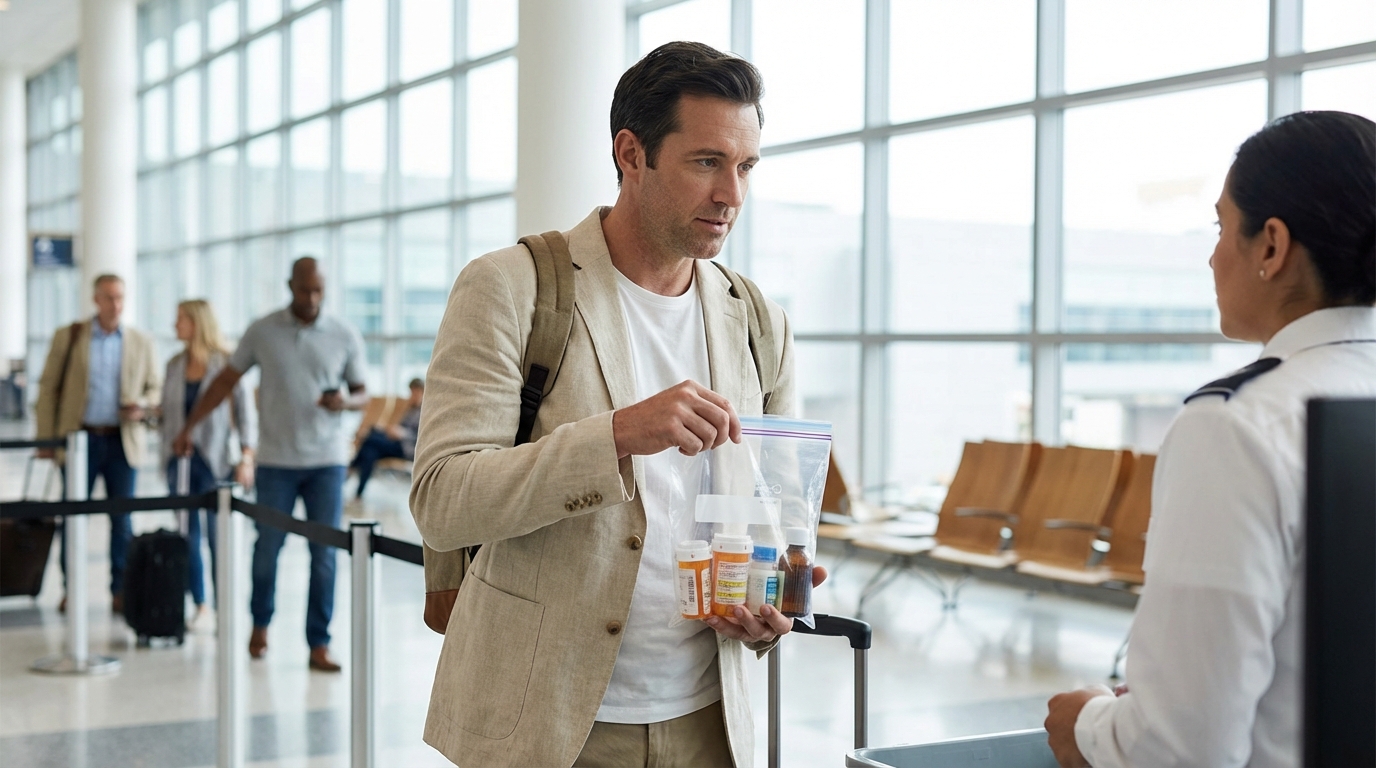
But there's a catch: you must declare liquid medications to the TSA officer before screening begins. Don't just toss them in your bag and hope for the best. Pull them out of your carry-on and tell the officer you have medically necessary liquids.
What happens next:
- The medication may be X-rayed separately
- The officer may ask you to open the container
- You might get additional screening (a pat-down or bag swab)
- The process takes an extra minute or two -- plan accordingly
A quick note: liquid medications that are 3.4 ounces or less can still go in your regular quart-sized liquids bag if you prefer. The exemption only matters when your medication containers are larger than the standard limit.
Injectable Medications and Syringes
If you use injectable medication like insulin, EpiPens, or other auto-injectors, the TSA has specific rules that are actually quite generous:
- Unused syringes are allowed when accompanied by the injectable medication they're used with
- No limit on the number of syringes you can bring
- EpiPens and auto-injectors are allowed and exempt from liquid restrictions
- Insulin and insulin delivery devices (vials, pens, pumps, infusers) are all permitted
- Declare them at the checkpoint. Tell the TSA officer you're carrying syringes and injectable medication
The TSA recommends (but doesn't require) that injectable medications be clearly labeled. Having the prescription label or a letter from your doctor can speed things up and avoid questions.
For diabetic travelers specifically: you can bring your entire diabetes management kit in your carry-on. This includes insulin (any quantity), syringes, pen needles, lancets, blood glucose meters, test strips, alcohol wipes, glucagon kits, and juice or gel for treating low blood sugar. All of it is exempt from standard liquid and sharp object restrictions when it's medically necessary.
Medical Devices and Supplies
Beyond medication itself, the TSA allows associated medical supplies in carry-on:
- Blood sugar monitors and test strips
- Insulin pumps (can stay attached to your body through screening)
- Continuous glucose monitors (CGMs)
- Nebulizers
- CPAP machines (don't count as a carry-on item)
- Ice packs used to keep medication cool (allowed even if partially melted)
- Sharps disposal containers
- Medical marijuana -- this one's complicated; TSA says they don't specifically search for marijuana, but if they find it, they'll refer it to local law enforcement, and federal law still prohibits it
CPAP machines deserve a special mention. Airlines are required to let you bring a CPAP as an additional item -- it doesn't count against your carry-on or personal item allowance. Pack it in its own bag and you're good.
The X-Ray Question
Some travelers worry about X-ray machines affecting their medication. Here's what you need to know:
You can request a visual inspection instead of X-ray screening. This request must be made before your items go on the conveyor belt. Once they've been through the X-ray, it's too late. Walk up to the officer and clearly state your request before placing anything on the belt.
In practice, standard X-ray screening at TSA checkpoints doesn't affect most medications. The doses used in carry-on X-ray machines are very low. But if you have concerns about specific drugs (some biologics, specialty medications, or certain film-based test strips may be sensitive), ask your pharmacist or doctor before your trip, and request a visual inspection at the checkpoint.
Note that insulin pumps and CGMs have their own screening considerations. Some manufacturers advise against sending them through X-ray machines or body scanners. If your device manufacturer recommends against X-ray or AIT (advanced imaging technology) screening, tell the TSA officer and request a pat-down and visual inspection instead.
Tips for Smooth Screening
You don't want to hold up the security line or create confusion. These tips make the process faster:
- Pack medications in a separate, easy-to-access pouch within your carry-on. You'll need to pull out liquid medications and declare them. A clear bag or pouch makes this quick.
- Keep prescription labels when possible. Not required by TSA, but it answers questions before they're asked.
- Carry a doctor's letter if you're traveling with controlled substances, large quantities of medication, or unusual medical devices. Especially helpful for international travel. A letter on official letterhead goes a long way.
- Use TSA Cares. If you have a medical condition that might make screening difficult, call TSA Cares at 855-787-2227 at least 72 hours before your flight. They'll coordinate assistance at the checkpoint and can arrange for a support person to help you through security.
- Arrive early. Additional screening for medications typically adds 5 to 10 minutes. Budget that time, especially if you're carrying liquids or injectable supplies.
- Know the difference between TSA and airline rules. TSA handles security screening. Airlines set their own policies about what you can use during the flight. If you need to self-administer medication in flight, check with your airline beforehand.
Checked Bag vs. Carry-On
Always pack essential medications in your carry-on. This isn't just a recommendation -- it's a critical travel strategy. Checked bags can be delayed, lost, or sent to the wrong airport. If your medication is in a bag that doesn't arrive with you, you could be in serious trouble.
Pack enough medication in your carry-on for:
- The entire trip, plus a few extra days
- The possibility that your return flight is delayed
- An emergency where you're stuck somewhere longer than planned
If you're bringing a large supply, it's fine to split it: carry-on for immediate needs, checked bag for extras. But never put all of your medication in checked luggage. Also keep in mind that checked luggage isn't temperature controlled -- the cargo hold can get very cold. Medications that are temperature-sensitive (like insulin) should always be in the cabin with you.
Controlled Substances
Traveling with controlled substances (Schedule II through V drugs) adds another layer of consideration:
- TSA doesn't check prescriptions. They're screening for threats, not verifying your prescriptions. Their job is security, not drug enforcement.
- But other agencies might. Customs and Border Protection (CBP) can check prescriptions on international flights, and state or local law enforcement can ask about controlled substances.
- Keep medications in original pharmacy containers with the prescription label showing your name, the drug, and the prescribing doctor.
- Carry no more than a 90-day supply for international travel to avoid issues at customs.
- Some medications are illegal in other countries. Adderall, codeine, and certain anxiety medications are controlled or banned in some destinations. Check your destination country's drug import rules before you fly.
A practical tip: if you take a controlled substance daily and use a pill organizer at home, transfer your travel supply into the original pharmacy bottle for the trip. It takes 30 seconds and eliminates potential headaches at the border.
International Travel with Medication
TSA rules cover U.S. departures, but international travel brings additional requirements that can trip up unprepared travelers:
- Carry a letter from your doctor explaining your condition and medications, ideally translated into the local language of your destination
- Check the destination country's drug import laws. Some common U.S. medications are illegal elsewhere. Japan, for example, strictly controls pseudoephedrine (found in Sudafed) and some ADHD medications
- Bring enough medication for the entire trip plus extras -- getting prescriptions filled abroad can be difficult or impossible, especially for controlled substances
- Keep everything in original packaging with pharmacy labels for customs inspections
- Research import quantity limits. Some countries cap the amount of medication you can bring in, even with a valid prescription
For extended international trips, contact your insurance company about filling a larger supply before departure. Most insurers will authorize a 90-day fill for international travel with a doctor's note.
Frequently Asked Questions
Does medication need to be in its original container for TSA?
No. The TSA does not require medications to be in original pharmacy bottles. Pill organizers and other containers are fine. However, keeping prescription labels is recommended for controlled substances, as state laws and international customs may require them.
Can I bring liquid medication over 3.4 ounces on a plane?
Yes. Liquid medications are exempt from the 3.4-ounce liquid limit. You must declare them to the TSA officer at the start of screening. They may be inspected separately.
Can I fly with syringes and needles?
Yes. Unused syringes are allowed in carry-on when accompanied by injectable medication. Declare them to the TSA officer at the checkpoint. There's no limit on the number of syringes you can bring.
Should I pack medication in carry-on or checked bags?
Always pack essential medication in your carry-on. Checked bags can be lost or delayed. Bring enough for the entire trip plus a few extra days. You can put extras in checked luggage, but never rely solely on checked bags for medication.
Can I bring Adderall or other controlled substances on a plane?
Yes, for domestic U.S. flights. Keep controlled substances in their original pharmacy containers with prescription labels. For international flights, check your destination country's drug import laws -- some common U.S. medications are illegal or heavily restricted abroad.
Written by Aviation Experts
Aviation Professionals
With decades of combined experience in the aviation industry, our team shares insider knowledge to make your travel experience smoother and less stressful.
Was this article helpful?