Can You Bring Perfume on a Plane?
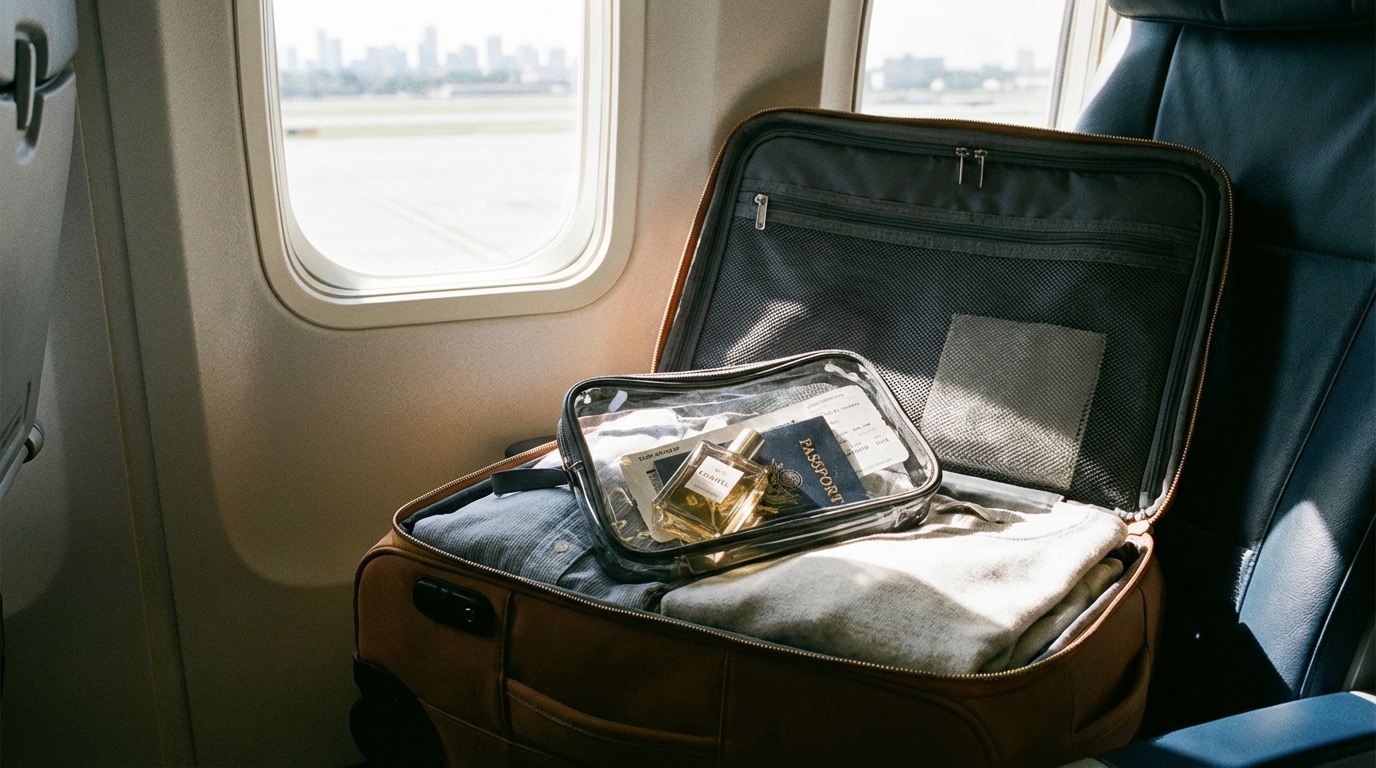
Quick Answer
Yes, you can bring perfume on a plane. In your carry-on, perfume bottles must be 3.4 ounces (100 ml) or smaller and fit in your quart-sized liquids bag. Larger bottles go in checked luggage — just pack them carefully to prevent breakage.
The Quick Answer
Yes, you can bring perfume on a plane. TSA treats perfume like any other liquid, so the same 3-1-1 rule applies. Bottles 3.4 ounces or smaller go in your carry-on quart bag. Bigger bottles go in checked luggage.
Here's how to fly with your favorite fragrance without losing it to TSA or having it shatter in your suitcase.
Carry-On Rules for Perfume
Perfume falls under TSA's 3-1-1 liquids rule:
- 3.4 ounces (100 ml) max per bottle
- 1 quart-sized clear, resealable plastic bag
- 1 bag per passenger
Most standard perfume bottles are 1.7 oz (50 ml) or 3.4 oz (100 ml), which means they fit the carry-on limit perfectly. A 3.4-ounce bottle is the largest you can bring through security.
If your bottle is even slightly over 3.4 ounces — say 3.5 oz or 4 oz — it won't make it through the checkpoint. TSA goes by the labeled container size, not how much liquid is left inside. A half-empty 5-ounce bottle still gets pulled.
Multiple Perfume Bottles
You can bring more than one perfume in your carry-on, as long as every bottle is 3.4 ounces or less and they all fit inside your single quart-sized bag. Remember, that bag also holds all your other liquids — shampoo, lotion, toothpaste, contact solution.
Realistically, if you're bringing two or three perfumes plus a full toiletry lineup, you'll run out of quart-bag space fast. Prioritize your must-haves.
Checked Luggage: Bigger Bottles Welcome
There's no TSA-imposed limit on perfume bottle size in checked bags. Want to bring your 6.7-ounce statement bottle? Go ahead. Pack it in your checked suitcase and you're set.
The only restriction is FAA's general rule for flammable toiletry items in checked bags: containers can't exceed 18 ounces (500 ml) each, with a total limit of 70 ounces (2 liters) for all flammable toiletries combined. No single perfume bottle comes close to 18 ounces, so this is a non-issue for fragrance.
Protecting Perfume in Checked Luggage
The bigger concern with checked luggage is breakage. Baggage handlers aren't gentle, and perfume bottles — especially glass ones — are fragile. Here's how to protect them:
- Wrap each bottle in a sock or soft clothing. This cushions it against impact.
- Place bottles in the center of your suitcase. Surrounded by clothes on all sides, they're less likely to take a direct hit.
- Use a padded toiletry bag. Hard-shell toiletry cases are even better for glass bottles.
- Put the bottle in a zip-lock bag. If it does break, the fragrance is contained instead of soaking everything in your suitcase.
- Keep the cap on tight. Pressure changes in the cargo hold can cause bottles to seep. A tight cap prevents leaks.
Common Perfume Bottle Sizes and TSA Compliance
Here's a quick reference for standard perfume sizes:
- Rollerball (0.33 oz / 10 ml): Carry-on approved
- Travel spray (0.5 oz / 15 ml): Carry-on approved
- Small bottle (1.0 oz / 30 ml): Carry-on approved
- Standard bottle (1.7 oz / 50 ml): Carry-on approved
- Full size (3.4 oz / 100 ml): Carry-on approved (maximum)
- Large bottle (5.0 oz / 150 ml): Checked only
- Extra large (6.7 oz / 200 ml): Checked only
If you're buying perfume specifically for travel, the 1.0 oz or 1.7 oz sizes are the sweet spot — small enough for carry-on with room to spare in your quart bag.
Solid Perfume: Skip the Liquids Bag
Solid perfumes and perfume balms aren't liquids. They don't fall under the 3-1-1 rule and don't need to go in your quart bag. You can pack them freely in your carry-on.
Brands like Diptyque, Le Labo, and Glossier make solid perfume versions. They're compact, spill-proof, and perfect for travel. The scent doesn't project as far as a spray, but for a quick refresh during a flight or after landing, they work great.
Buying Perfume at Duty-Free
Duty-free shops in international terminals sell full-sized perfume bottles that you can bring on the plane even if they exceed 3.4 ounces. Here's the catch — and it's an important one.
The duty-free purchase must be sealed in a tamper-evident bag with a visible receipt. As long as you keep that bag sealed, you can carry it through boarding even though the bottle exceeds the normal liquid limit.
The problem comes with connections. If you have a connecting flight that requires you to go through security again — especially in a different country — that sealed bag may get flagged. Some airports recognize duty-free bags and let them through. Others don't. If you're connecting through a strict airport, you risk losing your purchase.
The safest strategy: only buy duty-free perfume on your last flight of the journey, when you won't pass through security again before your final destination.
Cologne vs. Perfume: Same Rules
TSA doesn't distinguish between perfume, cologne, eau de toilette, eau de parfum, or body mist. They're all liquids. Same 3-1-1 rule applies across the board.
The only difference that matters for packing is concentration. Perfume (parfum) is more concentrated, so a smaller bottle lasts longer on a trip. Cologne and body mist are more diluted, meaning you might need more product — and more bottle space — for the same number of applications.
Travel Perfume Tips
- Invest in a refillable travel atomizer. These small spray bottles (typically 0.17-0.27 oz) let you transfer perfume from your big bottle at home. Brands like Travalo make ones that attach directly to most perfume nozzles for easy filling.
- Bring perfume samples. If you have sample vials from department stores or fragrance subscriptions, they're perfect for travel. Usually 0.05-0.1 oz, they take up almost no space.
- Apply before security. If you want to smell great for your flight without packing a bottle, apply your fragrance at home before heading to the airport.
- Store away from heat. Don't leave perfume in a hot car on the way to the airport or in direct sunlight. Heat degrades fragrance quality. In your suitcase, it's fine — the cargo hold is actually quite cold.
- Consider buying travel-exclusive sets. Many fragrance brands sell travel sets with multiple small bottles. You get variety without the bulk.
What Happens If TSA Flags Your Perfume?
If a TSA officer spots an oversized perfume bottle in your carry-on during X-ray screening, they'll pull your bag aside. You'll have a few options: surrender the bottle (it goes in the confiscated bin and you won't get it back), step out of line and put it in a checked bag if you have time, or ask a non-traveling companion to take it home for you.
This is why experienced travelers always double-check their quart bag before heading to the airport. A $150 perfume bottle isn't worth losing over a simple packing mistake.
One thing to note: TSA officers have some discretion, but don't count on it. Some screeners will let a borderline bottle slide. Others follow the rules to the letter. Always pack assuming strict enforcement.
Perfume and Flammability
Perfume contains alcohol, which makes it technically flammable. This is why the FAA includes perfume in its flammable toiletry category for checked luggage, with the 18-ounce-per-container and 70-ounce aggregate limit.
In practice, a standard perfume bottle poses negligible fire risk. The alcohol content is relatively low compared to something like rubbing alcohol or hand sanitizer, and the amounts are tiny. But the rules exist because the FAA regulates by category, not by individual product risk assessment.
You don't need to do anything special because of the alcohol content. Just follow the standard liquid rules and you're fine.
Can You Spray Perfume on the Plane?
Technically, there's no TSA rule against applying perfume during a flight. But please don't.
The cabin is a sealed, recirculated air environment. What smells pleasant to you can trigger headaches, allergies, or nausea in fellow passengers. Many people are sensitive to fragrance, especially in a confined space at altitude where air is already dry and irritating.
Apply your perfume before boarding or after you land. Your seatmates will thank you.
International Perfume Restrictions
Most countries follow similar liquid restrictions to the TSA's 3-1-1 rule, since the International Civil Aviation Organization (ICAO) sets global standards. However, specific details can vary:
- EU airports: 100 ml limit per container, same as TSA. Some airports have advanced CT scanners that let you keep liquids in your bag without removing them.
- UK airports: Same 100 ml rule. Some UK airports now allow containers up to 2 liters through new scanners, but this varies by airport — check before you fly.
- Asian airports: Generally follow the 100 ml standard. Japan and Singapore are particularly strict about enforcement.
When in doubt, stick to the 3.4 oz / 100 ml rule. It works everywhere.
Frequently Asked Questions
Can I bring a full-sized perfume bottle in my carry-on?
Only if it's 3.4 ounces (100 ml) or smaller. Many standard perfume bottles are exactly 3.4 oz or 1.7 oz, which are both carry-on approved. Anything larger must go in checked luggage.
Can I bring multiple perfume bottles on a plane?
Yes. You can bring as many perfume bottles as you want, as long as each is 3.4 ounces or less in your carry-on and they all fit in your single quart-sized liquids bag alongside your other liquids. Checked luggage has no bottle limit.
Does solid perfume count as a liquid for TSA?
No. Solid perfume balms aren't liquids, gels, or aerosols, so they don't fall under the 3-1-1 rule. You can pack solid perfume in your carry-on without putting it in your quart-sized bag.
Can I bring duty-free perfume on a connecting flight?
It depends. Duty-free perfume must stay in its sealed, tamper-evident bag. If your connection requires passing through security again, some airports accept sealed duty-free bags and some don't. The safest option is to buy duty-free on your last flight leg.
Is it safe to pack perfume in checked luggage?
Yes, it's allowed and safe. Wrap glass bottles in clothing or a padded case to prevent breakage, put them in a zip-lock bag in case of leaks, and place them in the center of your suitcase surrounded by soft items.
Written by Aviation Experts
Aviation Professionals
With decades of combined experience in the aviation industry, our team shares insider knowledge to make your travel experience smoother and less stressful.
Was this article helpful?