Can You Bring Power Banks on a Plane?
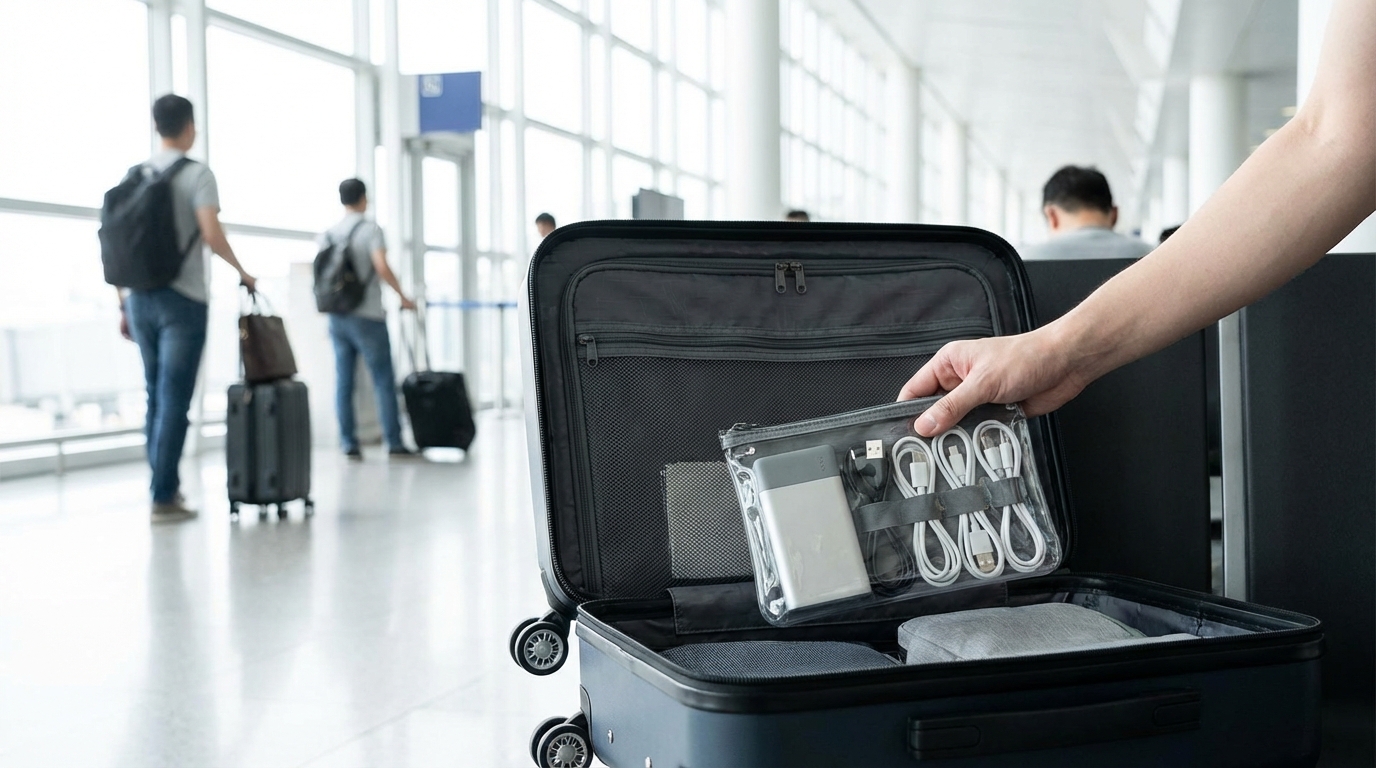
Quick Answer
Yes, you can bring power banks on a plane, but only in your carry-on bag. Power banks are banned from checked luggage. They must be under 100 watt-hours — roughly 27,000 mAh. Larger power banks (100-160 Wh) require airline approval.
The Quick Answer
Power banks are allowed on planes, but there are strict rules you need to follow. They must travel in your carry-on — never checked luggage. They must be under 100 watt-hours (about 27,000 mAh) to fly without airline approval. And you need to protect the battery terminals from short circuits.
These aren't TSA suggestions. They're FAA safety regulations. Break them and you're looking at confiscation, fines up to $17,062 per violation, and potential criminal charges. The rules exist because lithium batteries can catch fire, and a fire in the cargo hold is catastrophic.
The Rules at a Glance
Here's the framework for power banks on planes:
- Under 100 Wh — allowed in carry-on, no approval needed. This covers the vast majority of consumer power banks.
- 100-160 Wh — allowed in carry-on with prior airline approval. Limited to two spare batteries per person.
- Over 160 Wh — banned from passenger aircraft entirely. Cannot fly in carry-on or checked bags.
All power banks, regardless of size, are banned from checked luggage. No exceptions.
Why Carry-On Only?
Lithium-ion batteries can overheat, swell, and in rare cases catch fire through a process called thermal runaway. If this happens in the cabin, the flight crew can see it, respond immediately, and use fire suppression equipment. If it happens in the cargo hold, no one knows until smoke fills the aircraft.
This isn't theoretical. The FAA has documented hundreds of incidents involving lithium batteries on aircraft. That's why the carry-on requirement exists — it's a safety issue, not bureaucracy.
How to Calculate Watt-Hours
This is the part that confuses most travelers. Power banks are usually rated in milliamp-hours (mAh), but the FAA's limit is in watt-hours (Wh). Here's how to convert.
The Formula
Wh = (mAh / 1000) x Voltage
Most power banks use lithium-ion cells with a nominal voltage of 3.7V. So the calculation is:
Wh = (mAh / 1000) x 3.7
Common Power Bank Sizes
- 5,000 mAh = 18.5 Wh — allowed, great for a quick phone charge
- 10,000 mAh = 37 Wh — allowed, charges most phones twice
- 20,000 mAh = 74 Wh — allowed, four to five phone charges
- 26,800 mAh = 99.16 Wh — allowed, just barely under the limit
- 30,000 mAh = 111 Wh — needs airline approval
- 50,000 mAh = 185 Wh — banned from all passenger flights
Check the Label First
Many power banks print the Wh rating directly on the device label alongside the mAh. If your power bank shows both, use the Wh number — that's the one TSA and airlines care about. If it only shows mAh, do the calculation above.
If there's no label at all — no mAh, no Wh, no specs visible on the device — TSA officers may confiscate it. They have no way to verify it meets the limit. Always travel with clearly labeled power banks.
TSA Security Screening
Power banks go through the X-ray machine with your carry-on. Here's what to expect.
Should You Remove It From Your Bag?
TSA doesn't specifically require power banks to be pulled out for separate screening. However, they're dense rectangular lithium batteries that light up on X-ray screens. A bag with a power bank inside frequently gets pulled for manual inspection because the officer can't tell what the dense block is.
Pro tip: put your power bank in an outside pocket or on top of your other items. If the bag gets flagged, you can quickly point to it and move on. Some experienced travelers pull their power bank out and put it in the laptop bin preemptively to avoid the hassle.
TSA PreCheck
With PreCheck, nothing needs to come out of your bag. Your power bank stays packed.
Airline-Specific Rules
While the FAA sets the baseline, individual airlines can be stricter. Here are the general patterns:
Domestic US Airlines
Most major US airlines (American, Delta, United, Southwest, JetBlue) follow the FAA standard: under 100 Wh is fine, 100-160 Wh needs approval. Getting approval usually means calling the airline or notifying the gate agent. Some airlines let you do this at check-in.
International Airlines
International carriers often have additional restrictions:
- Some Asian airlines limit you to two power banks per person regardless of size
- Some Middle Eastern airlines cap at 100 Wh with no exceptions — no 100-160 Wh category
- Chinese airlines require power banks to have clear capacity markings and may confiscate unmarked ones at the gate
Always check your specific airline's policy before flying internationally.
What Happens If You Pack One in Checked Luggage
Airport security screens checked bags with powerful scanners. If they detect a power bank, several things can happen:
- Best case — security removes the power bank from your bag. You probably won't get it back.
- Possible case — your bag gets pulled from the flight for inspection, potentially delaying it from arriving with you.
- Worst case — you face FAA fines. Civil penalties for lithium battery violations can reach $17,062 per violation. Repeated or willful violations can result in criminal prosecution.
It's not worth the risk. Keep your power bank in your carry-on.
Gate Check Situations
This is the scenario that catches people off guard. You board a small regional jet, and the gate agent says your carry-on bag must be gate-checked because overhead bin space is limited.
When this happens, you must remove your power bank (and any other loose lithium batteries) from the bag before handing it over. Gate-checked bags go into the cargo hold — the same place where power banks are banned.
Keep your power bank in your personal item (backpack, purse, laptop bag) that goes under the seat in front of you. Then you never have to worry about gate-check scenarios.
Protecting Battery Terminals
The FAA requires that spare battery terminals be protected from short circuits. For power banks, this means:
- Keep the power bank away from coins, keys, and other metal objects
- Use the original packaging or a protective case
- Place tape over charging ports if you're paranoid about shorts
- Store it in a dedicated pocket in your bag
Most power banks have recessed USB ports that aren't prone to shorting, but it's good practice to keep them separated from metal objects.
Can You Use a Power Bank on the Plane?
Yes. You can charge your phone, tablet, headphones, or any other device from a power bank during the flight. There's no rule against using them at cruising altitude.
Some airlines ask you not to use them during takeoff and landing (same as other electronics), but once you're in the air, plug in and charge away. That's the whole point of bringing one.
Choosing a Travel-Friendly Power Bank
If you're shopping for a power bank specifically for air travel, here's what to look for:
- Under 100 Wh / 27,000 mAh — stays under the limit without needing airline approval
- Clearly labeled specs — mAh and Wh printed on the device body
- Multiple ports — USB-A and USB-C for flexibility
- USB-C PD (Power Delivery) — fast charging for modern phones and even some laptops
- Compact size — a 10,000 mAh power bank is pocket-sized and enough for most domestic flights
The sweet spot for most travelers is a 20,000 mAh power bank. It provides enough juice for a full day of heavy use, comfortably stays under the 100 Wh limit, and doesn't take up much space. For weekend trips, a 10,000 mAh model is more than enough.
Multiple Power Banks
The FAA doesn't set a specific limit on how many power banks under 100 Wh you can carry. However, individual airlines might. And practically speaking, if you're carrying five power banks, a TSA officer might take extra interest in your bag.
For 100-160 Wh power banks, you're limited to two per person. And you need airline approval for each one.
Most travelers don't need more than one or two power banks. If you're carrying more, consider whether a single larger-capacity (but still under 100 Wh) power bank would simplify things.
Frequently Asked Questions
Can power banks go in checked luggage?
No. Power banks must travel in your carry-on bag. The FAA bans all spare lithium-ion batteries from checked luggage because a battery fire in the cargo hold is extremely dangerous and hard to detect.
What is the maximum mAh allowed on a plane?
The FAA limit is 100 watt-hours, which translates to roughly 27,000 mAh at the standard 3.7V. Power banks between 100-160 Wh (about 27,000-43,000 mAh) require airline approval. Anything over 160 Wh is banned entirely.
How many power banks can you bring on a plane?
There's no specific FAA limit on power banks under 100 Wh, though individual airlines may set their own limits. For power banks between 100-160 Wh, you're limited to two per person with airline approval.
Do you need to take power banks out at TSA?
TSA doesn't specifically require it, but power banks often trigger bag checks because they appear as dense blocks on the X-ray. Placing your power bank in an accessible pocket or pulling it out preemptively can speed up screening.
What happens if TSA finds a power bank in your checked bag?
Security will likely remove it from your bag and you probably won't get it back. You could also face FAA fines up to $17,062 per violation. Your bag may be delayed while being inspected.
Written by Aviation Experts
Aviation Professionals
With decades of combined experience in the aviation industry, our team shares insider knowledge to make your travel experience smoother and less stressful.
Was this article helpful?