Can You Bring Sunscreen on a Plane?
Quick Answer
Yes, you can bring sunscreen on a plane in both carry-on and checked bags. Liquid, lotion, and spray sunscreen must follow the 3-1-1 rule in carry-on (3.4 oz max), but solid sunscreen sticks are completely exempt from liquid limits.
The Short Answer
You can absolutely bring sunscreen on a plane. But how you pack it depends entirely on the type of sunscreen you're carrying. Lotions, sprays, and gels all count as liquids under TSA rules, so they're capped at 3.4 oz in your carry-on. Solid sunscreen sticks? No size limit at all. They're the travel MVP.
Here's exactly what you need to know for each type.
Lotion Sunscreen in Carry-On
This is the most common type, and it falls squarely under the TSA's 3-1-1 liquids rule:
- Container must be 3.4 oz (100ml) or smaller. Doesn't matter if your 6 oz bottle is half empty — TSA goes by container size, not what's left inside.
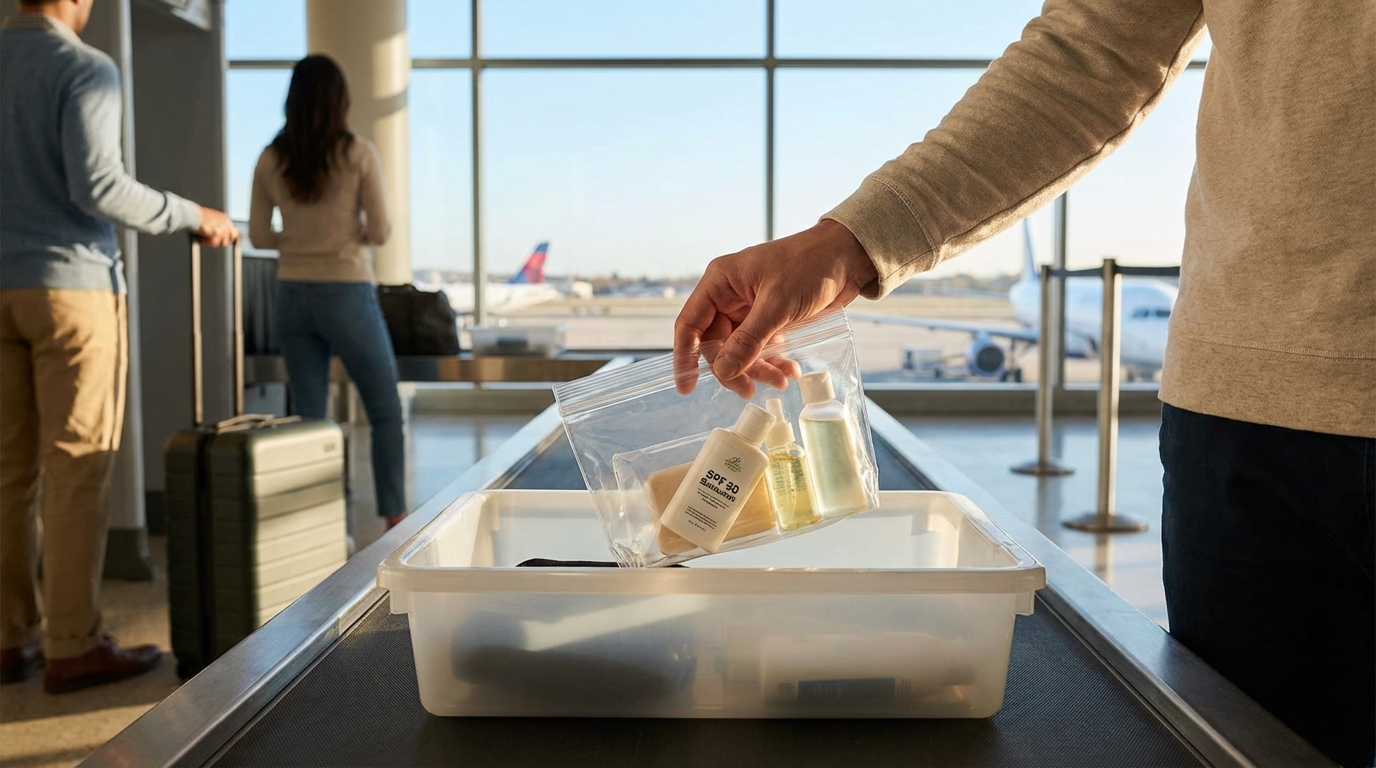
- Must fit in your quart-sized clear bag with all your other liquids, gels, and creams.
- One quart bag per passenger. That bag fills up fast when you're also packing moisturizer, toothpaste, and lip balm.
Most standard sunscreen bottles are 3 oz, 6 oz, or 8 oz. Only the 3 oz size works for carry-on. The popular travel sizes from brands like Neutrogena, Coppertone, and Banana Boat typically come in 1 oz or 3 oz options that fit perfectly.
Spray Sunscreen in Carry-On
Spray sunscreen follows the exact same 3-1-1 rule as lotions. TSA treats aerosol toiletries the same as liquid ones:
- 3.4 oz or smaller container in your carry-on.
- Must fit in your quart bag.
- Travel-size spray cans are usually 1-2 oz, which works fine.
One thing to keep in mind: aerosol cans can be a little bulky for that quart bag compared to a slim tube of lotion. If bag space is tight, lotion is the more efficient format for carry-on.
Sunscreen Sticks: The Best Travel Option
Here's where it gets good. Solid sunscreen sticks are completely exempt from the 3-1-1 liquids rule. TSA classifies them the same way as solid deodorant or a bar of soap — they're solids, not liquids.
What this means for you:
- No size limit. Bring a full-size stick or even a jumbo one.
- Doesn't go in your quart bag. Pack it anywhere in your carry-on.
- No need to remove it at security. Leave it in your bag and it'll pass through the X-ray without issue.
Brands like Sun Bum, Neutrogena, Supergoop, and Blue Lizard all make great stick sunscreens. If you're a frequent flyer heading to sunny destinations, switching to a stick for travel is a no-brainer. You'll save precious quart-bag space for things you can't get in solid form.
Sunscreen in Checked Bags
Checked luggage is much more flexible. You can pack full-size sunscreen bottles, sprays, and tubes without worrying about the 3-1-1 rule. But there are still some limits for aerosol and liquid toiletries:
- Each aerosol container can be up to 18 oz (500ml). That covers every consumer sunscreen spray on the market.
- Total aerosols and liquids capped at 70 oz (2 liters) per person. You'd have to pack a lot of sunscreen to hit this limit.
- Aerosol cans should have their caps on to prevent accidental spraying. Pressure changes at altitude can cause leaks.
For lotion sunscreen in checked bags, there's no individual container size limit beyond the 70 oz aggregate. Pack your family-size bottle without worry.
What About Mineral vs. Chemical Sunscreen?
TSA doesn't care about the SPF rating, ingredients, or whether your sunscreen is mineral (zinc oxide) or chemical. The only thing that matters is the physical form:
- Liquid, lotion, cream, gel, spray = follows 3-1-1 rule in carry-on
- Solid stick = no restrictions in carry-on
Whether you're using SPF 30 or SPF 100, reef-safe or not, tinted or clear — the TSA rules are identical.
Smart Packing Strategies
Here's how experienced travelers handle sunscreen without wasting quart-bag space:
For Short Trips
- Pack a sunscreen stick in your carry-on. Zero quart-bag impact, and one stick lasts several days of face and neck application.
- Buy full-size sunscreen at your destination. Every beach town, resort gift shop, and drugstore sells sunscreen. Sometimes it's cheaper than airport prices.
For Longer Trips
- Check a full-size bottle in your luggage. Put it in a zip-lock bag in case of leaks from pressure changes.
- Carry a stick for the journey. If you have a layover in a sunny city or want sun protection during travel, a stick in your personal item is always accessible.
For Families
- Check the big bottles. A family of four doesn't need four individual carry-on sunscreens. Put one or two large bottles in checked luggage and carry one travel-size tube for the travel day.
- Kids' sunscreen follows the same rules. No special exemptions for baby sunscreen or kids' formulas — same 3-1-1 limits apply.
Common Mistakes to Avoid
Packing a half-empty large bottle in carry-on. TSA will confiscate a 6 oz bottle even if there's only 2 oz of sunscreen left. Container size is what counts.
Forgetting sunscreen counts toward your quart bag. People tend to think of sunscreen as separate from toiletries, but it competes for the same limited space as your shampoo, toothpaste, and face wash.
Not protecting checked-bag bottles from leaks. The cargo hold is pressurized but can experience enough pressure variation to cause tubes to ooze. Double-bag anything that could leak.
Assuming you can buy sunscreen at the airport. Airport shops do carry it, but the selection is limited and the prices are steep. Buy travel sizes before you leave home.
International Flight Considerations
The 100ml carry-on liquid limit is actually an international standard, not just a TSA rule. You'll encounter the same restrictions flying through Europe, Asia, Australia, and most other regions. A few things to note:
- Duty-free sunscreen purchased after security can be any size, as long as it stays in the sealed duty-free bag with the receipt.
- Some countries restrict certain sunscreen ingredients. Hawaii, Palau, Thailand, and parts of Mexico have banned certain chemical UV filters like oxybenzone for reef protection. This doesn't affect what you can bring through security, but your sunscreen might not be legal to use at your destination.
- Check transfer airport rules. If you're connecting through a strict airport, any liquids above 100ml — even those purchased duty-free at your origin — might get confiscated at the connecting security checkpoint.
The Bottom Line
Bring your sunscreen. Just match the format to your bag. Sticks go in carry-on without limits, everything else follows 3-1-1, and checked bags handle full-size bottles just fine. The easiest move? Grab a sunscreen stick for your carry-on and toss the big bottle in your checked luggage. You'll get through security without a second thought.
Frequently Asked Questions
Can I bring a full-size bottle of sunscreen in my carry-on?
Only if it's a solid sunscreen stick. Liquid, lotion, cream, gel, and spray sunscreens must be in containers of 3.4 oz (100ml) or smaller and fit in your one quart-sized clear bag. Solid sticks have no size limit in carry-on.
Does spray sunscreen count as a liquid for TSA?
Yes. Aerosol spray sunscreen is treated exactly like liquid sunscreen under TSA rules. It must be 3.4 oz or smaller in carry-on and fit in your quart-sized bag. In checked bags, spray cans can be up to 18 oz each.
Are sunscreen sticks subject to the 3-1-1 rule?
No. Solid sunscreen sticks are exempt from the TSA's 3-1-1 liquids rule. You can bring any size stick in your carry-on without putting it in your quart bag. TSA treats them the same as solid deodorant.
How much sunscreen can I pack in checked luggage?
You can pack full-size sunscreen in checked bags. For aerosol sprays, each can can be up to 18 oz (500ml), with a total limit of 70 oz (2 liters) for all aerosols and liquids combined. Lotion and cream sunscreen have no practical size limit in checked bags.
Written by Aviation Experts
Aviation Professionals
With decades of combined experience in the aviation industry, our team shares insider knowledge to make your travel experience smoother and less stressful.
Was this article helpful?