Can You Bring Vape Juice on a Plane?
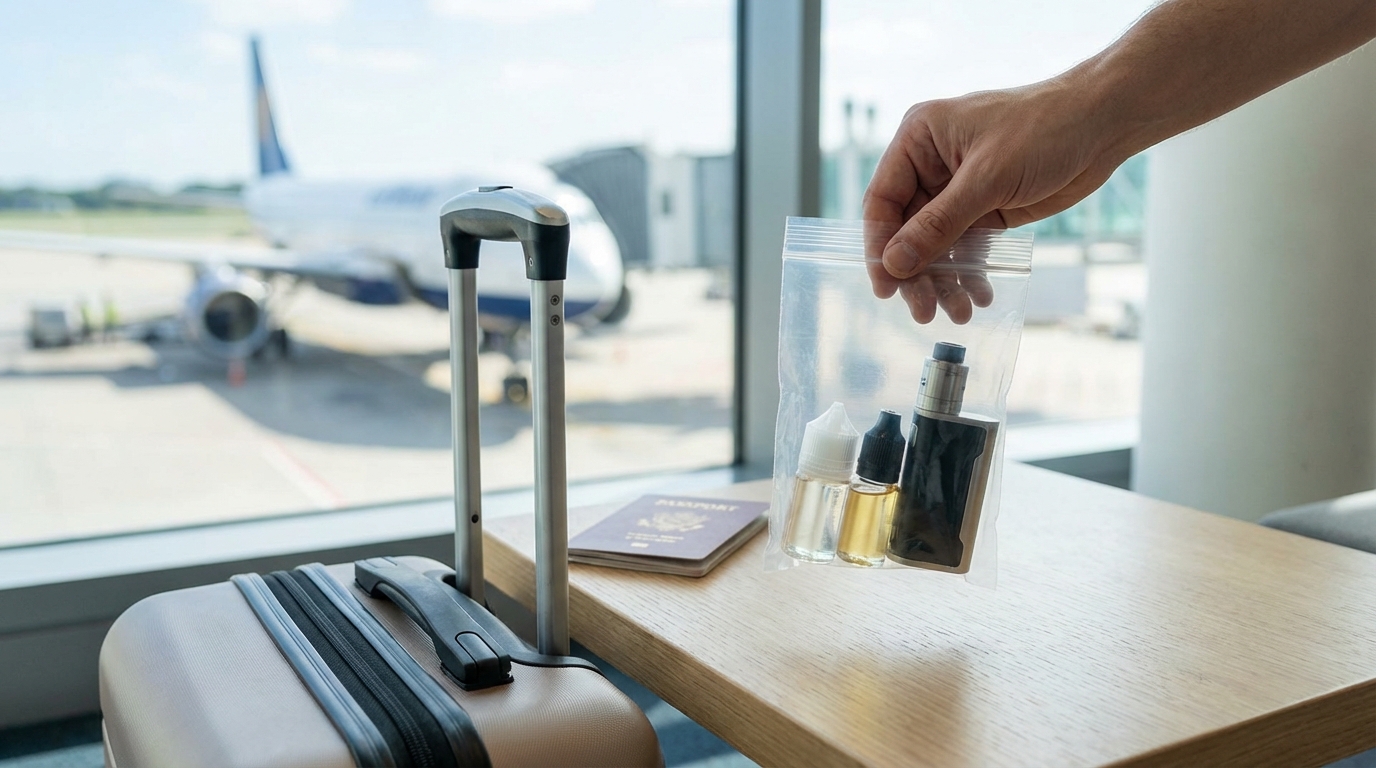
Quick Answer
Yes, you can bring vape juice on a plane. In carry-on, each bottle must be 3.4 oz or smaller and fit in your quart-sized liquids bag. Checked bags have no size limit on e-liquid. But your vape device itself must stay in your carry-on — never checked luggage.
The Quick Answer
Vape juice is allowed on planes, but there's a split rule you need to know. The e-liquid follows standard liquid rules (3.4 oz limit in carry-on, no limit in checked bags). Your vaping device, on the other hand, must go in your carry-on and is banned from checked luggage entirely because of the lithium battery inside.
Get those two rules straight and you'll have no problems at security.
Vape Juice in Carry-On Bags
E-liquid in your carry-on follows the TSA's 3-1-1 rule, same as any other liquid:
- 3.4 ounces (100ml) maximum per bottle
- All bottles must fit in one quart-sized clear bag along with your other liquids and gels
- One quart bag per passenger
Most standard vape juice bottles come in 30ml (1 oz), 60ml (2 oz), or 120ml (4 oz) sizes. The 30ml and 60ml bottles are carry-on compliant. The 120ml bottles are too big — they'll get confiscated at security.
If you're a heavy vaper or traveling for an extended period, you can bring multiple small bottles as long as they all fit in your quart bag. Three 30ml bottles? That's 90ml total of vape juice that's completely fine in carry-on.
Vape Juice in Checked Bags
Checked luggage has no size restrictions on vape juice. You can pack:
- Full-size 120ml bottles
- Multiple large bottles
- Bulk quantities for long trips
The only thing to watch for is leaking. Cabin pressure changes during flight can cause vape juice bottles to leak, especially if they're not sealed properly. More on preventing that below.
Vape Devices: Carry-On Only
This is the rule that catches people off guard. Your actual vaping device — the mod, pen, pod system, or disposable vape — must go in your carry-on bag. It is prohibited in checked luggage.
This isn't optional or a suggestion. It's an FAA regulation driven by fire safety. Lithium-ion batteries (which power all vaping devices) have a small but real risk of thermal runaway — basically catching fire. If that happens in the cabin, the crew can deal with it. If it happens in the cargo hold with no one around, it could be catastrophic.
This rule applies to:
- Box mods
- Vape pens
- Pod systems (JUUL, SMOK, Vuse, etc.)
- Disposable vapes
- Any device with a built-in or removable lithium battery
Can You Vape on a Plane?
No. Absolutely not. Vaping on an aircraft is illegal under federal law, just like smoking cigarettes. This applies to:
- The cabin, including the lavatory
- The jet bridge
- During boarding and deplaning
The smoke detectors in airplane lavatories are extremely sensitive and will detect vapor from e-cigarettes. Getting caught vaping on a plane can result in:
- Federal fines up to $4,000+
- Being banned from the airline
- Criminal charges in serious cases
- Emergency diversion of the aircraft (and you'll be billed for the cost)
Don't do it. Wait until you're in a designated smoking area at your destination airport.
Preventing Vape Juice Leaks During Flights
Pressure changes at altitude cause air inside containers to expand, which pushes liquid out through any weak point. Vape juice bottles and especially vape tanks are prone to leaking during flights. Here's how to prevent it:
For Bottles
- Leave air space. Don't fill bottles to the very top. About 25% empty gives the liquid room to expand without forcing its way out.
- Tighten caps completely. Seems obvious, but a loose cap is the number one cause of leaks.
- Store upright. Pack bottles standing up so any air rises to the top, away from the seal.
- Double-bag everything. Put your vape juice bottles inside a zip-lock bag inside your quart bag. If a bottle does leak, the mess is contained.
For Tanks and Pods
- Empty your tank before flying. A partially filled tank will almost certainly leak at altitude. Either vape it down before security or dump the juice into a bottle.
- Remove the tank from your device. Disconnect it and cap the mouthpiece if possible.
- Store tanks upside down. If you can't empty the tank, storing it mouthpiece-down keeps the liquid away from the airflow holes where leaks typically happen.
- Close airflow holes. If your tank has adjustable airflow, close it all the way for the flight.
- Wrap in paper towels. Put your tank/pod in a small zip-lock bag with a paper towel. If it leaks a little, the towel absorbs it.
Going Through Security
Here's what the process looks like in practice:
- Put your vape juice bottles in your quart-sized clear bag with your other liquids. Take the bag out of your carry-on and put it in a bin.
- Your vape device can stay in your carry-on during X-ray screening. It doesn't need to come out separately unless a TSA officer asks.
- Spare batteries should go in your carry-on, ideally in a battery case to prevent short circuits. Loose batteries in a bag with keys or coins are a fire risk.
TSA officers see vape equipment dozens of times per shift. It's completely routine. They're looking for prohibited items, not judging your nicotine habits. The screening process takes the same amount of time whether you're carrying vape juice or hand sanitizer.
Nicotine Concentration and THC Rules
Standard nicotine e-liquid is legal and allowed at any concentration. Whether your juice is 3mg, 6mg, 12mg, or 50mg nicotine salt, TSA doesn't care about the nicotine content.
THC vape juice is a completely different story. Cannabis remains federally illegal in the United States, which means:
- THC vape juice is prohibited at every U.S. airport, even in states where cannabis is legal
- TSA operates under federal jurisdiction — state laws don't apply at the checkpoint
- If TSA discovers THC products during screening, they'll refer the matter to local law enforcement
- CBD products derived from hemp with less than 0.3% THC are technically legal federally, but this is a gray area that could lead to delays and questions
The risk isn't worth it. If you use THC products, purchase them at your destination rather than flying with them.
International Travel With Vape Juice
U.S. domestic flights are straightforward, but international travel adds layers of complexity:
- Many countries ban vaping entirely. Thailand, Singapore, India, Brazil, and several others prohibit vaping products. Getting caught with vape juice at customs in these countries can mean confiscation, heavy fines, or even jail time.
- Some countries restrict nicotine e-liquid. Australia requires a prescription for nicotine vape juice. Japan bans nicotine-containing e-liquid but allows nicotine-free varieties.
- The carry-on liquid limit (100ml) is international. You'll face the same 3.4 oz/100ml restriction at security checkpoints worldwide.
- Duty-free allowances vary. Some countries have specific limits on how much vape juice you can import for personal use.
Before flying internationally with vape juice, research your destination country's laws. The penalties in some countries are severe — we're talking thousands of dollars in fines or criminal charges, not just confiscation.
Disposable Vapes
Disposable vapes (Elf Bar, Lost Mary, Puff Bar, etc.) combine the device and e-liquid in one unit. The rules:
- Must go in carry-on — they contain lithium batteries, so checked bags are off limits
- The e-liquid inside doesn't need to go in your quart bag — since it's a sealed, integrated device rather than a separate bottle of liquid
- Bring multiple if needed — there's no limit on the number of disposable vapes in your carry-on, though being reasonable is wise
Packing Checklist for Vapers
Here's your pre-flight checklist:
- Vape device — in carry-on (never checked)
- Vape juice bottles — 3.4 oz or smaller in quart bag for carry-on; any size in checked bags
- Spare batteries — carry-on only, in a protective case
- Tank/pod — emptied or removed from device, stored in a zip-lock
- Charger cable — carry-on (you might need it during long layovers)
- Paper towels — for cleaning up any leaks
- Zip-lock bags — extra containment for leak prevention
What Happens If You Pack a Vape in Checked Luggage?
If your vaping device is discovered in checked luggage during screening, TSA may pull your bag for inspection. In some cases, they'll remove the device and leave a notice in your bag. Your bag may be delayed. In worst-case scenarios involving battery concerns, your entire bag could be held.
It's not worth the risk. The rule exists because lithium battery fires in cargo holds have contributed to aviation accidents. Take the extra 10 seconds to put your vape in your carry-on.
Frequently Asked Questions
Can I bring vape juice in my carry-on?
Yes. Each bottle must be 3.4 oz (100ml) or smaller and fit in your quart-sized clear liquids bag. Most 30ml and 60ml bottles are carry-on compliant.
Can I put my vape device in checked luggage?
No. Vaping devices with lithium batteries are prohibited in checked luggage by the FAA. All vape devices — mods, pens, pods, and disposables — must go in your carry-on bag.
Can you vape on a plane?
No. Vaping on an aircraft is illegal under federal law, including in the lavatory. Violations can result in fines exceeding $4,000, airline bans, and criminal charges.
How do I stop vape juice from leaking on a plane?
Leave 25% air space in bottles, tighten all caps, store bottles upright, and double-bag in zip-locks. Empty your tank before flying, or store it upside down with airflow holes closed.
Can I fly internationally with vape juice?
It depends on the destination. Many countries ban vaping products entirely — including Thailand, Singapore, and India. Research your destination's laws before flying, as penalties can include heavy fines or jail time.
Written by Aviation Experts
Aviation Professionals
With decades of combined experience in the aviation industry, our team shares insider knowledge to make your travel experience smoother and less stressful.
Was this article helpful?