Traveling With A CPAP Machine: Tips For Air Travel
Quick Answer
CPAP machines are always allowed on planes as carry-on items and don't count toward your bag limit. TSA considers them medical devices, so they get special treatment at security.
The Bottom Line: Your CPAP Flies Free
Your CPAP machine is classified as a medical device by the TSA and every major airline. That means it doesn't count as one of your carry-on bags. You can bring your regular carry-on, your personal item, and your CPAP without anyone batting an eye. This is federal law under the Air Carrier Access Act, not just airline goodwill.
Let's cover everything you need to know to make flying with your CPAP as painless as possible.
Getting Through TSA Security
TSA officers see CPAPs all day long. Here's how the screening works:
- Remove it from your bag and place it in a separate bin, just like a laptop. The machine itself needs to go through the X-ray on its own.
- You don't need to take it apart. Leave the hose attached if you want. Just pull the unit out of whatever bag it's in.
- TSA may swab it for explosive residue. This takes about 30 seconds. Don't stress about it.
- Distilled water is allowed. You can bring distilled water for your humidifier chamber through security. It's exempt from the 3.4 oz liquid rule because it's medically necessary. That said, some TSA agents don't know this rule. Bring an empty chamber and fill it after security if you want zero hassle.
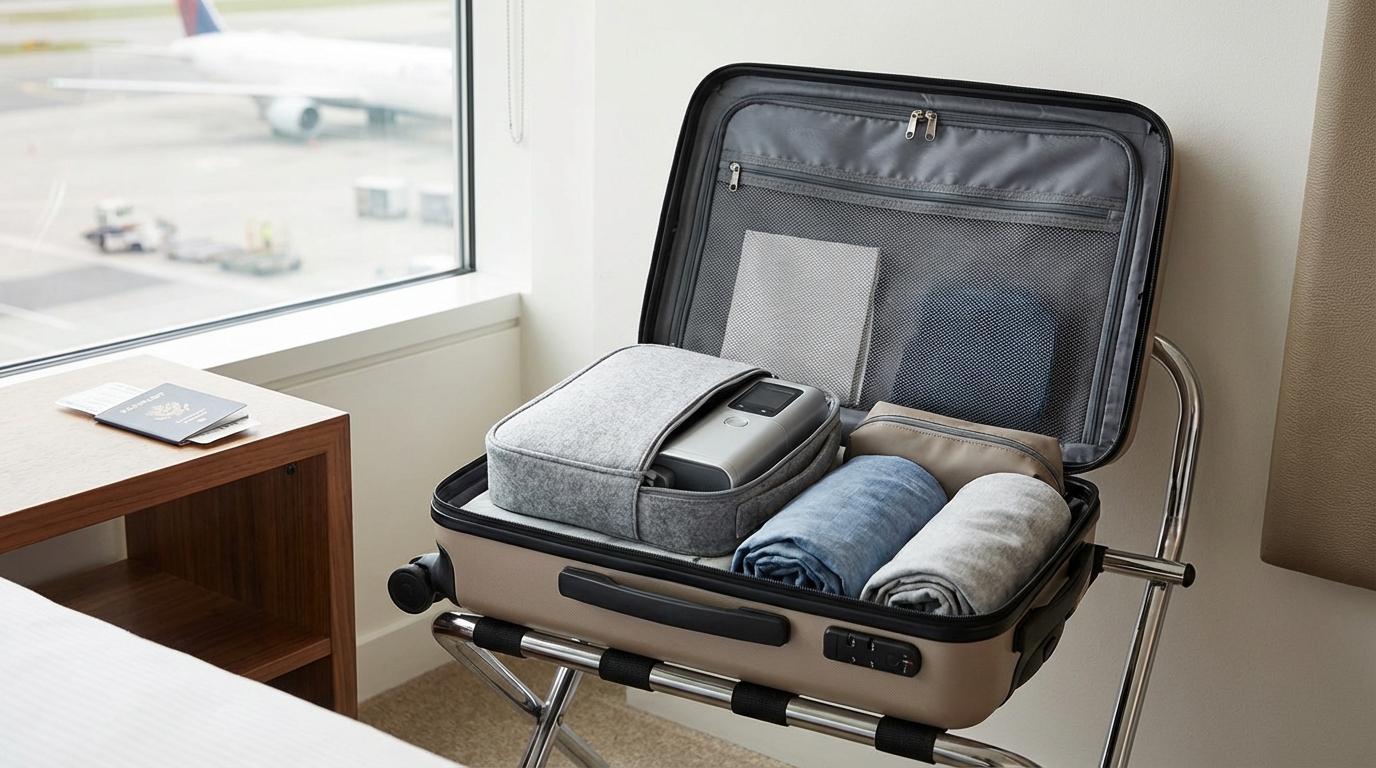
Pro tip: keep your CPAP in a clear, dedicated bag or its original travel case. It speeds up the screening process and makes it obvious what it is.
Does It Count As A Carry-On?
No. This is the single most important thing to know. Under the Air Carrier Access Act, airlines cannot count your CPAP (or any FAA-approved medical device) as one of your carry-on bags. You get your CPAP in addition to your normal bag allowance.
Every major U.S. airline follows this rule: American, Delta, United, Southwest, JetBlue, Alaska, Spirit, Frontier — all of them. If a gate agent tries to count it as a bag, politely point out that it's a medical device. You won't need a doctor's note, but having one doesn't hurt for international travel.
Packing Your CPAP For The Flight
How you pack matters more than you'd think:
- Use a dedicated CPAP travel bag. Most machines come with one. If yours didn't, grab one online for $20-40. It protects the machine and signals to airline staff exactly what it is.
- Drain the humidifier chamber before you pack. Water sloshing around in your bag is asking for trouble.
- Bring your power cord and any adapters. If you're flying internationally, you'll need the right plug adapter for your destination.
- Pack extra filters. A dirty filter in a hotel room with questionable air quality defeats the purpose.
- Consider a travel-sized CPAP. The ResMed AirMini and similar travel units weigh under a pound. If you fly frequently, they're worth every penny.
Using Your CPAP On The Plane
Yes, you can use your CPAP during the flight. Here's the reality check though:
Power is the big question mark. Not every seat has a power outlet, and even when there is one, it might not deliver enough wattage for your machine. Most airplane outlets provide 75 watts. Most CPAPs need 30-60 watts without the humidifier, so you're usually fine — but turn off the heated humidifier and heated tube to stay within the power limit.
Here's what to do:
- Call the airline ahead of time and ask if your specific seat has an outlet. Better yet, check SeatGuru for your aircraft type.
- Bring a battery backup. FAA-approved CPAP batteries exist and are allowed on planes. The battery must be under 100 watt-hours (most CPAP batteries are). Batteries between 100-160 Wh need airline approval. Over 160 Wh? Can't fly with it.
- Skip the water. Use your CPAP without the humidifier during the flight. Airplane air is already dry, but dealing with water at 35,000 feet isn't worth the hassle.
- Bring a mask that works while sitting up if you sleep upright. Nasal pillows tend to work better than full face masks in airplane seats.
Checked Bag vs. Carry-On
Always carry your CPAP on the plane. Never check it. Here's why:
- Checked bags get thrown around. Your CPAP has a motor, a circuit board, and a pressure sensor — none of which enjoy being dropped.
- If your checked bag gets lost, you're without your CPAP for however long it takes the airline to find it. That could mean nights without treatment.
- Temperature extremes in the cargo hold can damage electronics.
Your CPAP goes in the overhead bin or under the seat in front of you. No exceptions.
International Travel Considerations
Flying internationally with a CPAP adds a few wrinkles:
- Voltage differences: Most modern CPAPs are dual-voltage (100-240V), so you just need a plug adapter, not a voltage converter. Check your power supply label to confirm.
- Carry a letter from your doctor. Some countries and airlines want documentation that the device is medically prescribed. A simple letter on your doctor's letterhead with your name, diagnosis, and the device model is enough.
- Know the local water situation. If you can't find distilled water at your destination, you can use bottled water in a pinch. Just clean the chamber more frequently.
- Customs shouldn't be an issue as long as the device is clearly used (not in original retail packaging). If questioned, your prescription letter covers you.
Airline-Specific Tips
While every U.S. airline must accommodate your CPAP, some make it easier than others:
- Southwest: Very CPAP-friendly. Open seating means you can grab a seat near an outlet. No need to pre-notify.
- Delta: Most mainline aircraft have outlets in every seat. Their crews are generally well-trained on medical devices.
- United: Has outlets on most aircraft, but regional jets can be hit-or-miss. Call ahead for regional flights.
- American: Similar to United. Mainline fleet is well-equipped, but smaller regional jets may lack power.
- Spirit/Frontier: Don't count on power outlets. Bring a battery backup if you're flying ultra-low-cost carriers.
Troubleshooting Common CPAP Travel Problems
The gate agent says it counts as a bag. Stay calm. Say: "This is an FAA-approved medical device. Under the Air Carrier Access Act, it's exempt from carry-on limits." If they push back, ask for a supervisor. You're right on this one.
The outlet on the plane doesn't work. Ask a flight attendant to reset it. If it's dead, a battery backup saves the day. This is why you should always have one packed.
TSA wants to open your humidifier chamber. Let them. It's faster than arguing. They're just doing their job.
Your machine gets flagged at security. It happens. The swab test takes 30 seconds. Build an extra 10 minutes into your airport time if you're worried about it.
What To Buy Before Your Trip
If you travel more than a couple times a year, these items pay for themselves:
- A travel CPAP (ResMed AirMini, Transcend Micro, or similar) — $500-800
- An FAA-approved CPAP battery — $150-300, gives you 1-2 nights of power
- A padded travel case — $25-50
- Mask wipes — for quick cleaning on the go
- A universal power adapter — $15-25 for international trips
Frequently Asked Questions
Does a CPAP machine count as a carry-on bag?
No. Under the Air Carrier Access Act, CPAP machines are classified as medical devices and don't count toward your carry-on bag limit. You can bring your CPAP in addition to your regular carry-on and personal item on every U.S. airline.
Can I use my CPAP during a flight?
Yes, you can use your CPAP on the plane. The main challenge is power — check whether your seat has an outlet before the flight, and turn off the heated humidifier to reduce power draw. Bringing an FAA-approved CPAP battery (under 100 Wh) is a smart backup plan.
Can I bring distilled water for my CPAP through TSA security?
Technically yes — distilled water for a CPAP is considered medically necessary and is exempt from the 3.4 oz liquid rule. However, some TSA agents aren't aware of this exemption. To avoid delays, you can bring an empty humidifier chamber and fill it with distilled water purchased after security.
Written by Aviation Experts
Aviation Professionals
With decades of combined experience in the aviation industry, our team shares insider knowledge to make your travel experience smoother and less stressful.
Was this article helpful?