Can You Bring A Massage Gun On A Plane?
Quick Answer
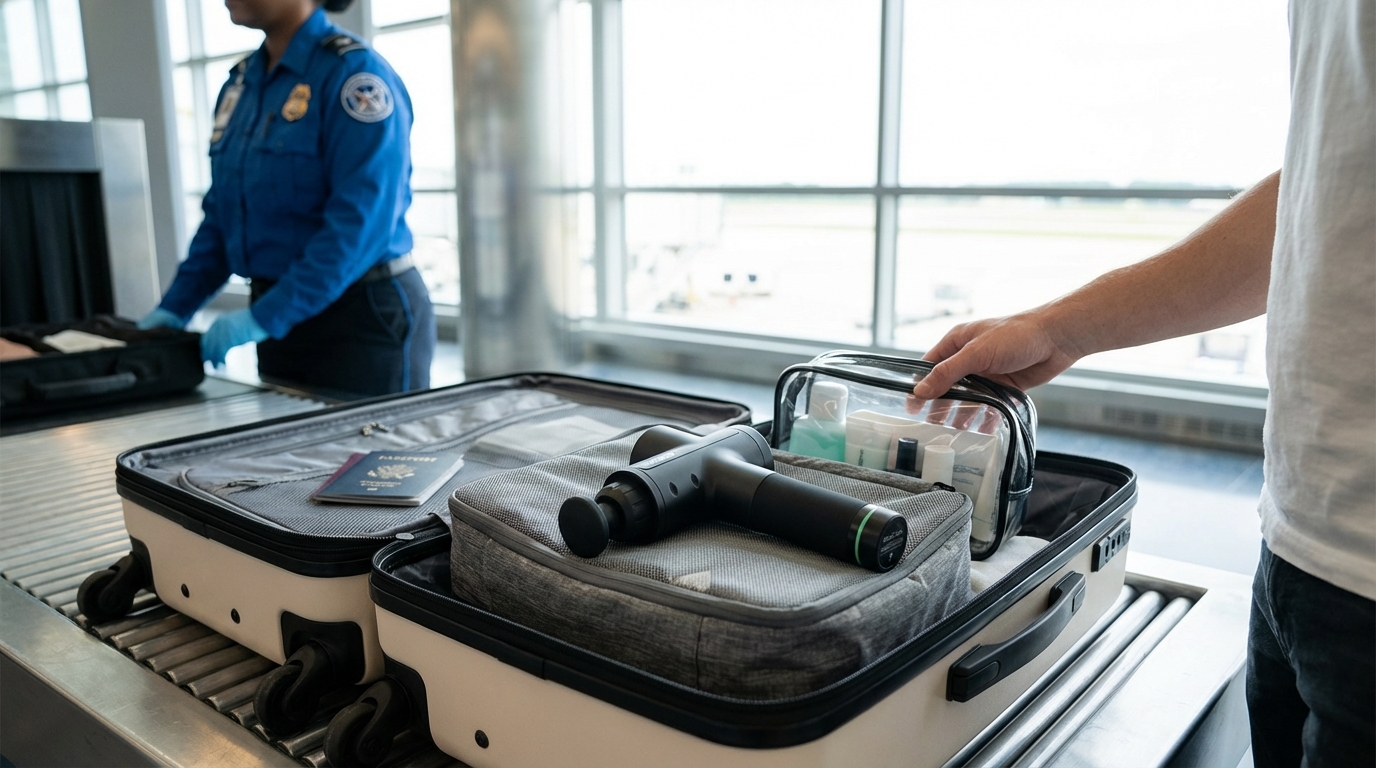
Yes, you can bring a massage gun in your carry-on or checked bag. TSA allows them, but there are battery rules you'll need to follow and some practical things to consider before packing one.
Yes, Massage Guns Are Allowed On Planes
TSA allows massage guns — Theraguns, Hypervolt, Bob and Brad, all of them — in both carry-on and checked bags. There's no specific TSA prohibition on percussive massage devices. They're treated like any other battery-powered personal electronic.
That said, getting through security smoothly and keeping your massage gun safe requires knowing a few rules. Let's break it down.
Carry-On vs. Checked Bag
You've got two options, and one is clearly better than the other.
Carry-On (Recommended)
Packing your massage gun in your carry-on is the smarter move. Here's why:
- Battery safety rules actually require it in most cases. Massage guns use lithium-ion batteries. If the battery is built-in (non-removable), the device should go in your carry-on. The FAA prefers lithium-ion batteries in the cabin where any issues can be spotted and handled immediately.
- Less risk of damage. Checked bags get tossed around. A $300-600 massage gun doesn't need that abuse.
- It won't raise alarms. TSA agents see them regularly. Your massage gun will go through the X-ray, and in most cases, that's it. You might get a bag check if the agent wants a closer look, but it's not a big deal.
Checked Bag
You can put a massage gun in your checked bag, but there are conditions:
- The device must be turned off completely — not just in standby mode. Make sure it can't accidentally turn on. Most massage guns have a lock feature or require a press-and-hold to start. Use it.
- If the battery is removable, remove it and carry it in your carry-on bag. Spare lithium-ion batteries are not allowed in checked bags, period.
- If the battery is built-in and can't be removed, the device should ideally go in your carry-on. If you must check it, make sure it's fully powered off and protected from accidental activation.
Lithium Battery Rules You Need To Know
This is where most confusion happens. Massage guns run on lithium-ion batteries, and the FAA has specific rules:
- Under 100 watt-hours (Wh): Allowed in carry-on and checked bags (if installed in the device). No airline approval needed. Most massage guns fall in this range.
- 100-160 Wh: Allowed in carry-on with airline approval. Some high-end professional massage guns hit this range.
- Over 160 Wh: Not allowed on passenger aircraft at all.
How do you check? Look at the battery label or the product specs online. You'll see something like "2550mAh, 25.2V." Multiply mAh by voltage and divide by 1000 to get watt-hours. In this example: 2550 × 25.2 / 1000 = 64.26 Wh. That's well under the 100 Wh limit.
For reference, here are some popular massage guns and their battery sizes:
- Theragun Pro: ~66 Wh — allowed without approval
- Theragun Elite: ~48 Wh — allowed without approval
- Theragun Mini: ~22 Wh — allowed without approval
- Hypervolt 2: ~43 Wh — allowed without approval
- Hypervolt 2 Pro: ~64 Wh — allowed without approval
You're almost certainly fine. Very few consumer massage guns exceed 100 Wh.
Getting Through TSA Security
Here's what to expect at the checkpoint:
- Leave it in your bag. Unlike laptops, you don't need to remove a massage gun from your carry-on for screening. However, if the bag gets flagged, the agent will ask you to take it out.
- It might look weird on the X-ray. A dense metal cylinder with a motor can catch an agent's attention. If they pull your bag, just tell them it's a massage gun. They'll likely do a visual inspection and send you on your way.
- Remove attachments if you want a cleaner X-ray. The metal or hard plastic heads can look odd on the scanner. Packing them separately in a small pouch can speed things up.
- Don't joke about it. Yes, some massage guns look like weapons. Don't make jokes about that at a TSA checkpoint. Ever.
Tips For Packing Your Massage Gun
A few practical tips to make traveling with your massage gun easier:
- Use the carrying case. Most massage guns come with a hard or semi-hard case. Use it. It protects the device and keeps all the attachments organized.
- Power it off completely. Press and hold the power button until the device fully shuts down. Some models have a travel lock — activate it. You don't want your bag vibrating aggressively on the conveyor belt.
- Consider a travel-sized model. The Theragun Mini, Hypervolt Go 2, and similar compact models weigh around 1.5 lbs and fit easily in a personal item. If you travel often, a dedicated travel massage gun is worth it.
- Pack it near the top of your bag. If TSA needs to inspect it, you won't have to unpack everything.
What About International Flights?
The rules get slightly more variable once you leave the U.S.:
- Most countries follow similar lithium battery rules (under 100 Wh in carry-on is generally fine worldwide), but always check the specific airline and country regulations.
- Some airlines are stricter. A few international carriers have tighter restrictions on battery-powered devices. Check your airline's dangerous goods page before you fly.
- Customs shouldn't be an issue. A massage gun is a personal care item. You won't have trouble bringing one into another country.
- If flying within Asia or the Middle East, be aware that security staff may be less familiar with massage guns. Having the product name and a photo on your phone can help explain what it is quickly.
Can You Use A Massage Gun On The Plane?
Technically, there's no rule against it. Practically? Don't be that person.
Massage guns are loud. Even the "quiet" ones produce 40-60 decibels of noise. In the confined space of an airplane cabin, that's obnoxious. Your seatmates won't appreciate it, and a flight attendant will likely ask you to stop.
If you're on a long-haul flight and your muscles are screaming, here's what actually works: a foam roller ball (silent, no batteries), stretching in the galley area, or walking the aisle every hour or two.
Save the massage gun for the hotel room.
What If TSA Confiscates My Massage Gun?
This is extremely rare, but it can happen if a TSA agent isn't familiar with the device or if there's a battery concern. If your massage gun gets flagged:
- Stay calm and explain what it is. "It's a percussive muscle massager" usually clears things up.
- Show them the battery specs if they're concerned about the lithium-ion battery size.
- Ask for a supervisor if an agent insists it's not allowed. Massage guns are not on the TSA prohibited items list.
- If all else fails, you can ship it to your destination from the airport, check it in your bag at the counter, or leave it with a non-traveling companion. Don't just abandon a $400 device.
Frequently Asked Questions
Will TSA take my massage gun?
No, massage guns are not on the TSA prohibited items list. They're allowed in both carry-on and checked bags. In rare cases an agent may want to inspect it more closely, but they shouldn't confiscate it. If an agent gives you trouble, ask for a supervisor.
Should I pack my massage gun in carry-on or checked luggage?
Carry-on is better. Massage guns contain lithium-ion batteries, which the FAA prefers in the cabin where any battery issue can be handled immediately. It also protects your device from the rough handling checked bags receive.
Can I use my Theragun during a flight?
There's no specific rule against it, but it's a bad idea. Massage guns produce significant noise (40-60 decibels) that will disturb everyone around you. Flight attendants will likely ask you to stop. Save it for the hotel.
Written by Aviation Experts
Aviation Professionals
With decades of combined experience in the aviation industry, our team shares insider knowledge to make your travel experience smoother and less stressful.
Was this article helpful?