Can A Plane Fly On One Engine?
Quick Answer
Yes, every modern commercial airplane can fly perfectly well on just one engine. In fact, twin-engine jets are specifically designed and rigorously tested to do exactly this. Planes can take off, climb, cruise, and land safely with a single engine — and pilots train for this scenario regularly.
Yes, Planes Can Absolutely Fly on One Engine
Every commercial twin-engine aircraft is designed, tested, and certified to fly on just one engine. This isn't an emergency improvisation — it's a core design requirement. Before any commercial plane enters service, manufacturers must prove it can take off, climb, cruise, and land safely with one engine completely shut down.
In fact, single-engine capability is so well-engineered that most passengers wouldn't even notice if one engine failed during cruise. The plane flies slightly differently — it might yaw a bit to one side — but the pilots correct for it, and the flight continues to the nearest suitable airport.
12 Things You Might Not Know About Single-Engine Flight
1. Pilots Train for Engine Failure on Every Check Ride
Every commercial pilot must demonstrate they can handle an engine failure during their recurrent training and check rides, which happen at least twice a year. They practice engine failures during takeoff (the most critical phase), during cruise, and during approach. It's one of the most heavily tested scenarios in all of pilot training.
Most pilots will only ever experience an engine failure in the simulator. Real-world engine failures on commercial jets are extremely rare.
2. Engine Failure Is a One-in-a-Million Event
Modern jet engines are extraordinarily reliable. The failure rate for a well-maintained commercial jet engine is roughly 1 in-flight shutdown per million flight hours. That means the average engine will run for over a million hours before experiencing a failure. When you consider that most flights are only 2-5 hours long, the odds of an engine failure on your specific flight are vanishingly small.
3. ETOPS Lets Twin-Engine Planes Fly Over Oceans
ETOPS stands for Extended-range Twin-engine Operational Performance Standards. It's the regulatory framework that allows twin-engine aircraft to fly routes far from diversion airports — like over the middle of the Atlantic or Pacific Ocean.
An ETOPS rating tells you how long a plane is certified to fly on one engine to reach an alternate airport. Common ratings include:
- ETOPS-120: 2 hours from a diversion airport
- ETOPS-180: 3 hours — the most common rating for transatlantic flights
- ETOPS-330: 5.5 hours — held by the Boeing 787 Dreamliner
- ETOPS-370: Over 6 hours — held by the Airbus A350-900, the highest rating currently awarded
To earn ETOPS certification, the airline, the aircraft, and the engines must all meet strict reliability requirements. It's not handed out lightly.
4. The Remaining Engine Produces Enough Power
A single engine on a modern commercial jet produces more than enough thrust to keep the aircraft flying at a safe altitude and speed. During the ETOPS certification process, manufacturers must demonstrate that the plane can maintain safe flight with full passenger and cargo load on just one engine for the entire rated duration.
The plane won't climb as fast or cruise as high on one engine, but it will fly safely and reach its diversion airport without any drama.
5. Planes Can Even Fly with ZERO Engines
If both engines fail — which is incredibly rare — the plane doesn't fall out of the sky like a rock. A commercial jet without engines becomes a glider. A typical commercial aircraft has a glide ratio of about 17:1, meaning it travels 17 miles forward for every mile of altitude it loses.
At cruising altitude of 35,000 feet, a plane with no engines could glide for roughly 100 miles before reaching the ground. That gives pilots significant time and distance to find an airport or suitable landing area.
The most famous example? Captain Chesley "Sully" Sullenberger landing US Airways Flight 1549 on the Hudson River after both engines were destroyed by a bird strike shortly after takeoff. Every person on board survived.
6. The Gimli Glider Flew 100+ Miles Without Fuel
In 1983, Air Canada Flight 143 ran out of fuel at 41,000 feet due to a metric conversion error during fueling. Captain Robert Pearson glided the Boeing 767 over 100 miles to a former military airstrip in Gimli, Manitoba, landing safely with all 69 passengers and crew. The plane had no functioning engines for the entire descent.
The aircraft was repaired and returned to service. It flew for another 25 years.
7. Four-Engine Planes Are Actually Disappearing
You might think four engines are safer than two. But modern twin-engine jets are so reliable that four-engine planes like the Boeing 747 and Airbus A380 are being retired in favor of more efficient twins like the Boeing 787 and Airbus A350.
The math is simple: two engines burn less fuel than four, modern engines are reliable enough that the extra redundancy isn't needed, and maintenance costs are lower. The 787 and A350 are now flying the longest routes in the world — routes that used to require four engines.
8. Engine Failure During Takeoff Is the Most Critical Scenario
Losing an engine at cruise altitude is manageable — there's time and altitude to work with. Losing one during takeoff is the most demanding scenario because the plane is close to the ground and moving relatively slowly.
This is why there's a speed called V1 — the "decision speed." Before V1, the pilot can abort the takeoff and stop on the runway. After V1, the plane is committed to taking off, even with one engine failed. The remaining engine has enough power to get the plane airborne and climbing safely. Pilots practice this scenario extensively in simulators.
9. Qantas Flight 32 Survived Catastrophic Engine Failure
In 2010, a Qantas Airbus A380 experienced an uncontained engine failure over Indonesia. A turbine disc exploded, sending debris through the wing and damaging multiple aircraft systems. The crew had to manage over 50 system failures triggered by the engine explosion.
The pilots brought the plane back to Singapore and landed safely with all 469 people on board. It remains one of the most impressive feats of airmanship in commercial aviation history — and a testament to how well modern aircraft handle catastrophic engine events.
10. Birds Are the Most Common Cause of Engine Damage
Bird strikes are the leading cause of engine issues on commercial aircraft. Modern jet engines are tested by literally firing dead chickens into them at high speed to prove they can survive bird ingestion.
FAA certification requires that engines continue to operate safely after ingesting a bird. Smaller birds typically pass through without issue. Larger birds (like the Canada geese that took out both engines on Sully's flight) can cause more serious damage, but that scenario involving multiple large birds hitting both engines simultaneously is extremely unusual.
11. Pilots Intentionally Shut Down Engines Sometimes
It's rare, but there are situations where pilots will deliberately shut down an engine in flight. If an engine is vibrating abnormally, showing signs of fire, or experiencing certain mechanical issues, the safest course of action is to shut it down, activate the fire suppression system if needed, and continue to the nearest airport on the remaining engine.
This is a trained, methodical procedure — not a panic move. The crew follows checklist procedures, communicates with air traffic control, and diverts to the closest suitable airport.
12. You've Probably Already Flown on a Two-Engine Plane Over an Ocean
If you've ever taken a transatlantic or transpacific flight on a Boeing 777, 787, or Airbus A330 or A350, you flew across thousands of miles of open ocean on just two engines. The entire flight was within ETOPS coverage, meaning at every single point during the crossing, you were within single-engine flying range of a diversion airport.
Millions of these flights happen every year without incident. It's one of the safest, most routine operations in commercial aviation.
What Happens During an Actual Engine Failure
Here's what the process looks like from the cockpit when an engine fails in flight:
- Identification: Pilots identify which engine has failed through instruments and aircraft behavior
- Verification: They confirm which engine it is — shutting down the wrong engine is the one thing they absolutely cannot do
- Secure the failed engine: They run the engine failure checklist, shutting off fuel and hydraulics to the failed engine and activating fire suppression if needed
- Fly the plane: Minor control adjustments to compensate for asymmetric thrust
- Communicate: They declare an emergency with air traffic control and request priority handling
- Divert: They head to the nearest suitable airport, which is prioritized by runway length, weather, and available emergency services
- Land normally: A single-engine approach and landing is well within the aircraft's capability
The whole process is methodical, well-rehearsed, and rarely makes the news because it ends uneventfully.
The Bottom Line
Every commercial airplane flying today is designed to fly safely on one engine. Pilots train for it constantly. The regulatory framework (ETOPS) ensures that twin-engine planes are never more than a few hours from a diversion airport, even in the middle of an ocean. And engine failures themselves are extraordinarily rare — roughly one per million flight hours.
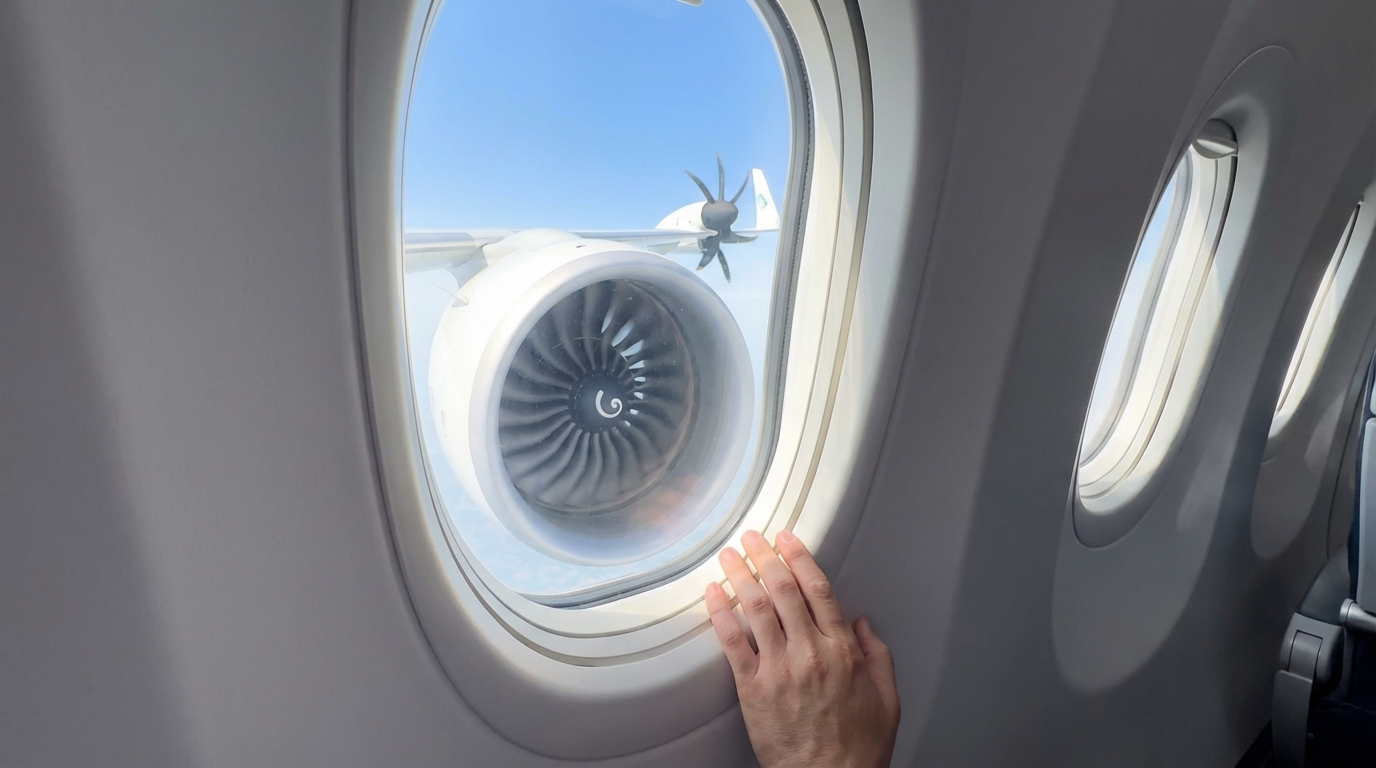
So next time you look out the window at those engines and wonder "what if," know that thousands of engineers, regulators, and pilots have already answered that question with decades of data: the plane will be fine.
Frequently Asked Questions
Can a plane take off with only one engine?
Yes. Every commercial aircraft is certified to complete a takeoff on one engine after reaching the decision speed (V1). The remaining engine provides enough thrust to get airborne and climb to a safe altitude. Pilots practice single-engine takeoffs regularly in simulator training.
How long can a plane fly on one engine?
It depends on the aircraft's ETOPS rating. A Boeing 787 can fly for up to 330 minutes (5.5 hours) on one engine. An Airbus A350-900 holds the current record at 370 minutes (over 6 hours). Most twin-engine planes on transatlantic routes are rated for at least 180 minutes (3 hours).
What happens if both engines fail?
The plane becomes a glider. Commercial jets have a glide ratio of about 17:1, meaning they travel 17 miles forward for every mile of altitude lost. From cruising altitude, a plane could glide roughly 100 miles. Total dual-engine failure is extremely rare — the most famous case is US Airways Flight 1549, which landed on the Hudson River with all passengers and crew surviving.
How common are engine failures on commercial planes?
Extremely rare. Modern jet engines experience roughly 1 in-flight shutdown per million flight hours. Most commercial pilots will never experience a real engine failure in their entire career — only in simulator training. Engine reliability has improved dramatically over the decades.
Why do modern planes only have two engines instead of four?
Modern jet engines are so reliable that four engines aren't necessary for safety. Two-engine planes like the Boeing 787 and Airbus A350 burn less fuel, cost less to maintain, and meet the same safety standards as four-engine aircraft. ETOPS certification proves they can safely fly long over-ocean routes on one engine if needed.
Written by Aviation Experts
Aviation Professionals
With decades of combined experience in the aviation industry, our team shares insider knowledge to make your travel experience smoother and less stressful.
Was this article helpful?