Can You Bring a Guitar on a Plane?
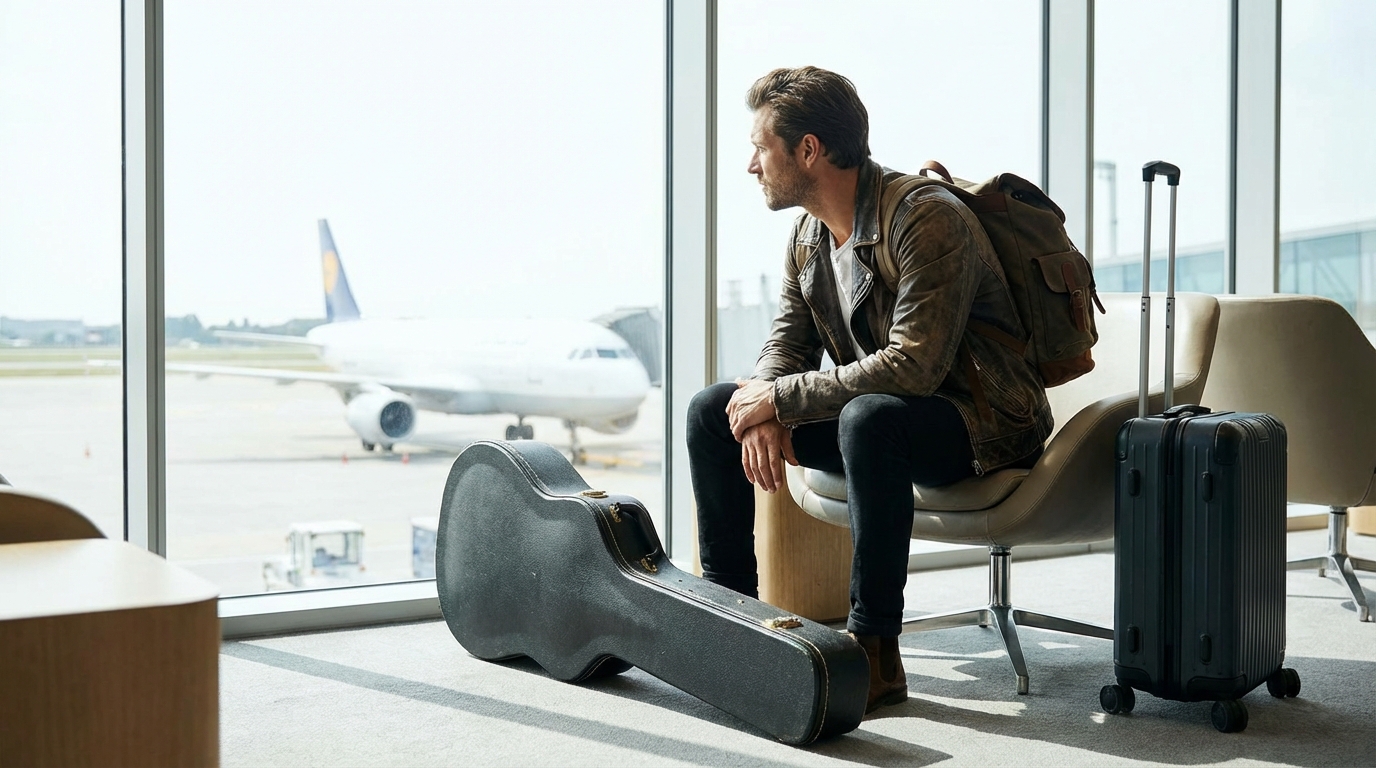
Quick Answer
Yes, you can bring a guitar on a plane as carry-on or checked baggage. Federal law actually requires U.S. airlines to let you carry a guitar in the cabin if it fits in an overhead bin or under a seat. You can also buy it a separate seat for full protection.
The Quick Answer
You can absolutely bring a guitar on a plane. In fact, U.S. federal law is on your side. The FAA Modernization and Reform Act requires all U.S. airlines to accept small musical instruments — including guitars — as carry-on items, as long as they fit in an overhead bin, closet, or under a seat.
That's not airline goodwill. That's the law.
TSA will let your guitar through the security checkpoint. They'll do a physical inspection of it, but there's no restriction on guitars in carry-on or checked bags. The real challenge isn't security — it's fitting the thing in the overhead bin before they run out of space.
Your Legal Rights Under Federal Law
The FAA Modernization and Reform Act of 2012 (codified as 14 CFR Part 251) gives musicians real, enforceable rights when flying with instruments. Here's what it says:
- Airlines must let you carry a guitar on board if it fits in an overhead bin, closet, or under a seat
- They can't charge you extra beyond what they'd charge for a comparable carry-on bag
- You can buy a seat for your guitar if it's too large for overhead bins — airlines must allow this
- Airlines must accept guitars as checked baggage as long as they meet standard size and weight limits
The catch? The airline only has to accommodate your instrument if there's space available when you board. This is why boarding position matters so much when you're flying with a guitar.
TSA Screening for Guitars
TSA allows guitars in both carry-on and checked bags. When you bring a guitar through the security checkpoint, expect a physical inspection. The TSA officer will likely:
- Ask you to open the case
- Visually inspect the instrument
- Possibly swab it for explosives residue
- Send the case through the X-ray machine if possible, or hand-inspect it
This adds a few minutes to your screening time. It's not a big deal, but budget the extra time — especially during peak travel hours.
Carrying a Guitar in the Cabin
This is the preferred method for any guitarist who values their instrument. Checked baggage handling is rough, and guitars are fragile. Here's how to maximize your chances of a smooth experience.
Board as Early as Possible
This is the single most important tip. Overhead bin space fills up fast, and if there's no room when you board, the airline isn't required to accommodate you. Pre-board if you can. Pay for priority boarding if your airline offers it. Join the loyalty program. Do whatever it takes to get on that plane early.
Use a Compact Case
A gig bag takes up less space than a hard case. Some airlines are more forgiving with soft cases that can be slightly compressed into a bin. That said, a hard case offers far better protection if someone shoves their roller bag into it.
Know the Overhead Bin Dimensions
Most mainline aircraft overhead bins can accommodate a standard guitar case — they're roughly 50-60 inches long. Regional jets and smaller aircraft? That's where it gets tricky. CRJ-200s and similar small planes have bins that won't fit a guitar case. If you're on a regional jet, talk to the gate agent early.
Be Polite to Gate Agents
They have discretion over boarding and stowage issues. A friendly, proactive conversation at the gate — "Hey, I've got a guitar, any tips on where to stow it?" — goes much further than demanding your legal rights at 6 AM.
Buying a Seat for Your Guitar
For high-value instruments, buying a separate seat is the gold standard. Airlines are required by law to allow this. Here's how it works:
- Book a second ticket for the seat (some airlines let you book it as "extra seat" at a reduced rate)
- The guitar must be in a case or cover
- It can't exceed 165 pounds (not an issue for guitars)
- Strap it in with the seatbelt over the case
- Book a window seat for the guitar so it's out of the way
This costs more, obviously. But if you're flying with a $3,000+ instrument, the peace of mind is worth it. Some touring musicians won't fly any other way.
Checking a Guitar
Sometimes carry-on isn't an option. Maybe you're on a tiny regional jet. Maybe the bins are full. Here's how to check a guitar and actually get it back in one piece.
Use a Flight-Rated Hard Case
This is non-negotiable. A standard guitar case won't survive the baggage handling system. You need a flight case — these are specifically built for air travel with:
- ATA-rated construction (Air Transport Association standards)
- Reinforced corners and edges
- Interior padding that cradles the instrument
- TSA-approved locks
Good options include Gator, SKB, and Calton cases. Expect to spend $150-$500+ for a quality flight case.
Prep the Guitar
- Loosen the strings. Cargo holds experience pressure and temperature changes that can stress the neck. Detuning a full step reduces tension.
- Support the headstock. Stuff soft material around the headstock so it can't move inside the case.
- Remove the strap. Loose straps can snag or shift inside the case.
- Pack soft items around the body. Fill any gaps with clothing, bubble wrap, or foam.
Mark It as Fragile
Slap a "Fragile" sticker on it. Will baggage handlers actually treat it gently? Maybe not. But it doesn't hurt, and some airlines put fragile-tagged items on top of the pile rather than on the bottom.
Airline-Specific Policies
Delta Air Lines
Guitars and smaller instruments are accepted as your free carry-on bag. Must fit in the overhead bin or approved storage. Standard checked bag fees apply if checked.
American Airlines
Accepts instruments as carry-on if they fit in overhead bins. Will allow a seat purchase for larger instruments. Standard checked bag fees for checked instruments.
United Airlines
Instruments accepted as carry-on per federal requirements. Encourages early boarding for musicians. Hard case recommended for checked instruments.
Southwest Airlines
Guitars count as your carry-on if they fit in the overhead bin. Southwest's open seating actually helps — board in the A group and you'll have plenty of bin space. Two free checked bags if you need to check it.
JetBlue
Accepts instruments as carry-on items. Standard size and space availability rules apply. Checked instruments treated as regular checked baggage.
Electric vs. Acoustic Guitars
Electric guitars are actually easier to fly with. They're smaller, the hard cases are more compact, and they fit in overhead bins more easily. The solid body is also more durable than an acoustic's hollow construction.
Acoustic guitars — especially dreadnoughts and jumbos — are the challenging ones. They're bigger, more fragile, and their cases take up more overhead space. If you fly frequently with an acoustic, consider a travel guitar or a 3/4-size model for trips.
Bass guitars are the hardest. They're long, heavy, and many won't fit in standard overhead bins. Bass players should seriously consider buying a seat or checking in a flight case.
What to Do If Your Guitar Gets Damaged
Despite your best efforts, damage happens. Here's the protocol:
- Inspect at baggage claim. Open the case before you leave the airport.
- Report immediately. Go to the airline's baggage service desk and file a damage report on the spot.
- Document everything. Photos of the damage, the case condition, your claim ticket.
- Know your limits. Airlines are liable for up to roughly $3,800 for domestic baggage damage under DOT regulations.
- Consider insurance. Instrument-specific insurance (like through the Musicians Union or specialty providers) covers more than airline liability limits.
Pro Tips from Touring Musicians
- Get TSA PreCheck. The dedicated lane means less crowding and more time to handle your instrument through screening.
- Fly direct whenever possible. Every connection doubles the risk of damage or loss.
- Put an AirTag in your case. If the guitar gets gate-checked or misrouted, you'll know exactly where it is.
- Carry strings and basic tools in your carry-on. If the worst happens and your guitar is damaged, at least you can do emergency repairs.
- Take a pre-flight photo. Document the guitar's condition before traveling. This helps enormously with damage claims.
Frequently Asked Questions
Can I bring a guitar as a carry-on for free?
Yes. Under federal law (14 CFR Part 251), U.S. airlines must let you carry a guitar on board at no additional charge beyond standard carry-on bag fees — if it fits in an overhead bin, closet, or under a seat. The catch is space must be available when you board, so board as early as possible.
Can I buy a seat for my guitar on a plane?
Yes. Federal law requires airlines to allow you to purchase a separate seat for a musical instrument. The guitar must be in a case, can't exceed 165 pounds, and needs to be secured with the seatbelt. Some airlines offer a reduced rate for extra seat purchases.
Do I need to loosen guitar strings before flying?
For checked guitars, yes — loosen the strings about a full step. Cargo holds experience pressure and temperature changes that can stress the neck. For carry-on guitars in the pressurized cabin, it's less critical but still a good precaution for long flights.
What kind of guitar case do I need for air travel?
For carry-on, a gig bag or standard hard case works. For checked baggage, you need an ATA-rated flight case with reinforced corners, interior padding, and TSA-approved locks. Brands like SKB, Gator, and Calton make flight-specific cases ranging from $150 to $500+.
Will TSA damage my guitar during screening?
TSA screens guitars with a physical inspection at the checkpoint. They'll open the case, visually inspect the instrument, and may swab for explosives. It's generally safe — they're trained to handle instruments — but you can request to watch the inspection and ask them to use care.
Written by Aviation Experts
Aviation Professionals
With decades of combined experience in the aviation industry, our team shares insider knowledge to make your travel experience smoother and less stressful.
Was this article helpful?