Can You Bring a Stroller on a Plane?
Quick Answer
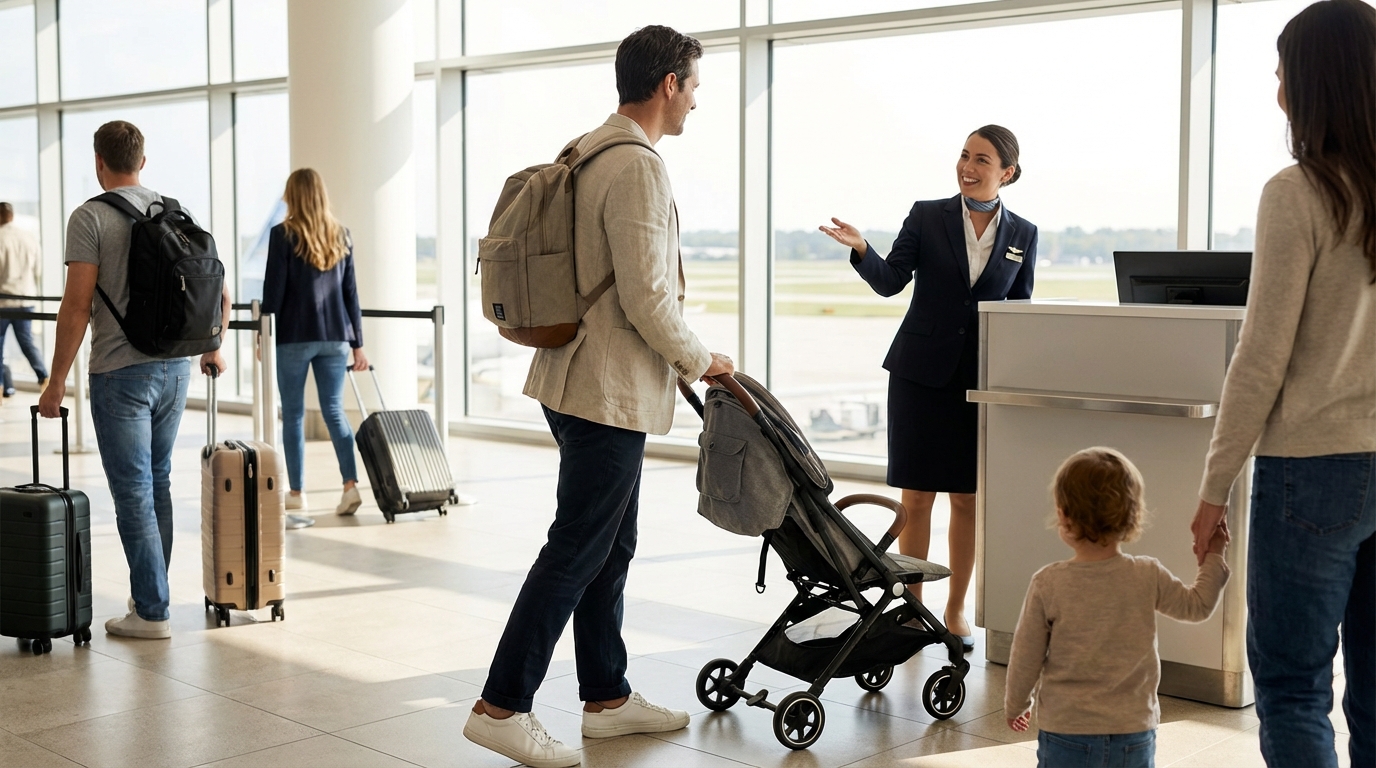
Yes, you can bring a stroller on a plane. Airlines let you gate check strollers for free, and TSA will screen them at security. You can use your stroller all the way to the gate, then pick it up at your destination.
Yes. You can bring a stroller on a plane. Every major airline allows strollers, and most let you gate check them for free. You'll use it through the airport, hand it off at the jet bridge, and get it back when you land. It's one of the few things in air travel that actually works smoothly.
Three Ways to Bring a Stroller
You've got three options for getting your stroller on the plane:
- Gate check it (most popular). Use the stroller through the airport, fold it at the jet bridge, and hand it to the ground crew. They'll stow it in the cargo hold, and it'll be waiting at the jet bridge when you land. Free on virtually every airline.
- Check it at the ticket counter. Hand it over with your regular checked bags. Free on most airlines. Good if you have a travel stroller bag to protect it, but the stroller spends more time in baggage handling.
- Carry it on board. Only works if your stroller folds small enough to fit in the overhead bin. A handful of ultra-compact travel strollers can pull this off. No gate check needed, no risk of damage.
Gate checking is the way to go for most families. You keep the stroller until the last possible moment, which is a lifesaver when you're wrangling a toddler through a busy airport.
TSA Security Screening
Your stroller has to go through security like everything else. Here's how it works:
- Remove your child. Take your baby or toddler out of the stroller before the checkpoint. You'll carry them through the metal detector or body scanner.
- Empty the pockets and basket. Take out all bags, toys, bottles, blankets, and anything else stashed in the stroller. These items need to go on the X-ray belt or in your carry-on bag.
- Fold and X-ray. If the stroller fits through the X-ray machine, fold it and send it through. Most umbrella strollers and compact travel strollers fit.
- Manual inspection for large strollers. If your stroller is too big for the X-ray machine (full-size joggers, double strollers), TSA will do a visual and physical inspection. They'll wipe it down for explosive residue and check all the compartments.
- Unfold and go. Once cleared, pop the stroller back open and you're on your way to the gate.
The whole process adds maybe 2-3 minutes to your security time. It's not a big deal, but factor it in if you're running tight on time.
Gate Checking: The Details
Gate checking a stroller is the standard approach, and here's exactly how it works:
- Get a gate check tag. When you arrive at your departure gate, tell the gate agent you need a stroller tag. They'll give you a claim tag -- attach it to the stroller frame.
- Fold at the jet bridge. When your boarding group is called, wheel the stroller down the jet bridge. At the end (right before the airplane door), fold it up and leave it. Ground crew will take it from there.
- Pick up on arrival. Most airlines bring gate-checked strollers to the jet bridge at your destination. Some deliver them to baggage claim instead. The gate agent can tell you which to expect.
- It's free. Gate-checked strollers don't count as checked bags and there's no fee. This is true on every major U.S. airline, including budget carriers like Spirit and Frontier.
One thing to note: gate check tags sometimes fall off during handling. Write your name and phone number directly on the stroller frame with a luggage tag or permanent marker as backup.
Which Airlines Allow What
The good news is that airline stroller policies are pretty uniform across the industry:
- Most U.S. airlines allow one stroller per child, gate checked for free.
- Budget airlines (Spirit, Frontier, Allegiant) also allow free stroller gate checking -- it's one of the few things they don't charge for.
- Double strollers are allowed but may need to be checked at the ticket counter on some airlines. Check your airline's policy.
- Stroller wagons (like the Veer Cruiser) are a gray area. Some airlines treat them as strollers, others classify them as wagons and charge checked bag fees. Call ahead.
- International airlines generally follow similar rules, but some have size or weight limits for gate-checked strollers. Verify before you fly.
Compact Strollers That Fit in the Overhead Bin
If you want to skip the gate check entirely and keep your stroller with you on the plane, you need an ultra-compact travel stroller. A few options that actually fit in overhead bins:
- GB Pockit/Pockit+ -- Folds down to roughly the size of a large handbag. One of the smallest folding strollers on the market.
- Babyzen YOYO2 -- Folds compact enough for overhead bins and meets most airline carry-on size requirements. Popular with frequent-flying families.
- JOOLZ Aer -- Lightweight, compact fold, fits in overhead compartments.
These strollers are designed specifically for air travel. They sacrifice some features (smaller canopies, less storage) for portability. If you fly regularly with a young child, a dedicated travel stroller is worth the investment.
Just keep in mind that overhead bin space isn't guaranteed. If the bins are full, you'll need to gate check it anyway. Board early if you want to claim that bin space.
Protecting Your Stroller During Travel
Baggage handling is rough on strollers. Gate-checked strollers get tossed into the cargo hold with limited protection. Here's how to minimize damage:
- Use a stroller travel bag. A padded bag protects against scratches, dirt, and rain. Essential if you're checking an expensive stroller at the ticket counter. Optional but smart for gate checking too.
- Remove accessories. Take off cup holders, toy bars, snack trays, and anything else that clips on. These will break or go missing. Toss them in your carry-on.
- Lock the fold. Make sure your stroller is securely folded and locked. If it pops open in the cargo hold, parts can get bent or broken.
- Inspect on arrival. Check the frame, wheels, brakes, and folding mechanism when you get the stroller back. Report any damage to the airline immediately -- they're liable for it.
Double Strollers and Special Situations
Traveling with twins or two young kids? Double strollers are allowed, but they come with extra considerations:
- Side-by-side doubles may not fit down airplane aisles or through jet bridge doors easily. Be ready to fold early.
- Tandem (front-to-back) doubles are easier to maneuver through airports.
- Some airlines require double strollers to be checked at the ticket counter rather than gate checked due to their size and weight.
- Consider a single travel stroller plus a carrier. If you've got an infant and a toddler, put the baby in a carrier and the toddler in a lightweight stroller. It's often easier than wrestling a double through the airport.
Stroller Alternatives for Flying
Don't want to deal with a stroller at all? Some alternatives:
- Baby carrier or wrap. Keep your baby on you and go hands-free. Works great through security (TSA lets you wear the baby through the metal detector) and you don't need overhead bin space.
- Ride-on luggage. Products like the Bagrider let your toddler ride on top of a carry-on suitcase. Eliminates the stroller entirely.
- Airport wheelchair service. Airlines will provide a wheelchair and attendant if needed. You hold the baby, they push you to the gate.
- Rent at your destination. Many vacation destinations, hotels, and baby gear rental companies offer stroller rentals. Skip the hassle of traveling with one.
Tips for a Smooth Trip
- Board early. Families with young children usually get preboarding. Take advantage of it -- the extra time helps.
- Practice the fold. Make sure you can fold your stroller quickly with one hand (because your other hand will be holding a child). Practice at home before the trip.
- Bring a stroller clip or strap. Useful for hanging a diaper bag on the stroller handle, freeing up your hands.
- Label everything. Put your name and phone number on the stroller. Gate check tags can fall off.
- Plan for the return trip. If your stroller gets damaged or lost, you'll need a backup plan. Know where to rent or buy a cheap umbrella stroller at your destination.
The Bottom Line
Bringing a stroller on a plane is easy, free, and something every airline accommodates. Gate check it at the jet bridge, pick it up when you land. If you fly a lot, invest in a compact travel stroller that fits in the overhead bin. Either way, don't stress about this one -- airlines deal with thousands of strollers every day, and the process is well-established.
Frequently Asked Questions
Is gate checking a stroller free?
Yes. Gate checking a stroller is free on every major U.S. airline, including budget carriers like Spirit and Frontier. The stroller does not count as a checked bag.
Can I bring a double stroller on a plane?
Yes. Double strollers are allowed, though some airlines may require them to be checked at the ticket counter rather than gate checked due to their size. Check with your airline before your flight.
Do I have to take my child out of the stroller at TSA?
Yes. Children must be removed from strollers at the security checkpoint. You'll carry your child through the metal detector or body scanner while the stroller is screened separately.
Can a stroller fit in the overhead bin?
Only ultra-compact travel strollers fit in overhead bins. Models like the GB Pockit and Babyzen YOYO2 are designed to fold small enough. Standard and full-size strollers are too large and must be gate checked.
What if my stroller is damaged during the flight?
Report the damage to the airline immediately at the arrival gate or baggage claim office. Airlines are liable for damage to gate-checked and checked items, and you can file a claim for repair or replacement.
Written by Aviation Experts
Aviation Professionals
With decades of combined experience in the aviation industry, our team shares insider knowledge to make your travel experience smoother and less stressful.
Was this article helpful?