Can You Bring a Wine Opener on a Plane?
Quick Answer
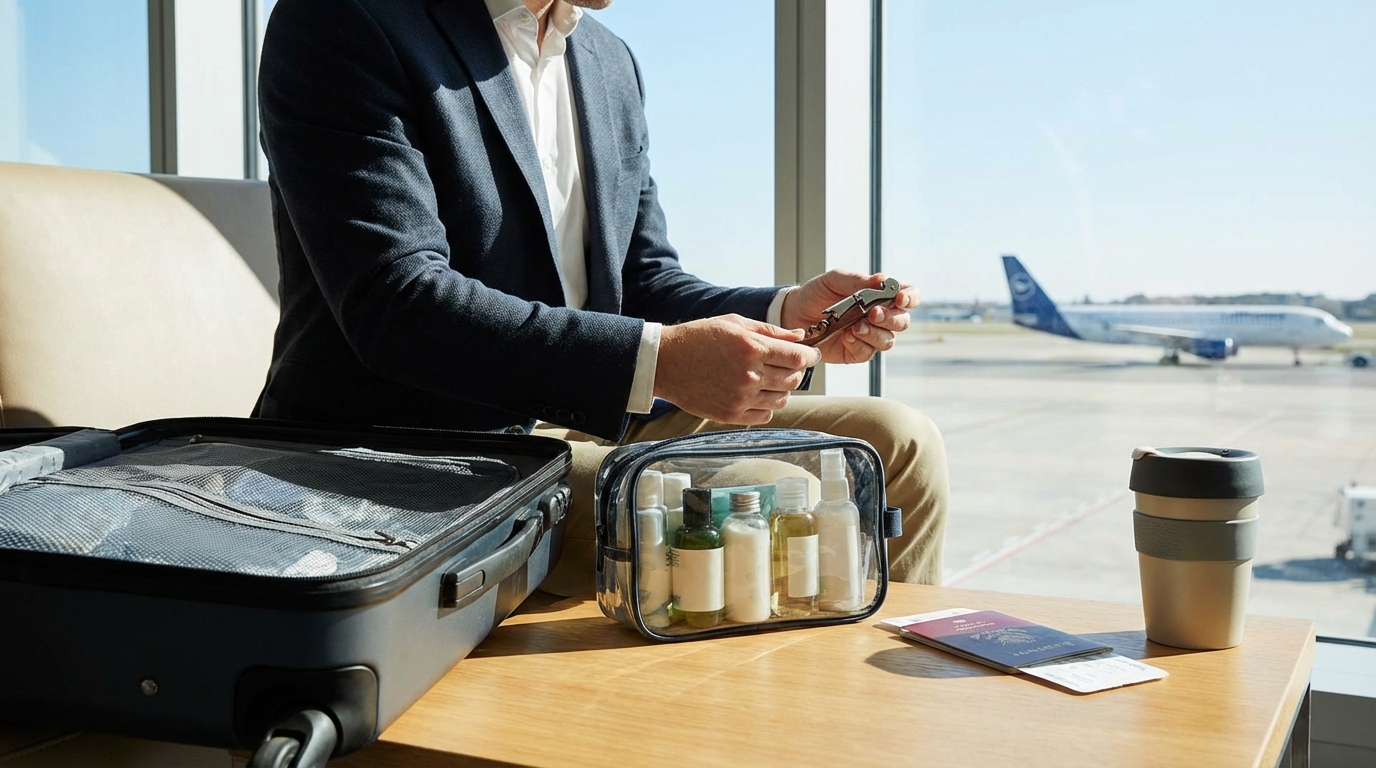
It depends on the type. Wine openers without blades (like a simple corkscrew or one with a foil-cutting wheel) are allowed in carry-on bags. Corkscrews with a small knife or blade must be packed in checked luggage.
The Quick Answer
TSA draws a clear line here: corkscrews without blades can go in your carry-on. Corkscrews with blades go in checked bags only. That tiny foil-cutting knife on your waiter's corkscrew? That's a blade. It'll get confiscated if you try to bring it through security.
Both types are always allowed in checked luggage, no restrictions.
What TSA Considers a "Blade"
This is where most people get tripped up. Let's look at the common wine opener types and where TSA stands on each:
Allowed in Carry-On
- Simple T-handle corkscrew: Just a handle with a worm (the spiral part). No moving parts, no blade. TSA is fine with this.
- Winged corkscrew (butterfly style): The kind with two levers that rise as you screw in. No blade, no problem.
- Ah-So / butler's friend: Two flat prongs that slide along the cork. No blade.
- Waiter's corkscrew with foil-cutting wheel: Some travel-specific corkscrews replace the traditional blade with a small wheel that scores the foil. No blade means carry-on approved.
- Lever-style openers (Rabbit style): These clamp onto the bottle and pull the cork with a lever mechanism. No blade, but they're bulky for travel.
- Electric wine openers: Battery-powered openers that twist the cork out automatically. No blade. Allowed in carry-on, though the lithium battery means carry-on is actually preferred over checked.
NOT Allowed in Carry-On (Checked Only)
- Waiter's corkscrew with foil knife: This is the most common wine opener in the world — the kind every bartender and sommelier carries. It has a small hinged knife for cutting foil. That knife is the problem. TSA will pull it.
- Sommelier knife: A fancier version of the waiter's corkscrew. Same blade issue.
- Any corkscrew with an integrated blade or knife: If there's a sharp edge designed for cutting, it's a no-go for carry-on.
"TSA Approved" Corkscrews: What That Really Means
You'll see lots of wine openers marketed as "TSA approved" or "TSA compliant." Let's be clear: TSA doesn't formally approve or certify any products. There's no official TSA stamp of approval for corkscrews or anything else.
What these products actually are: corkscrews that replace the traditional foil-cutting blade with a foil-cutting wheel. The wheel scores the foil without having a sharp edge that TSA considers a blade. It's a smart design that genuinely solves the problem — just don't believe the marketing implies any official certification.
Popular bladeless travel corkscrews include:
- True Jetsetter: Double-hinged waiter's style with a wheel foil cutter instead of a blade. About $8-12.
- The Carry-On Corkscrew: Uses "smart-kut" wheel technology. About $15.
- Boomerang Two-Step: Another bladeless option with a wheel cutter. Compact and functional.
Any of these will get through US security without issue the vast majority of the time.
The TSA Officer Has Final Say
Here's the uncomfortable truth: even with a bladeless corkscrew that technically meets every rule, the TSA officer at the checkpoint can still deny it. TSA's website says this explicitly — "the final decision rests with the TSA officer on whether an item is allowed through the checkpoint."
In practice, bladeless corkscrews get through security without any problems the overwhelming majority of the time. But every experienced traveler has a story about a TSA agent confiscating something that should have been allowed. If your corkscrew has sentimental or significant value, pack it in checked luggage where there's zero risk.
A few tips to smooth the screening process:
- Put it in the bin with your keys and wallet. Don't bury it in your bag where it looks suspicious on the X-ray. Placing it openly in the screening bin signals you have nothing to hide.
- Remove the foil cutter wheel if detachable. Some officers might mistake the wheel mechanism for a blade on the X-ray. Having it visible and obviously bladeless helps.
- Don't argue if they say no. It's not worth missing your flight. Let it go and buy a new one at your destination.
International Travel: Different Rules Apply
If you're flying internationally, the US rules might not apply at every leg of your journey:
- EU airports: The European Union bans "sharp objects that might be used as a weapon" from carry-on. Corkscrews are specifically mentioned as prohibited items in EU aviation security regulations — even bladeless ones. If you're flying from a European airport, pack your corkscrew in checked luggage regardless of type.
- UK airports: Similar to the EU. Corkscrews are listed as banned from carry-on bags.
- Australia: Corkscrews are prohibited in carry-on baggage.
- Canada: Generally follows similar rules to the US — bladeless is okay, bladed is not.
- Asia: Varies by country. Japan and Singapore are stricter; most Southeast Asian countries follow international norms.
The safest international strategy: checked luggage. Always. You don't want to lose your wine opener at a foreign security checkpoint where language barriers make explaining "it doesn't have a blade" extra difficult.
What to Do If You Don't Have a Wine Opener
Forgot to pack one? Left it at security? Here are your options:
- Hotel front desk. Almost every hotel has a corkscrew you can borrow. Just ask.
- Wine shop at your destination. Most wine stores sell basic corkscrews for $5-10.
- The shoe method. Place the bottom of the wine bottle inside a shoe, then bang the shoe against a wall. The pressure pushes the cork out gradually. It looks ridiculous but it works in a pinch.
- Use a key or screw. Insert a house key or screw at an angle into the cork, then wiggle and pull. Messy but functional.
- Buy screw-cap wines. Problem solved forever.
Packing Your Wine Opener in Checked Luggage
If you're checking a waiter's corkscrew or any opener with a blade, TSA asks that sharp objects be "sheathed or securely wrapped to prevent injury to baggage handlers and inspectors."
In practical terms:
- Fold the blade closed if it has a hinge.
- Wrap it in a sock or cloth. This protects the blade and prevents it from poking through anything.
- Don't pack it loosely in a pocket. If your bag gets inspected, a loose sharp object rolling around isn't a great look.
Electric Wine Openers on Planes
Electric wine openers are increasingly popular, and they're actually one of the easiest to fly with:
- No blade. Most use a simple spiral that grips and pulls the cork. Totally carry-on friendly.
- Lithium batteries prefer carry-on. If it's rechargeable, FAA regulations actually prefer you bring it in carry-on rather than checked luggage, since lithium batteries are a fire risk in the cargo hold.
- Charge it before you fly. Airport outlets can be scarce, and you don't want to arrive with a dead opener.
Pro Tips
- Pack a bladeless corkscrew in your toiletry kit permanently. If it's always in your travel bag, you'll never forget it and never accidentally pack one with a blade.
- Bring a cheap one. Don't travel with your $50 Laguiole sommelier knife in carry-on. If TSA takes it, that stings. A $10 bladeless travel corkscrew is easy to replace.
- Consider a multi-tool without a blade. Some keychain tools include a corkscrew without any knife components. TSA-friendly and useful beyond just wine.
- Wine key apps exist. They won't open your bottle, but if you're shopping for a TSA-compliant corkscrew, searching "bladeless travel corkscrew" or "TSA corkscrew" gets you to the right products fast.
Frequently Asked Questions
Can I bring a waiter's corkscrew in my carry-on?
Only if it doesn't have a foil-cutting blade. Standard waiter's corkscrews have a small hinged knife, which TSA prohibits in carry-on. Travel-specific versions replace the knife with a foil-cutting wheel, and those are carry-on friendly.
What types of wine openers are allowed in carry-on?
Simple corkscrews, winged/butterfly openers, lever-style openers, electric openers, and bladeless waiter's corkscrews with foil wheels are all allowed. Any opener with a knife or blade must go in checked luggage.
Are corkscrews allowed on European flights?
No. EU aviation security regulations ban corkscrews from carry-on bags, even bladeless ones. The same applies in the UK and Australia. If you're flying from a European airport, always pack your corkscrew in checked luggage.
Is there such a thing as a TSA-approved corkscrew?
Not officially. TSA doesn't approve or certify any products. Corkscrews marketed as 'TSA approved' are simply bladeless designs that replace the foil knife with a cutting wheel. They do work for getting through security, but the label is marketing, not an official endorsement.
Written by Aviation Experts
Aviation Professionals
With decades of combined experience in the aviation industry, our team shares insider knowledge to make your travel experience smoother and less stressful.
Was this article helpful?