Can You Bring Skis on a Plane?
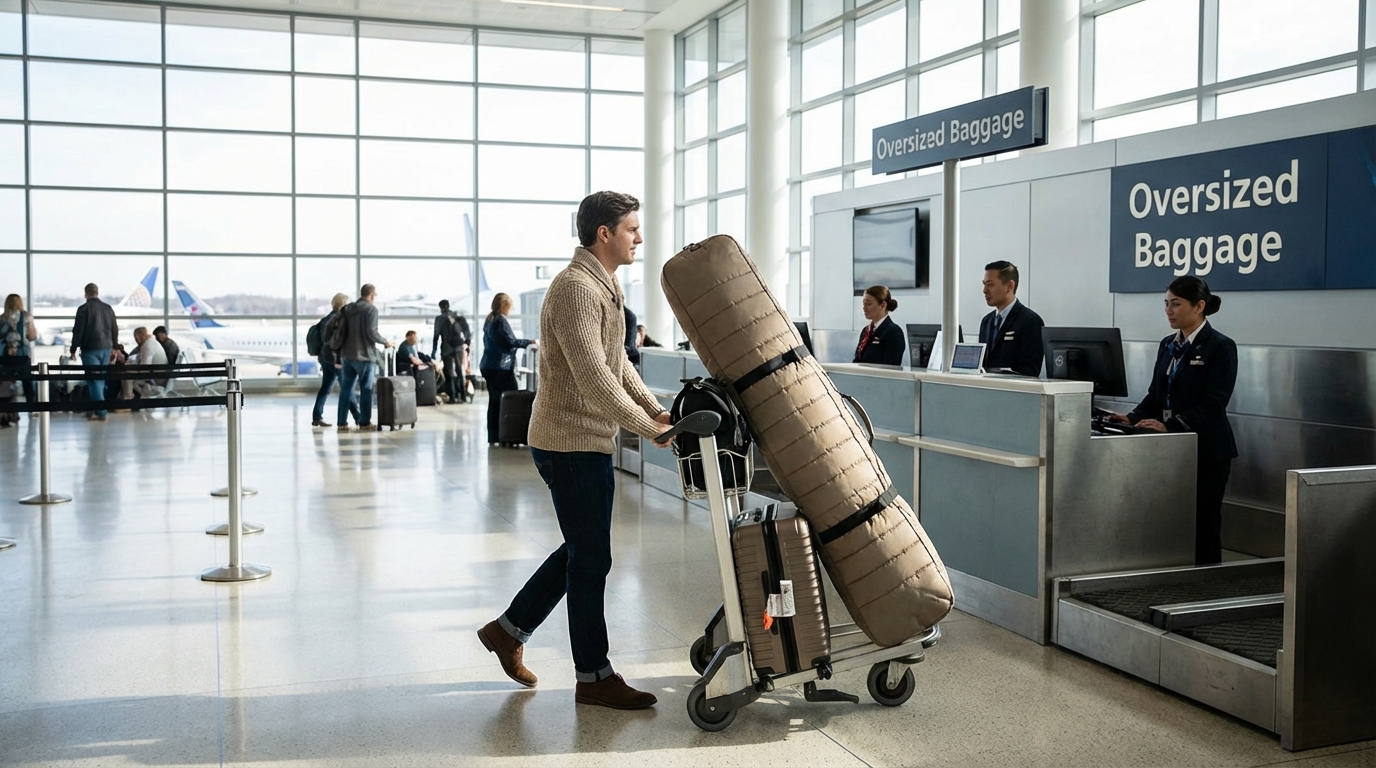
Quick Answer
Yes, you can bring skis on a plane as checked baggage. TSA requires skis and poles to go in the cargo hold — they're not allowed in carry-on. Most airlines let you check a ski bag and boot bag as a single checked item at standard bag fees.
The Quick Answer
Skis must go in checked baggage. TSA won't let you bring skis or poles through the security checkpoint — they're considered potential weapons due to their length and sharp edges. But every major U.S. airline accepts ski equipment as checked luggage, and most treat a ski bag plus a boot bag as a single checked item.
The real cost of flying with skis isn't the airline fee — it's whether you can keep everything under 50 pounds. Skis, bindings, poles, and a ski bag add up fast.
TSA Rules for Ski Equipment
TSA's rules are straightforward:
- Skis: Checked bags only
- Ski poles: Checked bags only (they're pointed — think about it)
- Ski boots: Allowed in carry-on or checked bags
- Goggles: Carry-on or checked
- Helmets: Carry-on or checked
- Hand/toe warmers: Carry-on or checked
Sharp edges on skis and the pointed tips on poles are the reason they're restricted to checked bags. Cover any sharp edges or points with protective caps or wrapping — it makes baggage handlers' jobs safer and reduces the risk of your gear puncturing through the bag.
Airline Ski Bag Policies
Here's the good news: most airlines treat ski equipment generously. A ski bag and a boot bag typically count as just one checked item, not two.
Delta Air Lines
- One ski bag and one boot bag count as one checked item
- Standard checked bag fee applies ($35 first bag domestic)
- Combined weight must stay under 50 lbs
- Bag must not exceed 115 linear inches in length
- Overweight fees apply if over 50 lbs
American Airlines
- One pair of skis or one snowboard plus one equipment bag = one checked item
- Standard checked bag fees apply ($40 first bag, $45 second bag domestic)
- 50 lb weight limit at standard rate
- Over 50 lbs: overweight fee (typically $100)
United Airlines
- One ski bag with equipment counts as one checked bag
- Can include up to two pairs of snow skis with associated equipment and one ski boot bag
- Standard checked bag fees apply ($35 first bag domestic)
- 50 lb weight limit
Southwest Airlines
- Ski bag and boot bag count as one checked item (even if packaged separately)
- Counts as one of two free checked bags
- Oversize fees waived for ski equipment
- Overweight fees apply if over 50 lbs
- Best value for skiers — it's essentially free
JetBlue
- No additional fee beyond standard checked bag cost
- Ski and snowboard equipment counted as a checked bag
- Standard size and weight limits apply
Alaska Airlines
- One set of ski equipment counts as one checked bag
- Includes one pair of skis with poles or one snowboard, plus one boot/helmet bag
- Standard checked bag fees apply
Bottom line: Southwest is the cheapest for skiing trips since checked bags are free. For other airlines, expect to pay $35-$45 per direction for your ski gear.
How to Pack Skis for a Flight
Proper packing protects your gear and keeps weight under 50 pounds. Here's the system:
Ski Bag Selection
You've got two main options:
- Padded single/double ski bag: $50-$200. Fits one or two pairs of skis with poles. Padding protects against impacts. This is what most recreational skiers use.
- Wheeled ski bag with boot compartment: $100-$350. All-in-one solution. Heavy but convenient. Brands like Thule, Dakine, and High Sierra make solid options.
Avoid unpadded ski bags. The thin nylon ones that come with some skis offer almost no protection during air travel.
Packing the Ski Bag
- Put skis base-to-base. Clamp them together with a ski strap or rubber bands. This protects the topsheets and keeps them from sliding around.
- Pad between skis and poles. Use clothing, towels, or bubble wrap. Poles can scratch topsheets if they're loose.
- Protect ski tips and tails. These are the most vulnerable points. Wrap them with bubble wrap, socks, or foam padding.
- Slide poles alongside the skis. Make sure pole baskets aren't pressing against anything that could scratch or dent.
- Fill empty space. Pack base layers, socks, gloves, and soft items around the skis. This adds protection and saves space in your suitcase.
Boot Bag Packing
- Pack boots buckled closed so they don't flop open
- Stuff socks and small items inside the boots
- Put your helmet in the boot bag if it fits — saves carry-on space
- Include anything heavy in the boot bag since it counts as part of the same checked item
Weight Management
The 50 lb limit is where most skiers run into trouble. Here's a typical weight breakdown:
- Pair of skis with bindings: 12-18 lbs
- Poles: 1-2 lbs
- Ski bag: 3-8 lbs (padded) or 8-15 lbs (wheeled)
- Ski boots: 6-10 lbs
- Boot bag: 1-3 lbs
- Helmet: 1-2 lbs
That's roughly 24-45 lbs before any clothing you stuff in. A single pair of skis in a lightweight padded bag with boots usually stays under 50 lbs. Two pairs of skis? That's going to get tight. Weigh everything at home before heading to the airport.
Shipping Skis vs. Flying With Them
For destination ski trips, shipping is worth considering:
- Ship Skis: Door-to-door service, starting around $60 each way. They pick up from your home and deliver to your hotel or condo.
- FedEx/UPS: Ship your own ski bag for $50-$150 depending on size, weight, and distance.
When shipping makes sense:
- You're flying on an airline with expensive checked bag fees
- You have multiple connections and don't want to risk lost gear
- You want to travel light through the airport
- You're going on a multi-resort trip and can ship ahead to each stop
When flying with skis makes sense:
- You're on Southwest (free checked bags)
- You're flying direct to a ski destination
- You want your gear immediately on arrival
- You're saving on shipping costs
Renting vs. Bringing Your Own
Real talk: if you're not an advanced skier with a dialed-in setup, renting at the resort might be the smarter move. Demo-quality rental packages cost $40-$80/day at most resorts, and high-end demo skis let you try different models.
Bring your own if:
- You have custom-fitted boots (this is the big one — boots matter more than skis)
- You're an advanced skier with a specific ski preference
- You're skiing for 4+ days (rental costs add up)
- You fly to ski destinations frequently
Tips for Flying With Ski Gear
- Weigh your bags at home. Overweight fees are $100+ and completely avoidable.
- Wear your ski jacket on the plane. It's bulky and heavy — wearing it saves luggage weight and space.
- Carry your boots on board if possible. Boots are the most important (and most expensive) part of your setup. If your boot bag fits as a carry-on, that's the safest option.
- Fly direct to ski towns. Denver, Salt Lake City, Reno, and Jackson Hole all have airports close to major resorts. Fewer connections = less risk.
- Book early morning flights. If your gear gets delayed, there's still time for it to arrive on a later flight the same day.
- Put an AirTag in your ski bag. Tracking is invaluable, especially during peak ski season when bags can get mixed up.
- Use TSA-approved locks. TSA can open your bag for inspection without cutting your lock.
Common Mistakes Skiers Make When Flying
Avoid these pitfalls and you'll have a smoother trip.
- Forgetting to check combined weight. A ski bag with two pairs of skis, poles, boots, and a helmet can easily hit 55-60 lbs. Weigh everything together at home, not just the skis.
- Packing a ski bag that's too heavy. A wheeled ski bag with built-in boot compartment can weigh 12-15 lbs empty. That's significant when your limit is 50 lbs. Sometimes a lighter bag is the better investment.
- Not protecting edges. Ski edges are sharp enough to cut through bag material. Edge guards, cardboard strips, or even pipe insulation along the edges prevents this.
- Leaving DIN settings unmarked. Rough handling can knock your binding DIN settings off. Note your DIN settings before packing so you can reset them if needed.
- Skipping insurance for expensive setups. Airlines cap liability around $3,800 per domestic claim. If you're flying with a $2,000+ ski setup, consider separate sports equipment insurance or check your homeowner's policy.
Ski Destinations and Airport Tips
Some airports are better set up for ski travelers than others.
- Denver (DEN): The gateway to Colorado skiing. Oversized baggage claim handles ski gear smoothly. Rental car counters are in a separate building — budget time for the shuttle.
- Salt Lake City (SLC): Closest major airport to world-class skiing. Seven resorts within an hour. The airport has a dedicated oversized baggage area.
- Reno-Tahoe (RNO): Gateway to Lake Tahoe resorts. Smaller airport means faster baggage handling.
- Jackson Hole (JAC): Small airport right at the base of the Tetons. Limited flights but incredibly convenient — you can be on the slopes within an hour of landing.
Frequently Asked Questions
Can I carry ski poles in my carry-on bag?
No. TSA prohibits ski poles from carry-on bags because of their pointed tips. Poles must go in your checked ski bag. Ski boots, goggles, helmets, and hand warmers are all fine in carry-on.
Do ski bags and boot bags count as one or two checked items?
Most airlines count a ski bag and a boot bag as a single checked item. This applies to Delta, United, American, Southwest, Alaska, and JetBlue. The combined weight still needs to stay under 50 lbs to avoid overweight fees.
How much does it cost to fly with skis?
Standard checked bag fees apply at most airlines — typically $35-$45 per direction for the first bag. Southwest includes ski equipment in its two free checked bags, making it the cheapest option. Overweight fees ($100+) kick in if your gear exceeds 50 lbs.
Can I bring two pairs of skis on a plane?
Yes. Most airlines allow two pairs of skis in one ski bag. United explicitly allows up to two pairs of snow skis with associated equipment and one boot bag as a single checked item. Just watch the weight — two pairs plus bindings can push close to 50 lbs before you add the bag.
Should I ship my skis instead of flying with them?
Shipping makes sense if you have expensive checked bag fees, multiple connections, or want to travel light. Services like Ship Skis cost about $60+ each way. Flying with skis is better on Southwest (free bags), direct flights, or when you want gear on arrival.
Written by Aviation Experts
Aviation Professionals
With decades of combined experience in the aviation industry, our team shares insider knowledge to make your travel experience smoother and less stressful.
Was this article helpful?