Can You Bring Jewelry On A Plane?
Quick Answer
Yes, you can bring jewelry on a plane with zero restrictions from TSA. There's no limit on the type, quantity, or value of jewelry you can carry. The real question is how to keep it safe during your trip.
TSA Has No Restrictions on Jewelry
You can bring any jewelry on a plane - diamonds, gold, platinum, costume jewelry, watches, whatever you've got. TSA doesn't limit the quantity, value, or type of jewelry you can travel with. There's no need to declare it at security, no forms to fill out, and no dollar threshold that triggers special screening.
This applies to everything: engagement rings, wedding bands, necklaces, bracelets, earrings, brooches, watches, anklets, body jewelry, and loose gemstones. All of it is fine in carry-on and checked bags.
That said, just because you can bring it doesn't mean you should throw it in your checked suitcase and hope for the best. How you pack and carry jewelry matters a lot more than whether TSA allows it.
Always Carry Jewelry in Your Carry-On
This is the single most important rule for traveling with jewelry: never put valuable jewelry in checked luggage.
Here's why:
- Theft is real. Checked bags are handled by dozens of people you'll never see. TSA screeners, baggage handlers, and ramp workers all have access. While most are honest, jewelry theft from checked bags is a documented and ongoing problem.
- Airline liability is capped. If your checked bag is lost or items are stolen, airlines cap domestic liability at $3,800 per passenger. That doesn't come close to covering a $10,000 watch or a $15,000 engagement ring. And airlines specifically exclude liability for jewelry, cash, and electronics in many cases.
- Lost luggage happens. Bags get misrouted, delayed, or lost entirely. Your jewelry sitting in a suitcase somewhere in the airline's system for 48 hours isn't a risk worth taking.
Your carry-on bag never leaves your sight. Keep your jewelry there.
Going Through Security with Jewelry
What to Wear Through the Scanner
You don't need to remove most jewelry before going through the body scanner or metal detector. Here's what you can typically keep on:
- Rings (including large cocktail rings)
- Earrings
- Necklaces
- Bracelets
- Small watches
The millimeter-wave body scanners used at most TSA checkpoints can see through jewelry and won't flag standard pieces. You might see a highlight on the screen where a large necklace or bracelet sits, but the agent will usually wave you through or do a quick pat-down of that area.
What Might Set Off the Metal Detector
If your airport still uses walk-through metal detectors (less common now, but still around), large or heavy metal pieces can trigger them. Big chain necklaces, heavy bangles, and oversized watches are the usual culprits. If you're wearing a lot of metal jewelry, consider removing it before you walk through to avoid the hassle of a secondary screening.
The Smart Move at Security
Here's a trick experienced travelers use: put your jewelry in your carry-on bag before you reach the conveyor belt, not in the bin.
Why? The bins are open, visible, and accessible to anyone standing nearby. If there's a delay - you get pulled for additional screening, the person ahead of you takes forever, the line backs up - your jewelry is sitting in an open tray on the other side of the X-ray machine where anyone could grab it. It happens more often than you'd think.
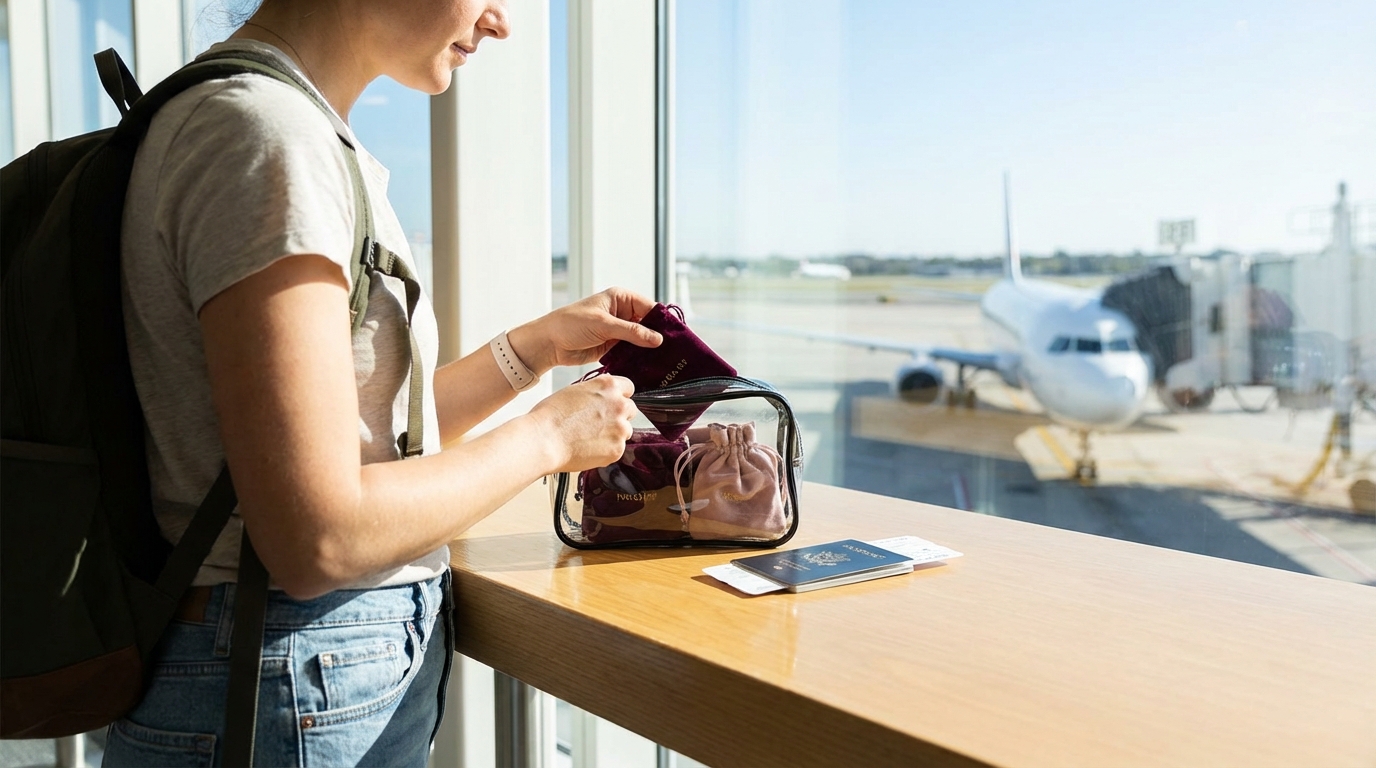
Instead, take off any jewelry you're removing, put it in a small pouch or zippered pocket inside your carry-on bag, and send the bag through the X-ray. Your valuables stay enclosed and out of sight the entire time.
How to Pack Jewelry for Travel
For Everyday Jewelry
A simple zippered pouch works fine for most people. Keep rings in a small ring holder or wrap them in a soft cloth. Necklaces should be clasped and laid flat - or threaded through a straw to prevent tangling (this actually works brilliantly).
Travel jewelry organizers with individual compartments are worth the $15-30 investment if you travel regularly. Brands like Vlando, Bagsmart, and Stackers make compact rolls and cases that fit easily in a carry-on bag.
For High-Value Pieces
If you're traveling with jewelry worth more than a few thousand dollars, step up your game:
- Use a non-descript case. Don't carry jewelry in a fancy branded box that screams "expensive." A plain zippered pouch inside your bag draws zero attention.
- Split it up. Don't put everything in one place. Put some pieces in your carry-on, wear others, and give some to your travel companion if you have one.
- Keep it on your person. For extremely valuable items (engagement rings, heirloom pieces), wearing them or keeping them in an inside jacket pocket is safer than any bag.
- Don't talk about it. This sounds obvious, but don't mention your expensive jewelry to strangers at the airport, on the plane, or at your hotel. Keep it low-key.
For Loose Stones and Settings
Traveling with unset gemstones or loose diamonds requires a bit more care. Use gem papers (the folded paper envelopes jewelers use) or small resealable bags, then place them inside a hard case so they don't get crushed. These go in your carry-on - always.
If you're a jeweler or dealer traveling with inventory, the same TSA rules apply. There's no limit on quantity or value. However, you may want to carry documentation (invoices, certificates) to smooth things over at customs if you're traveling internationally.
International Travel with Jewelry
Customs Declarations
When entering the US from abroad, you're required to declare goods exceeding $800 in value. However, personal jewelry that you already own and are bringing back isn't subject to duty - it's your stuff, not a purchase.
The tricky part: proving you owned it before you left. If you're traveling internationally with expensive jewelry, bring documentation:
- Appraisal certificates
- Purchase receipts
- Insurance documentation
- Photos with timestamps predating your trip
You can also register valuable items with US Customs before you depart using CBP Form 4457 (Certificate of Registration for Personal Effects Taken Abroad). This is free, takes a few minutes at a CBP office, and gives you ironclad proof that you owned the items before leaving the country.
Country-Specific Rules
Some countries have restrictions on bringing in jewelry:
India allows male passengers to bring in up to 50,000 INR (about $600) worth of jewelry duty-free, and female passengers up to 100,000 INR (about $1,200). Anything above that may incur duties of 36.05% on gold jewelry.
UAE has a generous duty-free allowance and is generally relaxed about personal jewelry. Dubai is a major jewelry hub, so they're used to travelers carrying pieces.
EU countries require declaration of goods over 10,000 euros in value when entering or leaving the EU. This includes jewelry if it could be considered a "store of value."
Australia requires you to declare goods worth over AUD 900. Personal jewelry you already own doesn't count, but new purchases do.
Jewelry Insurance for Travel
If you're traveling with valuable jewelry, make sure your insurance covers it outside your home. Check with your homeowner's or renter's insurance provider - many policies cover personal property worldwide, but some have limitations.
Things to verify before your trip:
- Does your policy cover theft from a hotel room?
- Is there a per-item limit? Many policies cap individual item coverage at $1,000-2,500 unless you have a scheduled rider.
- Does coverage extend internationally?
- What documentation do you need for a claim? Most insurers want a police report filed within 24-48 hours.
For high-value pieces, consider a jewelry-specific insurance policy. Companies like Jewelers Mutual and Lavalier specialize in this and typically offer worldwide coverage with fewer exclusions than homeowner's policies. Premiums usually run 1-2% of the appraised value per year.
Hotel Safety Tips for Jewelry
Getting your jewelry to your destination safely is only half the battle. Once you're at your hotel:
- Use the room safe. It's not Fort Knox, but it's better than leaving jewelry on the nightstand or in your suitcase.
- Use the front desk safe for truly valuable items. Most hotels offer safe deposit boxes at the front desk, which are more secure than in-room safes.
- Don't leave jewelry visible in your room when housekeeping will be in. Put it in the safe or take it with you.
- Avoid leaving jewelry in a rental car. Smash-and-grab theft from cars is common in tourist areas.
What About Jewelry Setting Off Airport Body Scanners?
Modern body scanners (the ones where you stand with arms raised) use millimeter-wave technology that can differentiate between jewelry and actual threats. Your rings, necklaces, and earrings will show up on the screen, but the TSA agent monitoring it can tell what they are.
Occasionally, large pieces or unusual shapes trigger a yellow box on the screen, prompting a quick pat-down of that area. This takes about 10 seconds and isn't a big deal. If you want to avoid it entirely, remove large statement pieces before stepping into the scanner.
Piercings, including body piercings in less visible locations, can sometimes flag the scanner. You won't be asked to remove them - a quick pat-down or hand-held detector resolves it.
Frequently Asked Questions
Should I take off my jewelry at airport security?
You don't need to remove most jewelry for the body scanner. Small rings, earrings, necklaces, and watches can stay on. If you do remove anything, put it inside your carry-on bag rather than in the open security bin where it's visible and accessible to others.
Is there a limit on how much jewelry you can fly with?
No. TSA has no limits on the quantity or value of jewelry you can bring on a plane. For international travel, you may need to declare jewelry above certain value thresholds at customs, but there's no restriction on actually transporting it.
Can I put jewelry in my checked luggage?
You can, but you absolutely shouldn't. Theft from checked bags is a real risk, airline liability for lost valuables is capped at $3,800 domestically, and many airlines specifically exclude jewelry from their liability coverage. Always carry jewelry in your carry-on.
Written by Aviation Experts
Aviation Professionals
With decades of combined experience in the aviation industry, our team shares insider knowledge to make your travel experience smoother and less stressful.
Was this article helpful?